

I’ve thought that in herbal product design we can use the endocannabinoid system (ECS) to leverage the clinical impact of primary herbs in a formula. From this perspective, the ECS can be understood as a cross-system threshold regulator, not as a general therapeutic pathway. The ECS is comprised of molecules called endocannabinoids made by the body, and which have a structural similarity to molecules in the cannabis plant. The ECS also consists of receptors the endogenous and external consumed cannabinoids that act on them, as well as the enzymes that make and break them down. Because ECS signaling is active in the brain, nervous system, immune system, gut, skin, and other tissues, it can influence how strongly the body responds numerous physiological signals.
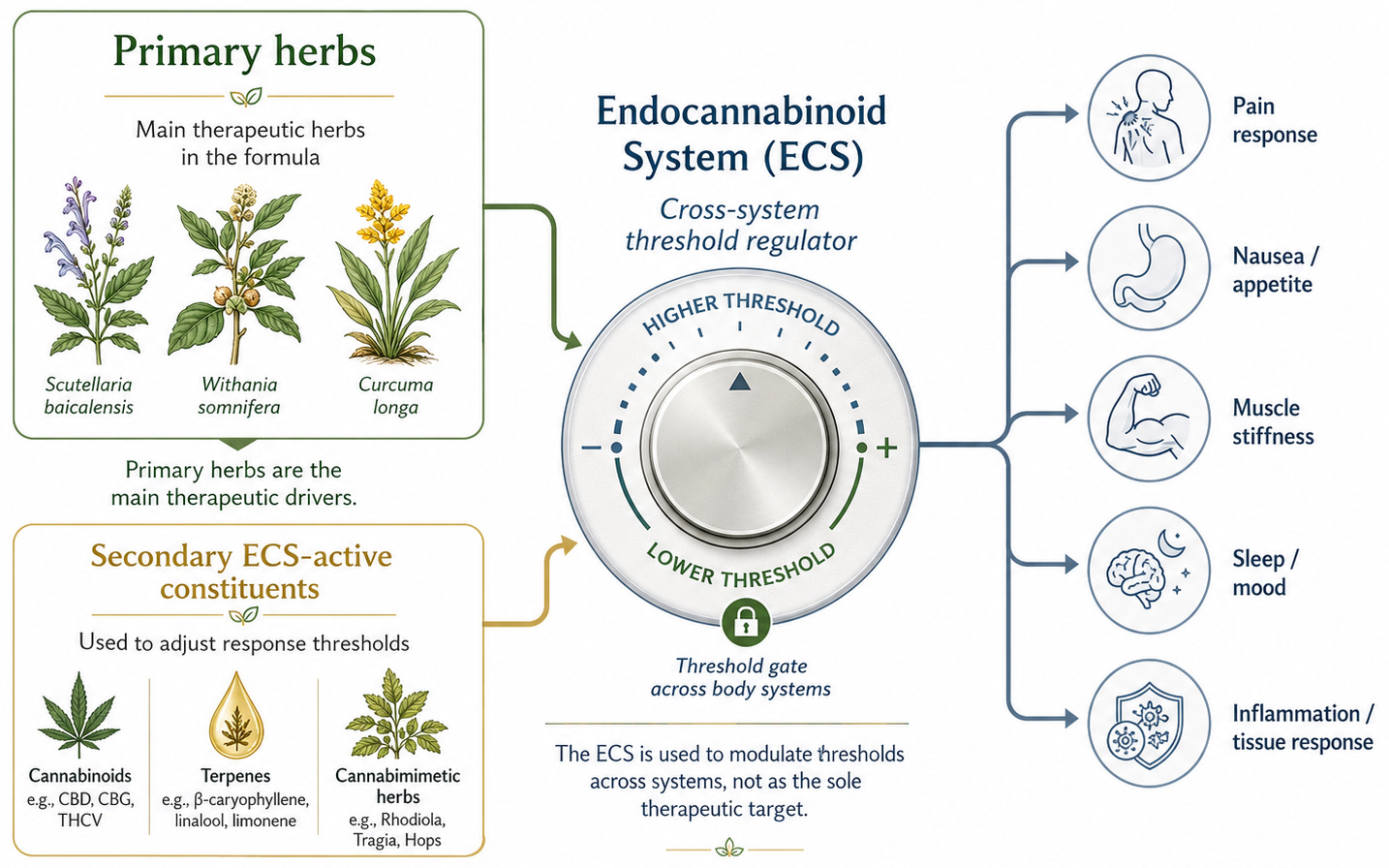
CB1 signaling regulates neurotransmitter release and neuronal excitability, which makes ECS biology most relevant when the endpoint is seizure frequency, pain, muscle stiffness, nausea, loss of appetite, sleep quality or anxiety symptoms (Castillo et al., 2012). The main psychoactive component in Cannabis, Δ9-Tetrahydrocannabinol (THC), is a partial CB1 agonist, so its most relevant to central nervous system effects, including intoxication, altered perception, appetite, nausea control, pain modulation, mood effects, sedation, and cognitive effects (Pertwee, 2008; Whiting et al., 2015).
CB2 signaling is more relevant to immune-cell behavior, inflammatory mediator release, and peripheral tissue response, which makes it more useful for formulating around localized pain, skin or mucosal irritation and inflammation rather than broad claims about restoring immune function (Gertsch et al., 2008; Raduner et al., 2006). Δ9-Tetrahydrocannabinol (THC) is also a partial agonist at CB2 receptors (Pertwee, 2008). Its CB2 activity is more relevant to immune-cell signaling and inflammatory pathways, although this should be treated as mechanistic support rather than proof of broad anti-inflammatory benefit (Pertwee, 2008; Zou & Kumar, 2018). This dual receptor activity helps explain why THC can have therapeutic value in selected symptom domains while also producing tolerability limits such as intoxication, anxiety, dizziness, sedation, and cognitive impairment (Whiting et al., 2015).
Cannabidiol (CBD) has a different, nonintoxicating pharmacologic profile. It has low direct affinity for the main CB1 and CB2 receptor binding sites, so its clinical effects should not be described as simple CB1/CB2 activation (Pertwee, 2008). CBD can reduce CB1 signaling through negative allosteric modulation, which provides one plausible mechanism by which it may alter the effects of THC in some mixed formulations (Laprairie et al., 2015). CBD also interacts with several non-CB1/CB2 targets and signaling systems (Iffland & Grotenhermen, 2017; Pisanti et al., 2017). Mixed THC:CBD products such as nabiximols are standardized formulations with evidence for specific symptom endpoints based on a specific ratio, especially multiple-sclerosis-related spasticity, rather than as evidence that cannabinoid combinations modify the underlying disease process (Novotna et al., 2011).
Cannabis contains multiple terpenes with varied evidence for ECS activity. β-Caryophyllene selectively binds CB2 and has been described as a nonintoxicating CB2 agonist, which makes it a reasonable candidate for formulas being evaluated for local inflammation (Gertsch et al., 2008). In a controlled human study, vaporized D-limonene reduced THC-related anxiety and paranoia rather than direct ECS-based anti-inflammatory activity (Spindle et al., 2024). Santiago et al. (2019) found that common cannabis terpenoids did not modulate THC activity at human CB1 or CB2 receptors, while Raz et al. (2023) reported increased CB1 activation with selected terpene–THC combinations under specific experimental conditions. Broad terpene “entourage” claims remain weakly supported.
In formulas where the primary herb works through a non-ECS mechanism our approach is to treat cannabinoids, terpenes, or cannabimimetics as secondary modifiers to lower the biological or perceptual threshold required for that primary effect to become useful. This does not mean that the ECS constituent strengthens the molecular binding of the primary herb. It means the ECS constituent may alter the clinical endpoint of primary herbs in a way that changes the dose threshold or apparent clinical threshold.
There are some examples from current research. D’Ascola et al. (2019) tested curcumin with β-caryophyllene in LPS-stimulated human articular chondrocytes and reported dose-effect synergy for inflammatory markers, including IL-1β-related effects. β-caryophyllene’s role can be interpreted as a CB2-linked secondary threshold modifier that may reduce the inflammatory response burden around the primary curcumin effect.
Matacchione et al. (2021) studied a mixture containing bioavailable curcumin, polydatin as a resveratrol precursor, and liposomal β-caryophyllene in human blood-vessel cells and human immune-cell models. The mixture reduced several markers of inflammation, including IL-1β, IL-6, and TNF-α, which are immune signals that help drive inflammatory responses. It also reduced miR-146a, a regulator that changes when cells are under inflammatory stress, and caspase-1 activation, a sign that an upstream inflammation pathway has been turned on. The mixture also increased SIRT1 protein, which is often associated with healthier metabolic and stress-response regulation (Matacchione et al., 2021). Polyphenols, such as reservatrol, remain the primary inflammation-focused herbs, while β-caryophyllene may add CB2-linked support.
Gertsch et al. (2004) reported that Echinacea cannabimimetic alkylamides modulate TNF-α gene expression through CB2-linked and other signaling pathways in human immune-cell models. Raduner et al. (2006) described Echinacea alkylamides producing CB2-dependent and CB2-independent immunomodulatory effects. Chicca et al. (2009) reported synergistic immunopharmacological effects among N-alkylamides in Echinacea purpurea extracts. This supports using Echinacea as a secondary immune-threshold herb in formulas where another herb remains primary, such as elderberry, Andrographis, goldenseal, or another non-ECS immune or mucosal herb.
Ginger has human evidence for reducing acute chemotherapy-induced nausea in a large clinical study (Ryan et al., 2012). Evidence from a a randomized, placebo-controlled, phase II crossover trial found that a 1:1 THC to CBD ratio (THC:CBD) provided evidence of secondary prevention of chemotherapy-induced nausea and vomiting (Grimison et al., 2024). D-Limonene, a terpene found in cannabis, has human evidence for reducing THC-induced anxiety and paranoia (Spindle et al., 2024). A formula containing ginger as the primary antiemetic herb, a THC:CBD ratio shifting nausea, vomiting, appetite effect thresholds, and D-limonene improving the tolerability of THC would be worth exploring in trials as a “rational adjunct design”.
Guineensine from Piper species inhibits endocannabinoid uptake, which suggests that black pepper chemistry may have ECS relevance beyond piperine-mediated bioavailability enhancement (Nicolussi et al., 2014). Macamides from maca inhibit FAAH in vitro, which suggests possible modulation of fatty-acid amide tone in stress, fatigue, or pain formulas (Alasmari et al., 2019). Yangonin from kava can bind to CB1 receptors, which makes kava relevant to mood, relaxation, and how strongly physical discomfort is noticed (Ligresti et al., 2012). These examples show that non-cannabis botanicals can intersect ECS signaling, but they do not yet show clinical enhancement of a primary herb.
In effect, this amounts to a dose-threshold theory, rather than an example of synergy. A cannabimimetic secondary herb may enhance a formula by:
Lowering the dose of the primary herb needed to move a target biomarker
Improving tolerability so the primary herb can be used consistently
Reducing how strongly symptoms are noticed so the primary herb’s effect becomes clinically noticeable
Acting on a parallel inflammatory or excitability thresholds that limits response.
Synergy means the combination exceeds the expected additive effect. Threshold enhancement means the ECS-active constituent makes the primary herb more useful by modifying the biological context in which the primary herb acts.
References
Castillo, P. E., Younts, T. J., Chávez, A. E., & Hashimotodani, Y. (2012). Endocannabinoid signaling and synaptic function. Neuron, 76(1), 70–81. https://doi.org/10.1016/j.neuron.2012.09.020
Chicca, A., Raduner, S., Pellati, F., Strompen, T., Altmann, K.-H., Schoop, R., & Gertsch, J. (2009). Synergistic immunopharmacological effects of N-alkylamides in Echinacea purpurea herbal extracts. International Immunopharmacology, 9(7–8), 850–858. https://doi.org/10.1016/j.intimp.2009.03.006
D’Ascola, A., Irrera, N., Ettari, R., Bitto, A., Pallio, G., Mannino, F., Atteritano, M., Minutoli, L., & Squadrito, F. (2019). Exploiting curcumin synergy with natural products using quantitative analysis of dose-effect relationships in an experimental in vitro model of osteoarthritis. Phytomedicine, 59, 152933. https://doi.org/10.1016/j.phymed.2019.152933
Gertsch, J., Leonti, M., Raduner, S., Racz, I., Chen, J.-Z., Xie, X.-Q., Altmann, K.-H., Karsak, M., & Zimmer, A. (2008). Beta-caryophyllene is a dietary cannabinoid. Proceedings of the National Academy of Sciences, 105(26), 9099–9104. https://doi.org/10.1073/pnas.0803601105
Grimison, P., Mersiades, A., Kirby, A., Lintzeris, N., Morton, R., Haber, P., Olver, I., Walsh, A., McGregor, I., Cheung, Y., Tognela, A., Hahn, C., Briscoe, K., Kao, S., Van Hal, S., & Currow, D. (2020). Oral THC:CBD cannabis extract for refractory chemotherapy-induced nausea and vomiting: A randomised, placebo-controlled, phase II crossover trial. Annals of Oncology, 31(11), 1553–1560. https://doi.org/10.1016/j.annonc.2020.07.020
Iffland, K., & Grotenhermen, F. (2017). An update on safety and side effects of cannabidiol: A review of clinical data and relevant animal studies. Cannabis and Cannabinoid Research, 2(1), 139–154. https://doi.org/10.1089/can.2016.0034
Laprairie, R. B., Bagher, A. M., Kelly, M. E. M., & Denovan-Wright, E. M. (2015). Cannabidiol is a negative allosteric modulator of the cannabinoid CB1 receptor. British Journal of Pharmacology, 172(20), 4790–4805. https://doi.org/10.1111/bph.13250
Ligresti, A., Villano, R., Allarà, M., Ujváry, I., & Di Marzo, V. (2012). Kavalactones and the endocannabinoid system: The plant-derived yangonin is a novel CB1 receptor ligand. Pharmacological Research, 66(2), 163–169. https://doi.org/10.1016/j.phrs.2012.04.003
Nicolussi, S., Viveros-Paredes, J. M., Gachet, M. S., Rau, M., Flores-Soto, M. E., Blunder, M., & Gertsch, J. (2014). Guineensine is a novel inhibitor of endocannabinoid uptake showing cannabimimetic behavioral effects in BALB/c mice. Pharmacological Research, 80, 52–65. https://doi.org/10.1016/j.phrs.2013.12.010
Novotna, A., Mares, J., Ratcliffe, S., Novakova, I., Vachova, M., Zapletalova, O., Gasperini, C., Pozzilli, C., Cefaro, L., Comi, G., Rossi, P., Ambler, Z., Stelmasiak, Z., Erdmann, A., Montalban, X., Klimek, A., Davies, P., & the Sativex Spasticity Study Group. (2011). A randomized, double-blind, placebo-controlled, parallel-group, enriched-design study of nabiximols, as add-on therapy, in subjects with refractory spasticity caused by multiple sclerosis. European Journal of Neurology, 18(9), 1122–1131. https://doi.org/10.1111/j.1468-1331.2010.03328.x
Pertwee, R. G. (2008). The diverse CB1 and CB2 receptor pharmacology of three plant cannabinoids: Δ9-tetrahydrocannabinol, cannabidiol and Δ9-tetrahydrocannabivarin. British Journal of Pharmacology, 153(2), 199–215. https://doi.org/10.1038/sj.bjp.0707442
Pisanti, S., Malfitano, A. M., Ciaglia, E., Lamberti, A., Ranieri, R., Cuomo, G., Abate, M., Faggiana, G., Proto, M. C., Fiore, D., Laezza, C., & Bifulco, M. (2017). Cannabidiol: State of the art and new challenges for therapeutic applications. Pharmacology & Therapeutics, 175, 133–150. https://doi.org/10.1016/j.pharmthera.2017.02.041
Raduner, S., Majewska, A., Chen, J.-Z., Xie, X.-Q., Hamon, J., Faller, B., Altmann, K.-H., & Gertsch, J. (2006). Alkylamides from Echinacea are a new class of cannabinomimetics: Cannabinoid type 2 receptor-dependent and -independent immunomodulatory effects. Journal of Biological Chemistry, 281(20), 14192–14206. https://doi.org/10.1074/jbc.M601074200
Ryan, J. L., Heckler, C. E., Roscoe, J. A., Dakhil, S. R., Kirshner, J., Flynn, P. J., Hickok, J. T., Morrow, G. R., & the University of Rochester Cancer Center Community Clinical Oncology Program. (2012). Ginger (Zingiber officinale) reduces acute chemotherapy-induced nausea: A URCC CCOP study of 576 patients. Supportive Care in Cancer, 20(7), 1479–1489. https://doi.org/10.1007/s00520-011-1236-3
Santiago, M., Sachdev, S., Arnold, J. C., McGregor, I. S., & Connor, M. (2019). Absence of entourage: Terpenoids commonly found in Cannabis sativa do not modulate the functional activity of Δ9-THC at human CB1 and CB2 receptors. Cannabis and Cannabinoid Research, 4(3), 165–176. https://doi.org/10.1089/can.2019.0016
Whiting, P. F., Wolff, R. F., Deshpande, S., Di Nisio, M., Duffy, S., Hernandez, A. V., Keurentjes, J. C., Lang, S., Misso, K., Ryder, S., Schmidlkofer, S., Westwood, M., & Kleijnen, J. (2015). Cannabinoids for medical use: A systematic review and meta-analysis. JAMA, 313(24), 2456–2473. https://doi.org/10.1001/jama.2015.6358
Zou, S., & Kumar, U. (2018). Cannabinoid receptors and the endocannabinoid system: Signaling and function in the central nervous system. International Journal of Molecular Sciences, 19(3), 833. https://doi.org/10.3390/ijms19030833