

I’m bringing you something sweet for the new year that will work for low carb diets!
A molecule in licorice (Glycyrrhiza glabra) called glycyrrhizin is an intensely sweet triterpenoid glycoside. A glycoside is a parent molecule (aglycone) attached to sugars (glycones). In plants, the glycone (sugar moiety) helps in the accumulation of secondary metabolites like glycosides at high concentrations by altering the chemical properties and biological activity of the aglycone (non-sugar part). It might detoxify and inactivate aglycones that might otherwise be toxic or biologically active in their free state, preventing autotoxicity and allowing the plant to store them safely at high levels until needed. Glycones increases the molecule’s water solubility, facilitating higher concentrations in the aqueous environments of plant cells. Additionally, glycones act as a biological address directing the parent molecule to specific storage sites, most commonly the vacuole. This spatial separation keeps the inactive glycoside away from activating enzymes (like β-glucosidases) located in other cellular compartments, such as the cytoplasm.
The sweetness of glycyrrhizin has been reported to be approximately 30 to 50 times that of sucrose in most experimental contexts (Shibata, 2000; Omar et al. 2012). Some sources report even higher potency, with values ranging up to 150–170 times sweeter than sucrose depending on the assay conditions (van der Heijden et al., 2020).
Licorice triterpenoid glycosides are mostly soluble in water, and when shaken the aqueous solution produces soap-like bubbles thus the nomenclature triterpenoid saponins (Güçlü-Ustündağ and Mazza, 2007). This is also true of ginsenosides, which we discussed earlier. The parent molecule (aglycone) without the sugars hanging off is insoluble in water.
Glycyrrhizin has a distinctive sensory profile with a delayed onset and lingering aftertaste (Kato et al., 2008). The aglycone is not sweet. Hydrolysis, or breaking of the bond between the parent molecule and the sugars, results in a complete loss of sweetness. This observation underscores the essential role of the sugar residues in eliciting sweet taste (Shibata, 2000; Kato et al., 2008). But the level of sweetness is influenced by the orientation of the glycones hanging off the molecular core with the net effect of enhancing binding to the sweet taste receptor.
The most abundant triterpenoid saponin isolated from licorice is glycyrrhizin (also known as glycyrrhizic acid). The technical name for the molecule is oleanolane-type pentacyclic triterpenoid (see figure #1) (Asl and Hosseinzadeh, 2008). Gut microbes metabolize glycyrrhizic acid into the aglycone, 18β-Glycyrrhetinic acid.
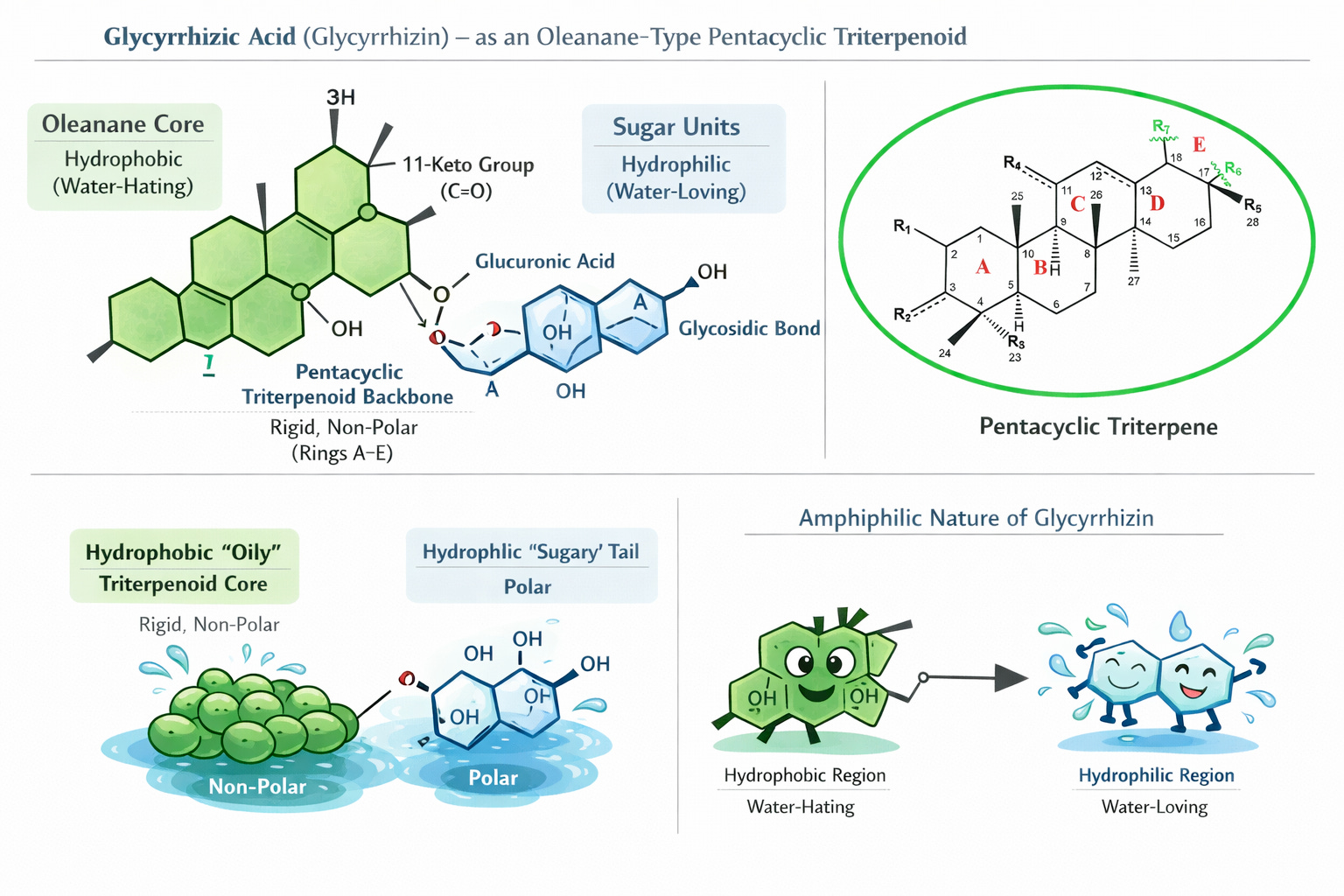
Structural Features Contributing to Sweet Flavor
Glycyrrhizin’s sweet flavor arises from its two glucuronic acid residues linked to the oleanane triterpenoid aglycone at the C-3 hydroxyl position. The sugar chain—β-D-glucuronosyl-(1→2)-α-D-glucuronide—provides hydrophilicity, hydrogen bonding capability, and structural rigidity, all of which are important for binding to sweet taste receptors (Kato et al., 2008). Structural analogs lacking these sugar units demonstrate diminished or absent sweetness, affirming their necessity.
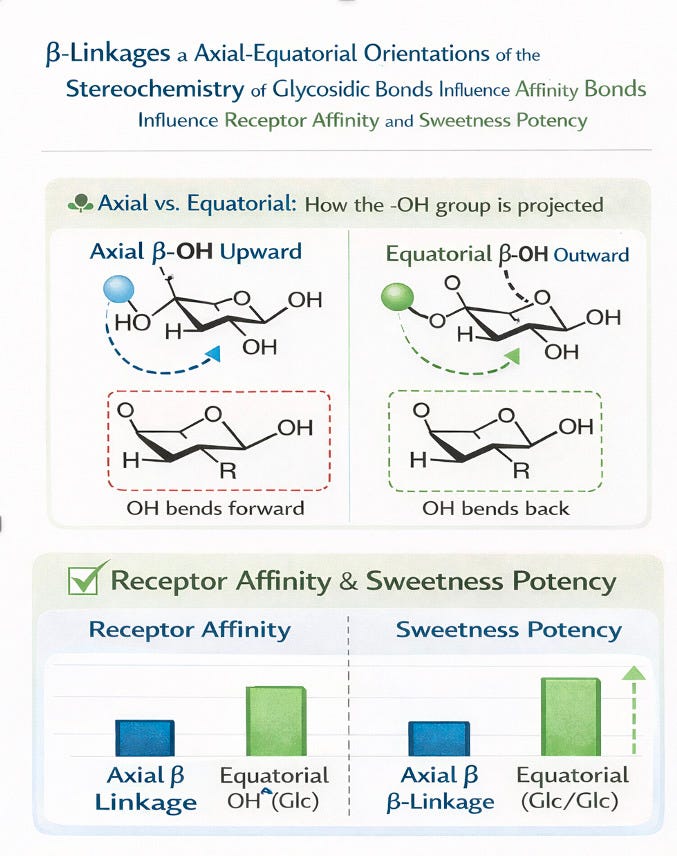
The stereochemistry of glycosidic bonds, particularly β-linkages and axial-equatorial orientations, influences receptor affinity and sweetness potency (Kato et al., 2008). The pentacyclic triterpenoid scaffold, while itself not sweet, acts as a structural base that positions the sugar moieties for optimal receptor engagement (Figure #2)
In contrast, 18β-Glycyrrhetinic acid, which lacks sugar residues, does not interact with sweet taste receptors and displays no detectable sweetness (Shibata, 2000).
Structural Features Contributing to Pharmacokinetics
Glycosidic structure plays a critical role in glycyrrhizin’s is metabolized by the body (pharmacokinetics). In vivo, glycyrrhizin is poorly absorbed in its intact form and is instead hydrolyzed by intestinal β-glucuronidase to yield 18β-glycyrrhetinic acid, which is more lipophilic and bioactive (Fiore et al., 2008). Thus, glycyrrhizin functions partly as a prodrug.
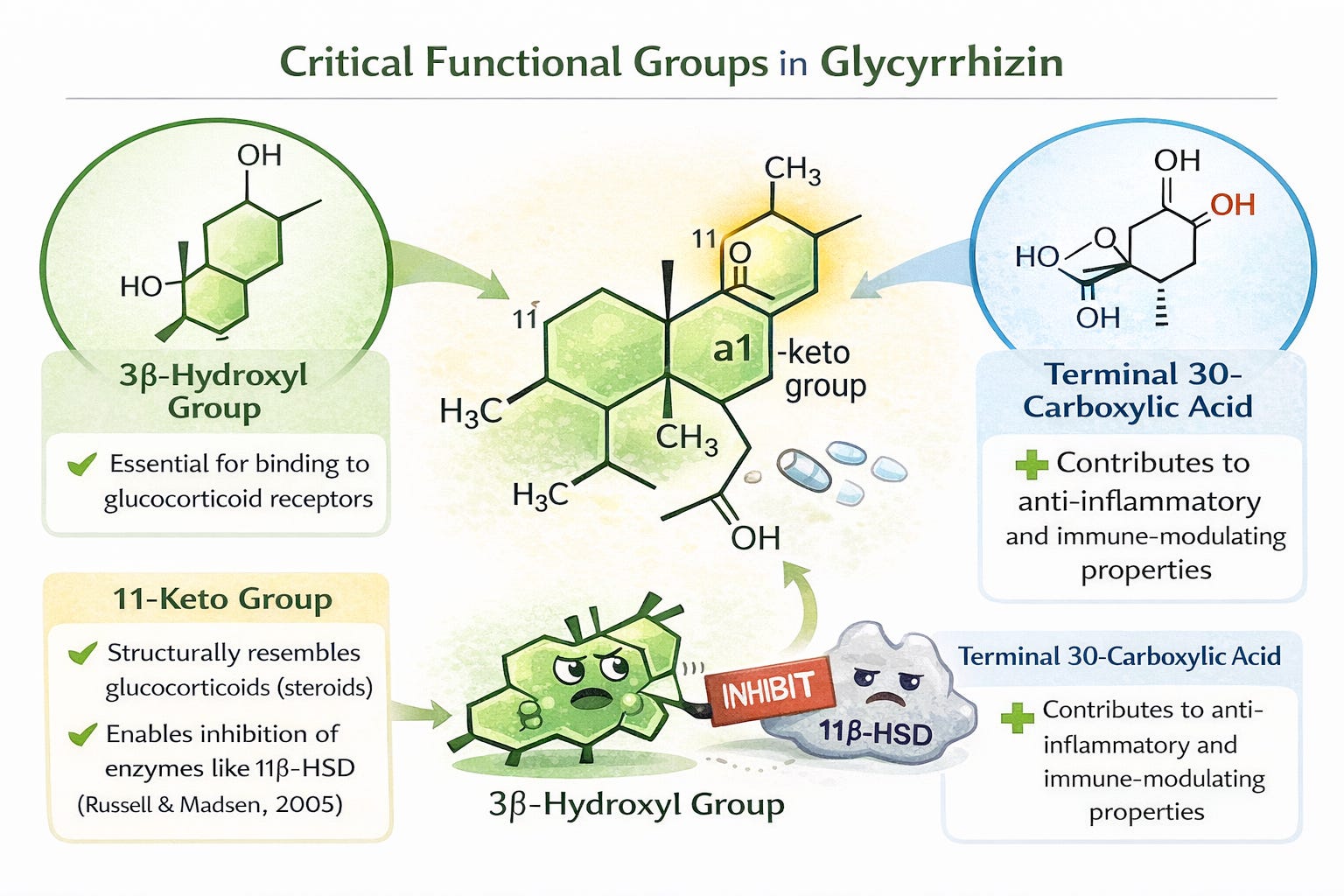
The oleanane triterpenoid core, (Figure #3) common to both molecules, drives their pharmacological effects. Critical functional groups include the 3β-hydroxyl, an 11-keto group, and a terminal 30-carboxylic acid. The 11-keto group structurally resembles glucocorticoids (a steroid), enabling inhibition of enzymes like 11β-hydroxysteroid dehydrogenase (Russell & Madsen, 2005). These interactions underlie anti-inflammatory activity and cortisol metabolism modulation.
The lipophilicity of 18β-glycyrrhetinic acid enhances its ability to cross cell membranes and directly interact with intracellular targets, unlike glycyrrhizin which is restricted to extracellular or systemic actions unless metabolized.
Structural Features Influencing Use in Emulsions
Given their saponin or soap-like qualities, a series of studies conducted by Ralla et al. (2020a, 2020b) using glycyrrhzin and the aglycone to investigate the role they might play on emulsions. The first study showed that neither were very surface-active, which would be found in a substance (such as a detergent) that reduces the surface tension of the solution in which it is dissolved. Glycyrrhizin did have a higher surface affinity at an air-water interface compared to its aglycone, which was based on the greater polarity of the glycyrrhizin structure. At an oil-water interface, glycyrrhizin moderately reduced the tension at boundary between the two liquids, whereas 18β-glycyrrhetinic acid showed was not active at all leading to potential use as a natural emulsifier. The rather rigid structure of the glycyrrhizin molecule seems to be the reason.
They also investigated the impact on a nano-emulsions, which can be influenced over the shelf life of a product by several mechanisms, all of which are dependent on pH, ionic strength, and temperature. These characteristics differ from product to product and include:
Glycyrrhizin and its aglycone yielded stable emulsions at very low molecule-to-oil ratios, a broad range of pH-values (pH 5–9), ionic strength (0–200 mMNaCl), and temperature values (up to 60 °C (Ralla et al., 2020a).
Their stabilizing effect suggests that glycyrrhizin acts on a mechanical of the droplet surface, locking the oil–water interface in place rather than altering the thermodynamics of dispersion. The aglycone participates less effectively but still contributes to emulsion stability at low molecule-to-oil ratios, an observation that emphasizes the importance of the triterpenoid scaffold in forming cohesive interfacial layers even in the absence of classical surfactant activity.
These findings have direct implications for formulation work. Glycyrrhizin is not a useful surface tension–lowering emulsifier but functions effectively as a structural stabilizer in nanoemulsion systems. Its ability to generate robust emulsions under diverse formulation conditions positions it as a valuable component in food, cosmetic, and pharmaceutical contexts where interfacial rigidity rather than rapid emulsification is desired. The aglycone, in contrast, provides minimal interfacial contribution.
References
1. Asl MN and Hosseinzadeh H. (2008) Review of pharmacological effects of Glycyrrhiza sp. and its bioactive compounds. Phytother Res.22(6):709–724.\
2. Fiore, C., Eisenhut, M., Krausse, R., Ragazzi, E., Pellati, D., Armanini, D., & Bielenberg, J. (2008). Antiviral effects of Glycyrrhiza species. Phytotherapy Research, 22(2), 141–148. https://doi.org/10.1002/ptr.2295
3. Güçlü-Ustündağ O, Mazza G. (2007) Saponins: properties, applications and processing. Crit Rev Food Sci Nutr 2007;47(3):231–258.
4. Kato, H., Matsumoto, T., Yoshida, S., & Tani, T. (2008). Sweetness of glycyrrhizin and its analogues. Chemical & Pharmaceutical Bulletin, 56(3), 405–408. https://doi.org/10.1248/cpb.56.405
5. Omar, H. R., Komarova, I., El-Ghonemi, M., Fathy, A., Rashad, R., Abdelmalak, H. D., Yerramadha, M. R., Ali, Y., Helal, E., & Camporesi, E. M. (2012). Licorice abuse: time to send a warning message. Therapeutic advances in endocrinology and metabolism, 3(4), 125–138. https://doi.org/10.1177/2042018812454322
6. Ralla, T., Salminen, H., Braun, K., Edelmann, M., Dawid, C., Hofmann, T., & Weiss, J. (2020a). Investigations into the structure-function relationship of plant-based surfactant glycyrrhizin: Interfacial behavior & emulsion formation. LWT, 120, 108910. https://doi.org/10.1016/j.lwt.2019.108910
7. Ralla, T., Salminen, H., Braun, K., Edelmann, M., Dawid, C., Hofmann, T., & Weiss, J. (2020b). Investigations into the Structure-Function Relationship of the Naturally-Derived Surfactant Glycyrrhizin: Emulsion Stability. Food Biophysics, 15(3), 288–296. https://doi.org/10.1007/s11483-020-09624-0
8. Russell, D. W., & Madsen, P. M. (2005). 11β-hydroxysteroid dehydrogenase and its inhibition by glycyrrhetinic acid: Implications for systemic glucocorticoid metabolism. Endocrine Reviews, 26(6), 731–745. https://doi.org/10.1210/er.2005-0012
9. Shibata, S. (2000). A drug over the millennia: Pharmacognosy, chemistry, and pharmacology of licorice. Yakugaku Zasshi, 120(10), 849–862. https://doi.org/10.1248/yakushi.120.849
10. van Beers EJ, Stam J, van den Bergh WM. (2011) Licorice consumption as a cause of posterior reversible encephalopathy syndrome: a case report. Crit Care. 15(1):R64.