

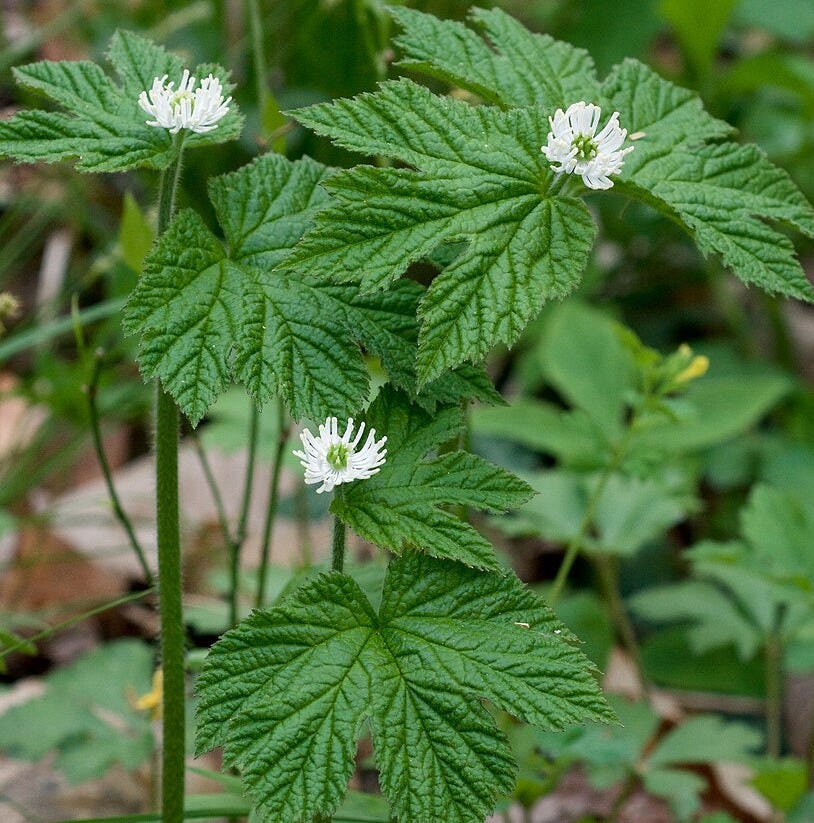
Goldenseal is a perennial North American herb rich in isoquinoline alkaloids, chiefly berberine, (–)-β-hydrastine, and canadine (Galeffi et al., 1997; Messana, 1980). Traditionally, goldenseal has been used for a wide range of infections, inflammation, and gastrointestinal ailments (Moerman, 1998; Mills & Bone, 2000). The concept of “ratio thinking” in goldenseal refers to the idea that the proportion of its metabolites (e.g., the berberine:hydrastine ratio) plays a key role in its biological activity, and that goldenseal’s therapeutic effects may depend on the synergistic interplay of multiple constituents.
Why would the plant invest in the synthesis of benzylisoquinoline alkaloids since goldenseal roots and rhizomes accumulate high levels of benzylisoquinoline alkaloids commonly exceeding 5–7 % dry weight in mature plants (Douglas et al., 2010; Burkhart & Zuiderveen, 2019)? From a perspective of plant-evolution nitrogen-rich investment only persists if the compounds represent adaptive traits selected for antimicrobial, antiherbivore, or allelopathic roles, rather than biochemical “noise” (Wink, 2003, 2008).
In addition to defense, the compounds play selectively role in relationship to specialized endophyte in the rhizosphere. Tims & Batista (2007) isolated fungal species from Hydrastis tissue, including roots/rhizome. They used roots and purified alkaloid mixtures to interrogate fungal responses. They found that Hydrastis root extracts influenced conidial behavior, macroconidial germination and hyphal growth of Fusarium isolates. The isolate obtained from goldenseal roots responded differently from a non-Hydrastis isolate, consistent with local adaptation to the goldenseal chemical environment.
Their findings also showed that alkaloid ratios matter more than any single compound. Berberine alone showed antifungal activity, but the most striking effect appeared when berberine, canadine, and hydrastine were combined in ratios approximating the native root profile. That mixture synergistically stimulated production of the mycotoxin zearalenone in the Hydrastis endophyte F. oxysporum strain, while effects on a naïve Fusarium isolate were different or absent (Tims & Batista, 2007). The work suggests that Hydrastis is not simply trying to sterilize its rhizosphere. Instead, its alkaloid blend imposes a chemical filter that disfavors some fungi while providing a performance advantage to the adapted F. oxysporum strain. The alkaloid profile acts as a selective environment, favoring a specific endophyte that can tolerate and exploit that chemistry (Wink, 2003).
Functionally, this looks like a chemically enforced partnership. Hydrastis pays the energetic cost of maintaining a high alkaloid load. In return it gets a rhizosphere dominated by a fungus that can outcompete other Fusarium lineages in that chemical niche. Whether that endophyte is purely mutualistic, commensal, or sometimes pathogenic is unresolved, but the direction of selection is clear: the alkaloids are actively shaping who lives at the root.
Later work from the Cech group showed that crude goldenseal extracts often outperform berberine alone, because flavonoids and other constituents inhibit bacterial efflux pumps, raising intracellular berberine levels (Ettefagh et al., 2010; Cech et al., 2012). In MRSA, leaf extracts both directly inhibit growth and quorum-sensing–regulated toxin production, with activity linked to alkaloids plus efflux-pump–inhibiting flavonoids (Cech et al., 2012).
Gao et al. showed that goldenseal root ethanolic extracts strongly inhibit growth of Alternaria panax, Fusarium sporotrichioides, and Pestalotiopsis nanjingensis isolated from American ginseng roots. At 2 % m/v, ethanolic root extracts suppressed mycelial growth by 86–95 % for Alternaria and Fusarium, with clear hyphal deformation on SEM. Activity correlated with berberine and hydrastine content (Gao et al., 2024). Generally, major alkaloids are disproportionately associated with antiherbivore and antimicrobial defense, with documented antifungal activity across multiple benzylisoquinoline systems (Wink, 2003; Elshafie & Camele, 2023).
The evidence supports the idea that dynamic tuning of alkaloid profiles in response to rhizophere influences occur in time and space. Douglas et al. (2010) measured biomass and alkaloid content in 2- and 5-year-old goldenseal over a growing season. Berberine in roots plus rhizomes stayed above 3.4 % and varied relatively little. Hydrastine, by contrast, displayed significant seasonal change, especially in roots (about 1.3–1.9 %), while rhizome hydrastine remained more stable (2.2–2.8 %).
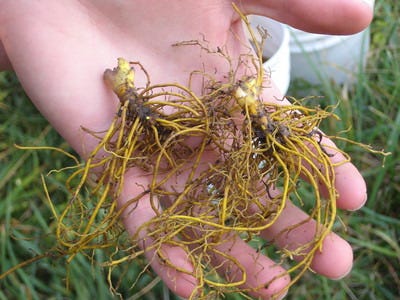
Burkhart & Zuiderveen (2019) worked with wild populations, showing that: alkaloid levels vary by colony as well as harvest stage. And that alkaloid levels tend to peak around senescence, with a secondary high at fruit maturity. Berberine appears to be maintained as a “baseline” defense and microbial filter, while hydrastine is modulated more dynamically, potentially tracking specific stresses, developmental stages, or shifts in rhizosphere demands.
These combined data suggests that the berberine:hydrastine:canadine ratio determines whether the chemical environment is primarily suppressive, permissive, or even stimulatory for particular fungi. Seasonal and tissue-level adjustments in those ratios allow the plant to rebalance between defense vs partner selection across its growth cycle. This mirrors dynamic turnover and ratio modulation seen in other alkaloid systems where concentrations shift rapidly in response to herbivory or infection (Fairbairn & Wassel, 1964; discussed in Zuiderveen et al., 2021).
Most ecological work has centered on roots, but the same logic can be applied aboveground in the phyllosphere. Leaves and stems contain lower, but still significant, levels of berberine and hydrastine, typically around 1.0–1.5 % and 0.4–0.8 % respectively (Douglas et al., 2010). Leaf extracts show potent activity against MRSA in vitro, with crude extracts outperforming berberine alone, in part because of flavonoid-mediated efflux-pump inhibition and quorum-quenching activity (Cech et al., 2012). Minor surface wounds, insect feeding sites, or microbial colonization points will see locally high concentrations as cells are disrupted.