

Toxicity of plant material changes the behavior of consumers of those plants in the ecosystem. This article will focus on non-human consumption of pyrrolizidine alkaloids (PAs). The classical coevolutionary framing for secondary metabolites is that plant chemical defenses can drive reciprocal adaptation in predators and, through host shifts and specialization dynamics, contribute to diversification patterns (Ehrlich & Raven, 1964; Janz, 2011). PAs fit this framework because they represent multiple evolutionary origins in plants, structurally contingent bioactivity, and repeated impact on herbivores as well as other consumers that tolerate, sequester, and repurpose them (Wink, 2019).
Structural features of PA chemistry mean the 1,2-unsaturated necine bases (often retronecine/heliotridine-type backbones and related motifs) can be metabolically activated (See Fig. 1). They represent an important concern in vertebrate toxicity, whereas saturated PAs are typically far less hazardous. This structure–activity relationship is what makes PAs useful for thinking about selection on metabolic pathways, transport, storage chemistry, and consumer adaptations (El-Shazly & Wink, 2014; Wink, 2019).
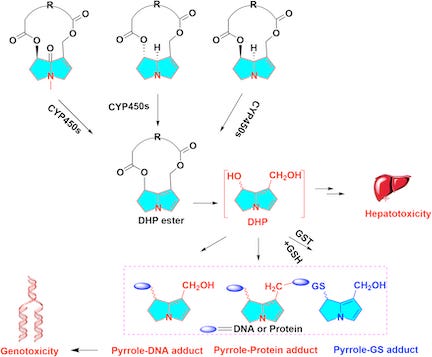
Recurrent evolutionary origins
A core mechanistic insight from PA biosynthesis is that the first pathway-specific step is catalyzed by homospermidine synthase (HSS), and that HSS evolved from duplication and neofunctionalization of deoxyhypusine synthase (DHS). This demonstrates that PA biosynthesis can emerge through predictable evolutionary moves (gene duplication plus functional divergence), consistent with repeated origins across distantly related lineages. These compounds are distributed across more than 6,000 plant species spanning approximately 350–600 genera in at least 6–8 families, most prominently within the Asteraceae, Boraginaceae, and Fabaceae (Ober & Hartmann, 1999; El-Shazly & Wink, 2014),
This implies that PA production is not a one-off innovation but a repeated defensive strategy. Selection acts not only on whether plants produce PAs, but also on where they are allocated within tissues, when they are produced during development, and how they are deployed in ecological interactions (Ober & Hartmann, 1999; Wink, 2019).
Where PAs are made, where they are stored, and when
Floral PA partitioning varies strongly among tissues and is implicated in flower ecology (Stegemann et al., 2019). Evidence for a second biosynthetic site during the floral stage in comfrey supports localized production linked to reproductive function (Kruse et al., 2017). More broadly, these patterns are consistent with chemical–ecological frameworks in which secondary metabolites mediate interactions across trophic levels (Wink, 2019).
Stegemann et al. (2019) found that comfrey PAs were found in differential patterns. 7-acetylintermedine was distributed at higher concentrations in floral tissue, as well as being present in leaves and roots. 7-acetyllycopsamine was present in leaves and roots. Intermedine and Lycopsamine were equally distributed in all tissue. Only myosorpine was present in petal and seed tissue, while 3-acetylmyoscorpine was only shown in trace levels.
The tissue-specific distribution of pyrrolizidine alkaloids (PAs) reported in Symphytum officinale cannot be explained solely by either (a) position within a linear biosynthetic pathway or (b) passive partitioning based on chemical structure. First, a pathway-order explanation is not supported because the principal non-acetylated PAs, intermedine and lycopsamine, are distributed relatively uniformly across tissues, indicating systemic transport rather than accumulation of early intermediates in all organs and late products in specific ones. In addition, acetylated derivatives are not confined to a single tissue, which would be expected if they were terminal products formed only at the end of a localized pathway (Stegemann et al., 2019; Kruse et al., 2017). Second, a purely structure driven explanation is insufficient. While acetylation can increase lipophilicity and potentially influence membrane retention, closely related compounds such as 7-acetylintermedine and 7-acetyllycopsamine show divergent tissue distributions, and highly restricted localization of myoscorpine to petals and seeds cannot be predicted from polarity or molecular class alone (Stegemann et al., 2019).
The most consistent interpretation is a coordinated system involving long-distance transport of core PAs, followed by tissue-specific enzymatic modification and selective retention. Uniform distribution of intermedine and lycopsamine supports systemic movement, likely via vascular transport, while enrichment of 7-acetylintermedine in floral tissues implies localized acylation activity with substrate specificity. The confinement of myoscorpine to reproductive tissues suggests either localized biosynthesis from transported precursors or selective sequestration mechanisms, such as vacuolar trapping or restricted export. Trace levels of 3-acetylmyoscorpine are consistent with either low enzymatic flux or rapid turnover of a transient intermediate. Together, these patterns indicate that regulation occurs primarily at the level of tissue-specific metabolism and allocation (Kruse et al., 2017; Stegemann et al., 2019; Wink, 2019).
Stegemann did not measure flux, so the proportions of core PAs present everywhere may not be resolve whether long-distance transport from a primary synthesis site or multiple low-level synthesis sites is the driving mechanistic explanation. Restriction of Myoscorpine to petals and seeds suggests several potential reasons, including selective transport, selective retention, or local conversion from a precursor. Without kinetic data the trace levels of 3-acetylmyoscorpine mean transient intermediate, low enzyme activity or rapid turnover.
Herbivore and predator landscapes
In insects that sequester plant PAs, the tertiary amine versus N-oxide distinction is not just chemical, it also determines storage and defensive deployment. Radiotracer work showed efficient ingestion of both senecionine and its N-oxide but exclusive sequestration as N-oxides, implying systematic conversion and/or selective retention of the N-oxide pool (Lindigkeit et al., 1997).
PA ingestion increases male insect attractiveness across two moth lineages, Utetheisa and Creatonotos. In Utetheisa ornatrix male courtship signaling is tied to plant-derived PA intake. Males produce a courtship pheromone (hydroxydanaidal) derived from plant PAs. The level of this pheromone correlates with systemic alkaloid levels and with alkaloid transfer to females, creating a plausible sexual-selection route by which PA access and metabolic handling become mating-relevant traits (Dussourd et al., 1991).
Parallel work in Creatonotos links larval PA intake to development of male scent organs and pheromone production, explicitly connecting plant chemistry to insect developmental outcomes (Schmitz et al., 1989; Schulz et al., 1993). These examples of coevolution via metabolism selection act on insect enzymes that transform PA precursors, on storage compartmentalization, on tolerance at molecular targets, and on behavioral traits that exploit PA-mediated defenses and signals (Lindigkeit et al., 1997; Schmitz et al., 1989; Schulz et al., 1993; Wink, 2019).
Complexity and origin of phytochemical background
Whole Jacobaea extracts reduced Western flower thrips (WTF) survival more than any fraction alone, and the recombined fractions still underperformed the intact extract, indicating non-additive interactions across the metabolite classes (Liu et al., 2018). The same work reports that polarity-associated fractionation changes bioactivity and highlights that N-oxide and free-base forms coexist across fractions. They did find that when combined with chlorogenic acid (CGA), the N-oxide was more active than when combined with free base. This shows that bioactivity is determined by specific cross-class interactions rather than the intrinsic activity of a single PA form. It demonstrates that metabolite context, not just compound identity, governs biological effect.
Ragwort (Jacobaea/Senecio system) shows that rhizosphere fungal community composition is associated with the content and composition of the root PA complex, consistent with PAs shaping the below ground microbial neighborhood (Kowalchuk et al., 2006). In Crotalaria, PA biosynthesis depends on nodulation. PAs are detected only when plants form nodules with rhizobial partners. HSS transcripts are localized to nodules, and nodules hold the highest PA concentrations, implying that a key defensive trait is conditionally expressed through symbiosis-linked developmental programming (Irmer et al., 2015).
Plant–plant chemical neighborhoods
Soil-mediated PA movement occurs when one species’ defense metabolites can contribute to another species’ internal chemistry, at least transiently, via the shared soil environment. This changes how selection might act on donor release processes, acceptor uptake and transformation, as well as ecological interactions influenced in the acceptor (e.g., herbivore deterrence or attraction shifts).
Highly polar PA-rich extracts can leach rapidly, whereas cyclic diesters can show low mobility due to sorption and/or degradation. Additionally, N-oxides can be reduced to free bases in soil, changing sorption and membrane-crossing behavior (Nakurte et al., 2025). However, the dominance of N-oxides in many plant tissues implies that storage chemistry is part of the defense phenotype. N-oxides are typically more polar than free bases, affecting mobility in planta and in soil, and likely changing which consumers can access which forms without metabolic conversion (Stegemann et al., 2019; Wink, 2019).
Decomposing donor biomass can release PAs that are taken up by roots and translocated primarily to leaves not flowers in guest plant, which is consistent with transpiration-driven allocation patterns (Nowak et al., 2016; Yahyazadeh et al., 2017). Flowers represent typical source-sink-translocation via phloem. Concentration of imported PAs dropped precipitously in the second week. They did find accumulation of salt like N-oxides, which was unexpected since free bases are more membrane-permeable and N-oxides likely require transport or in situ redox conversion. They suggested that there must be either a transporter in the guest plant able to translocate or free base PAs were taken up and oxidized to N-oxide. Co-culture studies indicate that living donor plants can also release alkaloids into soil that are taken up by neighboring plants, and that acceptor plants can modify imported alkaloids (Selmar et al., 2019).
Soil chemistry can modulate uptake by shifting the fraction of unprotonated alkaloid available for membrane diffusion. Rhizosphere pH becomes a mechanistic control point for whether an alkaloid is imported at all (Hijazin et al., 2020). This provides a general physical-chemistry basis for when plant–plant chemical neighborhoods are likely to matter. Field-context data show that when a PA-producing weed dominates a site, soil can act as a PA reservoir during the season and crops can show PA residues in tissues, though detectability and tissue distribution vary by time and organ (Letsyo et al., 2021; Chmit et al., 2021).
References
1. Chmit, M. S., Horn, G., Dübecke, A., & Beuerle, T. (2021). Pyrrolizidine alkaloids in the food chain: Is horizontal transfer of natural products of relevance? Foods, 10(8), 1827. https://doi.org/10.3390/foods10081827
2. Dussourd, D. E., Harvis, C. A., Meinwald, J., & Eisner, T. (1991). Pheromonal advertisement of a nuptial gift by a male moth (Utetheisa ornatrix). Proceedings of the National Academy of Sciences of the United States of America, 88(20), 9224–9227. https://doi.org/10.1073/pnas.88.20.9224
3. Ehrlich, P. R., & Raven, P. H. (1964). Butterflies and plants: A study in coevolution. Evolution, 18(4), 586–608. https://doi.org/10.1111/j.1558-5646.1964.tb01674.x
4. El-Shazly, A., & Wink, M. (2014). Diversity of pyrrolizidine alkaloids in the Boraginaceae: Structures, distribution, and biological properties. Diversity, 6(2), 188–282. https://doi.org/10.3390/d6020188
5. Hijazin, T., Radwan, A., Lewerenz, L., Abouzeid, S., & Selmar, D. (2020). The uptake of alkaloids by plants from the soil is determined by rhizosphere pH. Rhizosphere, 15, 100234. https://doi.org/10.1016/j.rhisph.2020.100234
6. Irmer, S., Podzun, N., Langel, D., Heidemann, F., Kaltenegger, E., Schemmerling, B., Geilfus, C.-M., Zörb, C., & Ober, D. (2015). New aspect of plant-rhizobia interaction: Alkaloid biosynthesis in Crotalaria depends on nodulation. Proceedings of the National Academy of Sciences of the United States of America, 112(13), 4164–4169. https://doi.org/10.1073/pnas.1423457112
7. Janz, N. (2011). Ehrlich and Raven revisited: Mechanisms underlying codiversification of plants and enemies. Annual Review of Ecology, Evolution, and Systematics, 42, 71–89. https://doi.org/10.1146/annurev-ecolsys-102710-145024
8. Kowalchuk, G. A., Hol, W. H. G., & van Veen, J. A. (2006). Rhizosphere fungal communities are influenced by Senecio jacobaea pyrrolizidine alkaloid content and composition. Soil Biology and Biochemistry, 38(9), 2852–2859. https://doi.org/10.1016/j.soilbio.2006.04.043
9. Kruse, L. H., Stegemann, T., Sievert, C., & Ober, D. (2017). Identification of a second site of pyrrolizidine alkaloid biosynthesis in comfrey to boost plant defense in floral stage. Plant Physiology, 174(1), 47–55. https://doi.org/10.1104/pp.17.00265
10. Letsyo, E., Adams, Z. S., Dzikunoo, J., & Asante-Donyinah, D. (2021). Uptake and accumulation of pyrrolizidine alkaloids in the tissues of maize (Zea mays L.) plants from the soil of a 4-year-old Chromolaena odorata dominated fallow farmland. Chemosphere, 270, 128669. https://doi.org/10.1016/j.chemosphere.2020.128669
11. Lindigkeit, R., Biller, A., Buch, M., Schiebel, H. M., Boppré, M., & Hartmann, T. (1997). The two facies of pyrrolizidine alkaloids: The role of the tertiary amine and its N-oxide in chemical defense of insects with acquired plant alkaloids. European Journal of Biochemistry, 245(3), 626–636. https://doi.org/10.1111/j.1432-1033.1997.00626.x
12. Liu, X., Vrieling, K., & Klinkhamer, P. G. L. (2018). Phytochemical background mediates effects of pyrrolizidine alkaloids on western flower thrips. Journal of Chemical Ecology, 45(2), 116–127. https://doi.org/10.1007/s10886-018-1009-2
13. Nakurte, I., Skudriņš, G., & Mežaka, I. (2025). Fate of pyrrolizidine alkaloids in soil: Insights from Myosotis arvensis L. and Senecio vulgaris L. Toxins, 17: 335. https://doi.org/10.3390/toxins17070335
14. Nowak, M., Wittke, C., Lederer, I., Klier, B., Kleinwächter, M., & Selmar, D. (2016). Interspecific transfer of pyrrolizidine alkaloids: An unconsidered source of contaminations of phytopharmaceuticals and plant derived commodities. Food Chemistry, 213, 163–168. https://doi.org/10.1016/j.foodchem.2016.06.069
15. Ober, D., & Hartmann, T. (1999). Homospermidine synthase, the first pathway-specific enzyme of pyrrolizidine alkaloid biosynthesis, evolved from deoxyhypusine synthase. Proceedings of the National Academy of Sciences of the United States of America, 96(26), 14777–14782. https://doi.org/10.1073/pnas.96.26.14777
16. Schmitz, B., Buck, M., Egelhaaf, A., & Schneider, D. (1989). Ecdysone and a dietary alkaloid interact in the development of the pheromone gland of a male moth (Creatonotos, Lepidoptera: Arctiidae). Roux’s Archives of Developmental Biology, 198(1), 1–7. https://doi.org/10.1007/BF00376363
17. Schulz, S., Francke, W., Boppré, M., Eisner, T., & Meinwald, J. (1993). Insect pheromone biosynthesis: Stereochemical pathway of hydroxydanaidal production from alkaloidal precursors in Creatonotos transiens (Lepidoptera, Arctiidae). Proceedings of the National Academy of Sciences of the United States of America, 90(14), 6834–6838. https://doi.org/10.1073/pnas.90.14.6834
18. Selmar, D., Wittke, C., Beck-von Wolffersdorff, I., Klier, B., Lewerenz, L., Kleinwächter, M., & Nowak, M. (2019). Transfer of pyrrolizidine alkaloids between living plants: A disregarded source of contaminations. Environmental Pollution, 248, 456–461. https://doi.org/10.1016/j.envpol.2019.02.026
19. Stegemann, T., Kruse, L. H., Brütt, M., & Ober, D. (2019). Specific distribution of pyrrolizidine alkaloids in floral parts of comfrey (Symphytum officinale) and its implications for flower ecology. Journal of Chemical Ecology, 45(2), 128–135. https://doi.org/10.1007/s10886-018-0990-9
20. Wink, M. (2019). Quinolizidine and pyrrolizidine alkaloid chemical ecology: A mini-review on their similarities and differences. Journal of Chemical Ecology, 45(2), 109–115. https://doi.org/10.1007/s10886-018-1005-6
21. Yahyazadeh, M., Nowak, M., Kima, H., & Selmar, D. (2017). Horizontal natural product transfer: A potential source of alkaloidal contaminants in phytopharmaceuticals. Phytomedicine, 34, 21–25. https://doi.org/10.1016/j.phymed.2017.07.007