

Developing efficient extraction methods for goldenseal (Hydrastis canadensis) is key both for research and for producing quality supplements. High-resolution LC-MS work on goldenseal confirms that Hydrastis contains both tertiary and quaternary isoquinoline alkaloids (berberine quaternary, canadine tertiary, hydrastine phthalide-isoquinoline), with differing ring conjugation patterns around the nitrogen that impacts their physicochemical behavior and retention in reversed-phase and ion-pair systems (Tims, 2006; Le et al., 2012). The key physiochemistry for benzylisoquinoline and related alkaloids such as berberine, palmatine, and hydrastine is that they exist predominantly as protonated cations at the mildly acidic pH used for both HPLC mobile phases and most decoctions or tinctures (Heinrich et al., 2021). Specifically, berberine, a quaternary ammonium base with strong hydrophilicity and highly polar, is characterized by a very low partition into nonpolar phases with a lipid–water partition coefficient of 1.5 (Cui et al., 2019; Fang et al. (2022).
However, differentiating between intrinsic polarity and charge state versus real-world solvent behavior in complex plant matrices leads to different results. Molecular polarity does not determine extraction yield in isolation. Berberine is permanently charged and hydrophilic. That predicts theoretical solubility in pure water, not maximal extraction efficiency from plant tissue. Extraction yield is not limited by aqueous solubility, rather by matrix liberation.
High-resolution work on Hydrastis and other berberine containing plants shows that these matrices also contain tertiary and more hydrophobic alkaloids and co-constituents, so a purely aqueous system selectively favors the most polar cations and under-extracts less polar partners unless the process is strongly driven (Neag et al., 2018; Liao et al., 2012).
Hydroalcoholic mixtures disrupt cell wall structures and penetrate hydrophobic domains more effectively than water alone. Water hydrates and swells plant tissue, while ethanol solubilizes lipophilic components (Bitwell et al., 2023). Ethanol–water mixtures maximize extraction efficiency by improving both matrix disruption and solute diffusion (Li et al., 2021; Neag et al., 2018).
Ethanol lowers the dielectric constant and disrupts molecular associations. It precipitates tannins, pectins, and polysaccharides that would otherwise bind berberine (Guo et al., 2017; Tai et al., 2020). This liberation effect increases berberine recovery despite its higher intrinsic water solubility. Water opens tissue structure; ethanol dissolves and liberates trapped alkaloids. The mechanism is spatial, not chemical. The consistent outcome: higher yield of all goldenseal alkaloids (Neag et al., 2018; Bitwell et al., 2023).
Studies show that beyond a certain solvent-to-solid ratio, additional solvent does not improve yield (Li et al., 2021). Techniques like ultrasound may double berberine yield compared to passive soaking under identical solubility conditions (Neag et al., 2018). Pressurized hot water extraction achieves similar yields in minutes due to improved matrix penetration (Mokgadi et al., 2013).
Mixed water–ethanol systems maintain protonation of these cations while improving wetting of lipophilic domains and loosening cell walls, which explains the empirical observation that 50–70% ethanol gives larger HPLC peak areas for Hydrastis alkaloids than water under matched time/temperature conditions. This same “compromise solvent” effect has been documented for other alkaloid-rich species where hydroalcoholic media capture both strongly polar and moderately nonpolar molecules in a single extract (Oyedemi et al., 2012; Zhang et al., 2015; Jain et al., 2021; Lee et al., 2024).
Berberine, hydrastine, and canadine differ in polarity and benefit from co-solubilization. Multiple solutes in solution reduce crystallization and microenvironmental polarity gradients, allowing higher total alkaloid load than any single compound alone (Plaskova & Mlček, 2023). This supports the use of whole-plant extracts over isolated compounds.
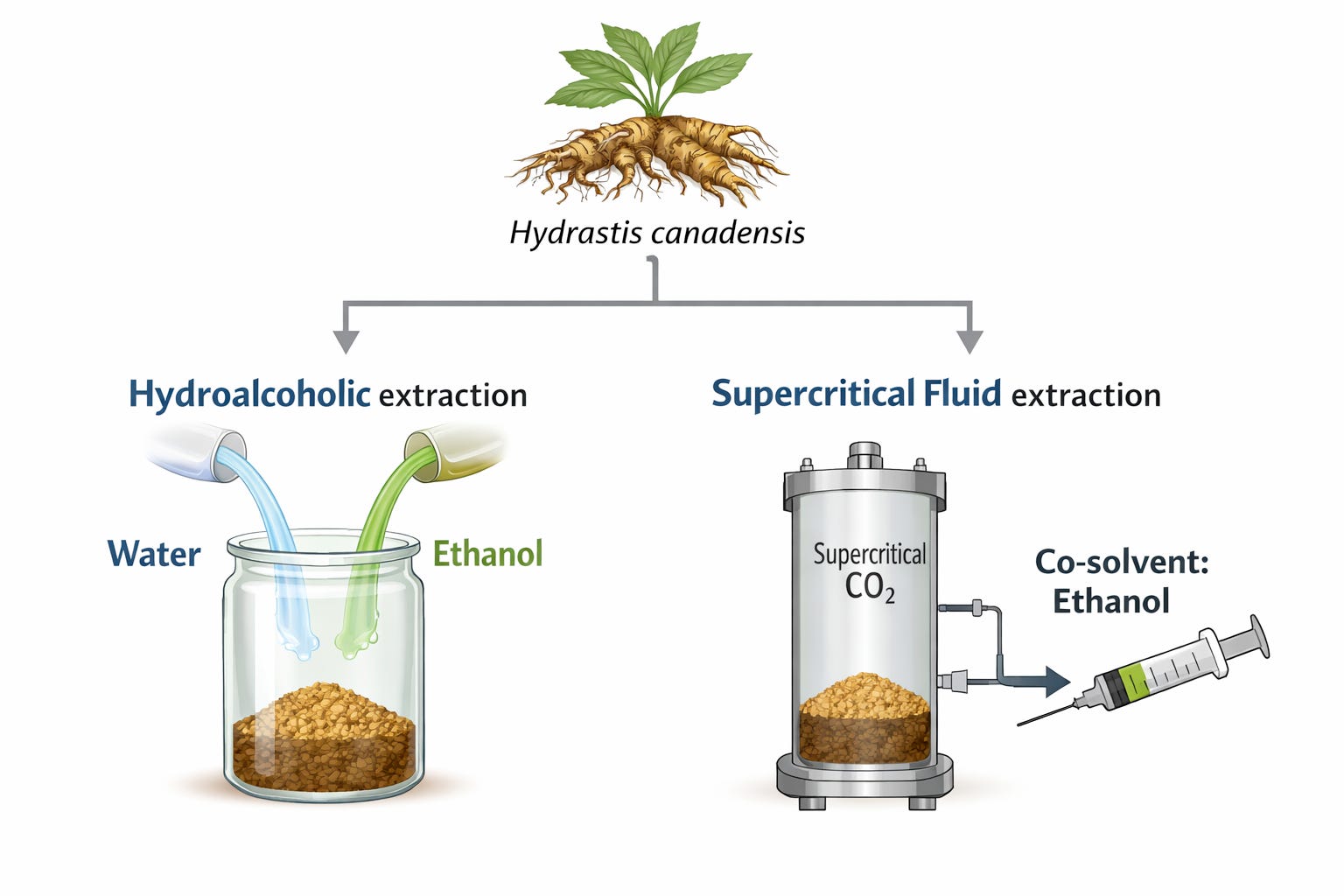
Many of these methods can be time-consuming and may require large volumes of solvent. Recent studies have explored optimized and greener extraction strategies to maximize alkaloid yield while preserving constituent integrity (Haq et al., 2025). Pressurized hot water extraction (PHWE) and subcritical water extraction raise temperature and pressure so that liquid water’s dielectric constant drops and its ion product increases, while viscosity and surface tension fall sharply. Under these conditions, water behaves like a mid-polarity organic solvent with exceptional diffusion into dense plant tissue (Ong & Len, 2003; Cheng et al., 2021). Pressurized hot water extraction of berberine, baicalein, and glycyrrhizin at 95–140 °C and 10–20 bar yielded recoveries comparable to or better than sonication or Soxhlet extraction with organic solvents, illustrating how “tuned” water can efficiently strip highly polar alkaloids from matrices that resist simple decoction (Ong & Len, 2003).
The same technology, applied to goldenseal root, produced high hydrastine and berberine yields using water alone when temperature and residence time were optimized, confirming that Hydrastis alkaloids can be fully recovered in an aqueous system if the energy input and mass-transfer driving forces are large enough (Mokgadi et al., 2013). However, a trade-off was noted: excessive heat can degrade these thermally labile alkaloids, so temperature optimization is critical (American Herbal Pharmacopoeia, 2001; Mokgadi et al., 2013). It is unclear whether either co-solvent or modifier increases solubilization of goldenseal’s polar alkaloids (Liu et al., 2006; Cuéllar et al, 2024).
Subcritical water extraction of quinolizidine alkaloids from Sophora flavescens provides a parallel example. When water was used at elevated temperatures and pressures, total alkaloid yields equaled or surpassed those obtained with ethanol in accelerated solvent extraction, and subcritical water was identified as the most efficient route for total alkaloids under optimized conditions (Wang et al., 2012). The use of a nonpolar modifying solvent to gain access to strongly basic alkaloids during Supercritical CO₂ extraction of quinolizidine alkaloids from Sophora illustrates how matrix penetration and co-solvency together govern recovery (Ling et al., 2007; Ruan et al., 2016).
In another example, ultrahigh pressure extraction of berberine from Cortex phellodendri, using water–ethanol mixtures at several hundred MPa, further demonstrates that mechanical disruption of cell walls coupled with modest organic content can dramatically shorten extraction time and improve yield compared with conventional maceration (Liao et al., 2012).
Microwave-assisted aqueous two-phase extraction of Sophora alkaloids achieved rapid, high-yield partitioning of multiple alkaloids into a PEG–salt phase from an essentially aqueous environment, but only because microwave energy and phase-separation physics overcame the usual diffusion constraints of simple water decoction (Zhang et al., 2015). Across these techniques, water performs comparably to or better than hydroalcohol only when its thermodynamic properties are shifted by temperature and pressure and when additional driving forces such as ultrahigh pressure, microwave, or phase-separation fields are provided. At room temperature and atmospheric pressure, with simple maceration, those advantages disappear and hydroalcoholic solvents are the optimal approach.
The goal of extraction is not only to maximize yield but also to retain the proper metabolite ratio reflective of that found in the plant. Recent research underscores that extraction conditions can skew this ratio. Zuiderveen et al. (2021b) specifically examined post-harvest drying conditions (rather than solvent extraction per se), but their findings are relevant: drying goldenseal roots at high temperatures (54 °C) significantly reduced canadine levels (by ~50%) compared to freeze-drying, whereas berberine and hydrastine were largely unaffected by that level of heat (Zuiderveen et al., 2021b). This indicates canadine (a tertiary alkaloid) is more heat-labile; thus, any extraction or drying process involving heat should account for possible loss of this component. Standardizing gentle extraction and drying protocols can help ensure that the full complement of alkaloids (and their natural ratios) are preserved (American Herbal Pharmacopoeia, 2001), noting a paucity of data on optimal drying/extraction conditions as an area needing attention to improve product consistency.
References
1. Alam, S. D., Beg, M. A., Bagadi, M., Locatelli, M., AlOthman, Z. A., Mustaqeem, M., & Ali, I. (2023). Facile extraction of berberine from different plants, separation, and identification by thin-layer chromatography, high-performance liquid chromatography, and biological evaluation against leishmaniosis. Journal of Separation Science, 46(21), e2300582. https://doi.org/10.1002/jssc.202300582
2. American Herbal Pharmacopoeia. (2001). Goldenseal Root, Hydrastis canadensis: Standards of Analysis, Quality Control, and Therapeutics (Monograph). Santa Cruz, CA: American Herbal Pharmacopoeia.
3. Bitwell, C., Indra, S. S., Chimuka, L., & Kakoma, M. K. (2023). A review of modern and conventional extraction techniques and their applications for extracting phytochemicals from plants. Scientific African, 19, e01585. https://doi.org/10.1016/j.sciaf.2023.e01585
4. Cheng, Y., Xue, Y., Wang, Q., Wu, X., Zhang, Q., & Li, P. (2021). Subcritical water extraction of natural products. Molecules, 26(13), 4004. https://doi.org/10.3390/molecules26134004
5. Cuéllar, L. M., Escobedo-Avellaneda, Z., & del Valle, J. M. (2024). Effect of supercritical CO₂ modified with ethanol on the extraction yield and antimicrobial activity of bioactive compounds from aerial parts of Berberis microphylla G. Fort. LWT, 211, 116885. https://doi.org/10.1016/j.lwt.2024.116885
6. Cui, L., Li, C., Dong, L., Chen, Y., & Zhang, X. (2019). Preparation and evaluation of antidiabetic agents of berberine organic acid salts for enhancing the bioavailability. Molecules, 24(1), 103. https://doi.org/10.3390/molecules24010103
7. Fang, X., Wu, H., Wei, J., Miao, R., Zhang, Y., & Tian, J. (2022). Research progress on the pharmacological effects of berberine targeting mitochondria. Frontiers in Endocrinology, 13, 982145. https://doi.org/10.3389/fendo.2022.982145
8. Guo, X., Zhang, T., Meng, H., & Yu, S. (2017). Ethanol precipitation of sugar beet pectins as affected by electrostatic interactions between counter-ions and pectin chains. Food Hydrocolloids, 65, 203–209. https://doi.org/10.1016/j.foodhyd.2016.11.010
9. Haq, E., Afzal, E., Aslam, M., Zafar, F., & Assad, N. (2025). Green approach to phytochemicals: Alkaloids purification as used in health therapeutical and wellness activities. Insights–Journal of Health and Rehabilitation, 3, 201–209. https://doi.org/10.71000/f4dmxb96
10. Heinrich, M., Mah, J., & Amirkia, V. (2021). Alkaloids used as medicines: Structural phytochemistry meets biodiversity—An update and forward look. Molecules, 26(7), 1836. https://doi.org/10.3390/molecules26071836
11. Jain, A., Kulkarni, M., & Tripathi, J. (2021). Quantitative study of total phenolic and alkaloid content in hydroalcoholic extract of Rauwolfia serpentina stem. Plant Archives, 21(1), 1735–1738. https://doi.org/10.51470/plantarchives.2021.v21.no1.236
12. Lee, J. E., Kim, H. S., & Park, H. J. (2024). The influence of solvent choice on the extraction of bioactive compounds from Asteraceae: A comparative review. Foods, 13(19), 3151. https://doi.org/10.3390/foods13193151
13. Le, P. M., McCooeye, M., & Windust, A. (2012). Characterization of the alkaloids in goldenseal (Hydrastis canadensis) root by high resolution Orbitrap LC-MS. Analytical and Bioanalytical Chemistry, 405, 4487–4499. https://doi.org/10.1007/s00216-012-6539-9
14. Li, L., Zhang, D., Wang, Y., Liu, F., Xu, Y., & Bao, H. (2021). Effective extraction of palmatine and berberine from Coptis chinensis by deep eutectic solvents-based ultrasound-assisted extraction. Journal of Analytical Methods in Chemistry, 2021, 9970338. https://doi.org/10.1155/2021/9970338
15. Liao, G., Liu, J., He, S., Chen, J., & Zhang, Z. (2012). Optimization for ultrahigh pressure extraction of berberine from Cortex phellodendri by central composite design–response surface methodology. Journal of Medicinal Plants Research, 6(23), 3963–3970. https://doi.org/10.5897/JMPR11.1092
16. Ling, J. Y., Zhang, G. Y., & Sun, J. Y. (2007). Supercritical fluid extraction of quinolizidine alkaloids from Sophora flavescens Ait. Journal of Chromatography A, 1145(1–2), 123–127. https://doi.org/10.1016/j.chroma.2007.01.080
17. Liu, B., Li, W., Chang, Y., Dong, W., & Ni, L. (2006). Extraction of berberine from rhizome of Coptis chinensis Franch using supercritical fluid extraction. Journal of Pharmaceutical and Biomedical Analysis, 41(3), 1056–1060. https://doi.org/10.1016/j.jpba.2006.01.034
18. Mokgadi, J., Turner, C., & Torto, N. (2013). Pressurized hot water extraction of alkaloids in goldenseal. American Journal of Analytical Chemistry, 4(8), 398–403. https://doi.org/10.4236/ajac.2013.48050
19. Neag, M. A., Mocan, A., Echeverría, J., Pop, R. M., Bocsan, C. I., Crișan, G., & Buzoianu, A. D. (2018). Berberine: Botanical occurrence, traditional uses, extraction methods, and relevance in cardiovascular, metabolic, hepatic, and renal disorders. Frontiers in Pharmacology, 9, 557. https://doi.org/10.3389/fphar.2018.00557
20. Oyedemi, S. O., Bradley, G., & Afolayan, A. J. (2012). Antioxidant and antibacterial activities of hydroalcoholic stem bark extract of Curtisia dentata (Burm. f) C.A. Sm. International Journal of Molecular Sciences, 13(5), 6189–6203. https://doi.org/10.3390/ijms13056189
21. Plaskova, A., & Mlček, J. (2023). New insights into the application of water or ethanol–water plant extracts rich in active compounds in food. Frontiers in Nutrition, 10, 1118761. https://doi.org/10.3389/fnut.2023.1118761
22. Ruan, J., Li, Z., Zhang, Y., Li, J., & Li, H. (2016). Optimization of supercritical fluid extraction of total alkaloids from bulbs of Fritillaria thunbergii Miq. and their antioxidant activity. Materials, 9(7), 524. https://doi.org/10.3390/ma9070524
23. Tai, Y., Shen, J., Luo, Y., Qu, H., & Gong, X. (2020). Research progress on the ethanol precipitation process of traditional Chinese medicine. Chinese Medicine, 15, 84. https://doi.org/10.1186/s13020-020-00366-2
24. Tims, M. C. (2006). The chemical ecology of Hydrastis canadensis L. (Ranunculaceae): Effects of root isoquinoline alkaloids on the Hydrastis endophyte, Fusarium oxysporum (Doctoral dissertation, University of Maryland, College Park). University of Maryland Libraries. https://drum.lib.umd.edu/handle/1903/3389
25. Wang, H., Lu, Y., Chen, J., Li, J., & Liu, S. (2012). Subcritical water extraction of alkaloids in Sophora flavescens Ait. and determination by capillary electrophoresis with field-amplified sample stacking. Journal of Pharmaceutical and Biomedical Analysis, 58, 146–151. https://doi.org/10.1016/j.jpba.2011.09.014
26. Zhang, W., Zhang, H., Wang, H., Guo, Y., & Li, X. (2015). Simultaneous extraction and purification of alkaloids from Sophora flavescens Ait. by microwave-assisted aqueous two-phase extraction coupled with resin adsorption. Separation and Purification Technology, 141, 113–123. https://doi.org/10.1016/j.seppur.2014.11.014