

An earlier post reviewed structural features of licorice that influence clinical effects. As a reminder:
A molecule in licorice (Glycyrrhiza glabra) called glycyrrhizin is an intensely sweet triterpenoid glycoside. A glycoside is a parent molecule (aglycone) attached to sugars (glycones). In plants, the glycone (sugar moiety) helps in the accumulation of secondary metabolites like glycosides at high concentrations by altering the chemical properties and biological activity of the aglycone (non-sugar part).
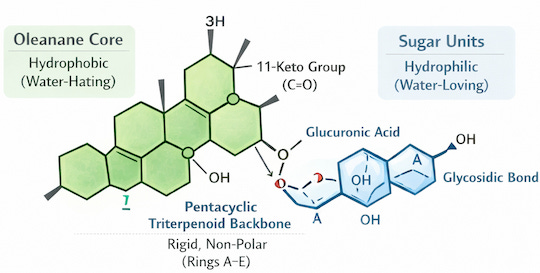
Clinically, glycyrrhizin acts to support recovery and protection of the alimentary, respiratory, nervous, endocrine, and cardiovascular systems (Wang et al., 2015; Ceccuzzi et al., 2023). It has demonstrated robust anti-inflammatory, antiviral, and hepatoprotective properties. It has been used clinically in Japan to treat chronic hepatitis and cirrhosis (Fiore et al., 2008).
Its antiviral effects are well-documented against hepatitis viruses (HBV, HCV), herpes simplex virus (HSV), and coronaviruses including SARS-CoV-2. Glycyrrhizin impedes viral replication and egress through inhibition of phospholipase A2 and disruption of viral envelope integrity (Cinatl et al., 2003; van de Sand et al., 2021).
It is widely used in dermatology and gastroenterology for treating eczema, ulcers, and oral inflammation. It also exhibits antibacterial and antiviral actions, including inhibition of DNA and RNA synthesis in bacterial pathogens (Rastogi et al., 2015).
Emerging mechanistic evidence also supports its anticancer activity, especially via PPAR-γ activation, apoptotic signaling, and suppression of tumor angiogenesis (Zhou et al., 2019). Its use in cosmetic formulations is also expanding due to its skin-lightening and anti-aging properties.
van Beers et al. (2011) investigated licorice toxicity and found large doses and extended use led to over production of mineralocorticoids, leading to sodium retention and potassium excretion with adverse effects including fatigue, thirst, irritability, excessive urination, edema, hypertension, hypokalemia, and alkalosis.
Differentiating Therapeutic Activity of Glycoside vs. Aglycone
Intravenous (IV) administration of glycyrrhizin bypasses gut metabolism and allows systemic distribution of the intact glycoside (van Rossum et al., 1999). Normally, the molecule would be hydrolyzed to the aglycone and sugar component in oral ingestion. However, the conversion of glycyrrhizin (GL) to glycyrrhizic acid (GA) enhances its pharmacologic profile in most systemic therapeutic contexts. GA demonstrates higher bioavailability and potency in modulating enzymes such as 11β-hydroxysteroid dehydrogenase (11β-HSD2), which regulates cortisol metabolism. GA’s inhibition of 11β-HSD2 contributes to mineralocorticoid-like effects including sodium retention, potassium loss, and elevated blood pressure (Stewart et al., 1987).
This unmasking of clinical effect might suggest a prodrug status, where the intact glycoside, glycyrrhizin, is not pharmacologically inert. Several studies have shown that GL has direct antiviral, anti-inflammatory, and immunomodulatory actions prior to hydrolysis. It inhibits the replication of viruses such as hepatitis A virus and SARS-CoV-2, blocks high mobility group box 1 (HMGB1), and suppresses proinflammatory cytokines (Cinatl et al., 2003; van de Sand et al., 2021; Basso et al., 2020). Furthermore, GL modulates drug absorption and permeability by interacting with cell membranes, enhancing the delivery of co-administered pharmaceuticals (Nomura et al., 2003).
Therefore, GL exhibits a distinct pharmacological profile in contexts where it acts within the gastrointestinal tract, bloodstream (following IV administration), or epithelial barriers. Oral administration results in systemic GA effects, IV dosing favors GL-mediated systemic effects, and topical application relies on GA for local action. Sustained systemic exposure translates into prolonged physiological effects such as suppression of 11β-HSD2, which contributes to hypertension and electrolyte imbalances commonly associated with chronic licorice ingestion (Stewart et al., 1987).
Knowing how structural change impacts clinical endpoints allows greater nuance in using licorice effectively.
Note: The analyses presented here drew exclusively on human-relevant in vitro, in silico, and clinical data when evaluating the therapeutic potential of licorice. Systematic evaluations across toxicology and drug development indicate poor concordance between animal and human outcomes, with predictive performance for efficacy and safety frequently approaching chance levels, particularly for toxicity endpoints (Perel et al., 2007; Van Norman, 2019). Given these limitations, animal data are not relied upon in the present assessment, which instead prioritizes mechanistic, pharmacokinetic, and clinical evidence directly applicable to human physiology.
References
1. Basso, A., Corbo, F., Buonerba, C., Scafuri, L., Di Lorenzo, A., Di Marzo, M., ... & Toma, C. C. (2020). Could glycyrrhizin prevent the harmful effects of SARS-CoV-2? A hypothesis. Cureus, 12(5), e8023. https://doi.org/10.7759/cureus.8023
2. Ceccuzzi G, Rapino A, Perna B, et al. (2023) Liquorice toxicity: a comprehensive narrative review. Nutrients. 15(18):3866.
3. Cinatl, J., Morgenstern, B., Bauer, G., Chandra, P., Rabenau, H., & Doerr, H. W. (2003). Glycyrrhizin, an active component of liquorice roots, and replication of SARS-associated coronavirus. The Lancet, 361(9374), 2045–2046. https://doi.org/10.1016/S0140-6736(03)13615-X
4. Fiore, C., Eisenhut, M., Krausse, R., Ragazzi, E., Pellati, D., Armanini, D., & Bielenberg, J. (2008). Antiviral effects of Glycyrrhiza species. Phytotherapy Research, 22(2), 141–148. https://doi.org/10.1002/ptr.2295
5. Nomura, T., Fukushi, E., Narui, T., & Yamada, H. (2003). Absorption-enhancing effects of glycyrrhizin and its derivatives on peptide drugs. Journal of Pharmacy and Pharmacology, 55(5), 699–704.
6. Perel, P., Roberts, I., Sena, E., Wheble, P., Briscoe, C., Sandercock, P., … Macleod, M. (2007). Comparison of treatment effects between animal experiments and clinical trials: Systematic review. BMJ, 334 (7586), 197. https://doi.org/10.1136/bmj.39048.407928.BE
7. Rastogi, S., Pandey, M. M., & Rawat, A. K. S. (2015). Medicinal plants and natural products in amelioration of arsenic toxicity: A short review. Frontiers in Pharmacology, 6, 122. https://doi.org/10.3389/fphar.2015.00122
8. Stewart, P. M., Wallace, A. M., Valentino, R., Burt, D., Shackleton, C. H. L., & Edwards, C. R. W. (1987). Mineralocorticoid activity of liquorice: 11-β-hydroxysteroid dehydrogenase deficiency comes of age. The Lancet, 330(8563), 821–824.
9. van Beers EJ, Stam J, van den Bergh WM. (2011) Licorice consumption as a cause of posterior reversible encephalopathy syndrome: a case report. Crit Care. 15(1):R64.
10. Van Norman, G. A. (2019). Limitations of animal studies for predicting toxicity in clinical trials: Is it time to rethink our current approach? JACC: Basic to Translational Science, 4(7), 845–854. https://doi.org/10.1016/j.jacbts.2019.10.008)
11. van de Sand, L., Bormann, M., Alt, M., Schipper, L., Heilingloh, C. S., Steinmann, E., ... & Pöhlmann, S. (2021). Glycyrrhizin effectively inhibits SARS-CoV-2 replication by disrupting viral uptake and replication. Viruses, 13(4), 609. https://doi.org/10.3390/v13040609
12. van Rossum, T. G. J., Vulto, A. G., Hop, W. C. J., Schalm, S. W. (1999). Pharmacokinetics of intravenous glycyrrhizin after single and multiple doses in patients with chronic hepatitis C infection. European Journal of Clinical Pharmacology, 55(10), 745–749. https://doi.org/10.1007/s002280050697
13. Wang L, Yang R, Yuan B, et al. (2015) The antiviral and antimicrobial activities of licorice, a widely-used Chinese herb. Acta Pharm Sin B. 5(4):310–315.
14. Zhou, Y., Zheng, J., Li, S., Li, X., Chen, Y., Lu, X., & Li, H. B. (2019). Natural polyphenols for prevention and treatment of cancer. Nutrients, 11(5), 1036. https://doi.org/10.3390/nu11051036