

What are the tissue characteristics?
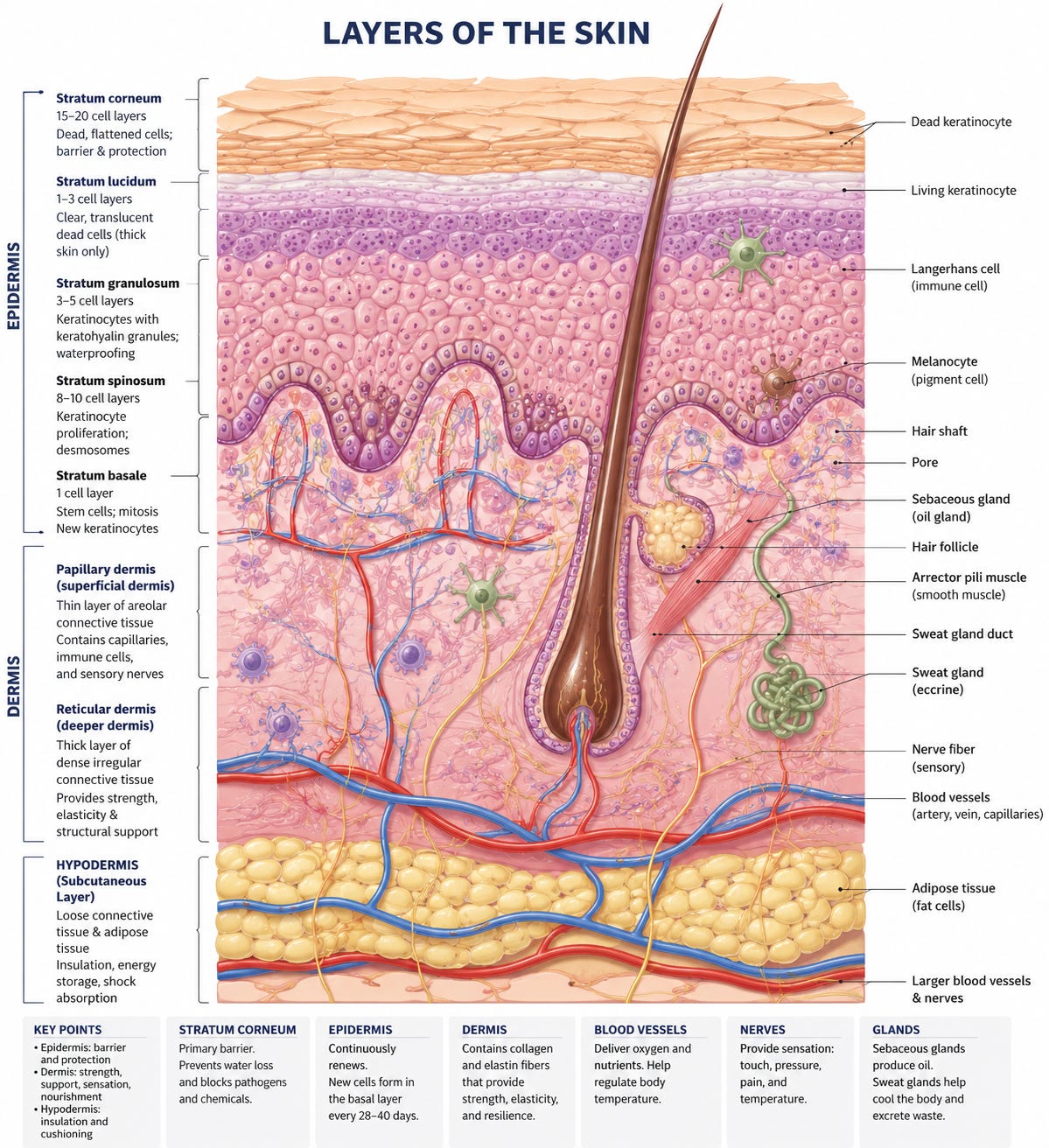
A topical constituent applied to the skin surface has to release from the formulation matrix. Strong affinity for the oil, gel, or emulsion can limit penetration because the compound must partition out of the vehicle before it can enter skin. The first major barrier is the stratum corneum, the outermost layer of the epidermis. Its tightly organized lipids and keratinized cells strongly restrict diffusion. Most cosmetic ingredients remain largely at this level. Molecules that cross must generally have an appropriate balance of lipophilicity, size, and solubility, or be assisted by formulation strategies such as penetration enhancers, hydration, or specialized carriers.
Below this lies the viable epidermis. This tissue is much more aqueous, so a constituent that crossed the lipid-rich stratum corneum must now repartition into a different environment. Cellular binding and metabolism can slow further movement. The epidermis itself has no blood vessels, so systemic uptake is minimal at this stage.
At the dermal–epidermal junction and papillary dermis, the compound enters vascularized connective tissue. Diffusion through extracellular matrix, binding to proteins, and local metabolism become important barriers. This is also the first level where meaningful uptake into dermal capillaries can occur.
Deeper in the reticular dermis, continued penetration competes increasingly with vascular and lymphatic clearance. A compound may remain locally in dermal tissue, bind to connective tissue, or enter the circulation rather than continue moving downward.
The subcutaneous tissue or hypodermis lies beneath the dermis. Reaching it requires substantial penetration through the preceding layers. Conventional cosmetic formulations generally deliver little material this deeply. Lipophilic compounds that do reach it may partition into adipose tissue. An additional pathway is found via the hair follicles because they bypass part of the stratum-corneum barrier and can act as reservoirs extending into the dermis.
Your application should be judged against the destination within this complex tissue your active phytochemicals will reach. An oil that leaves most of a botanical constituent in the stratum corneum could be completely adequate for barrier or surface effects and inadequate for fibroblast-directed photoaging treatment. Conversely, a formulation engineered for maximum dermal or transdermal flux could be unnecessarily aggressive for an epidermal or follicular target.
Target Applications
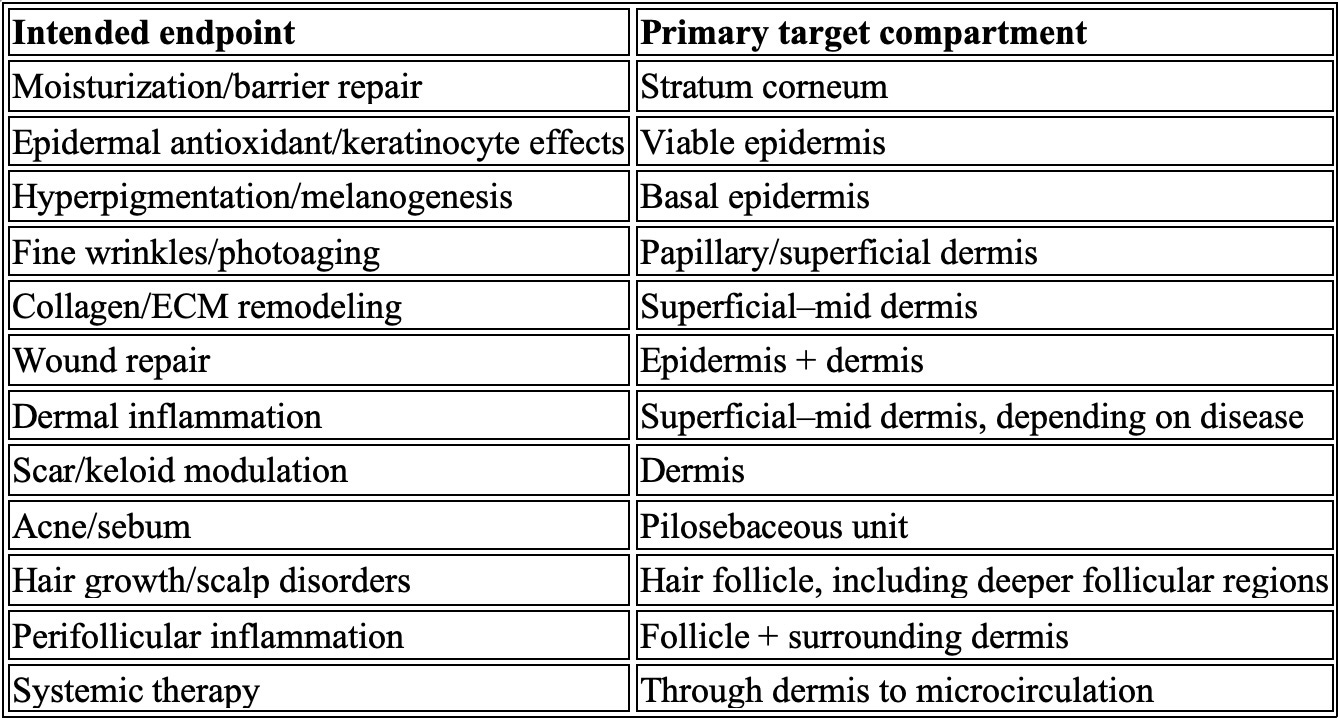
A quick review of intended effects helps in understanding the anatomical endpoint that should be targeted. See Figure 1 for a complex depiction of the skin tissue. What follows is a summary. It’s not a definitive targeting approach, but a generalized description of clinical effects associated with the varied dermal layers. As the ability of your enhanced formula to move thru the skin tissue increases phytochemicals will be associated with multiple layers, rather than moving as a single, uniform pulse (Table 1).
Therapeutic endpoints associated with herbal constituents reaching the top layer or stratum corneum and upper epidermis include barrier repair, moisturization, scaling, superficial antimicrobial effects, and reduction of transepidermal water loss (Proksch et al., 2008; Roberts et al., 2021). Keratinocytes, which make up about 90% of the epidermis and form a strong physical and immune barrier in the viable epidermis are important for inflammatory signaling as well as epidermal differentiation (Bito & Nishigori, 2012; Lambert et al., 2019; Proksch et al., 2008). Thus, a formulation at this level may be sufficient for (Roberts et al., 2021):
moisturization and barrier support
xerosis and scaling
superficial antimicrobial activity
mild irritant/inflammatory conditions
antioxidant protection of epidermal cells
modulation of keratinocyte differentiation
Melanocytes are concentrated in the basal layer of the epidermis. Therapeutic herbal compounds intended to effect melanogenesis need to move beyond the stratum corneum into the viable epidermis, but do not require deeper penetration (Lambert et al., 2019; Roberts et al., 2021). Relevant cosmetic or clinical endpoints include:
hyperpigmentation
melasma
post-inflammatory pigmentation
uneven pigmentation
modulation of melanocyte–keratinocyte signaling
The superficial or papillary dermis contains fibroblasts, extracellular matrix, small blood vessels, sensory structures, immune cells, and the upper portions of appendages. Delivery into this compartment is required for treating dermal inflammation, extracellular-matrix remodeling, wound repair, or vascular responses (Huang et al., 2022; Pfisterer et al., 2021; Rittié & Fisher, 2015), as well as the following:
photoaging and fine wrinkles
stimulation or preservation of collagen
inhibition of excessive matrix metalloproteinase activity
superficial wound healing
inflammatory dermatoses involving epidermal–dermal signaling
erythema and superficial vascular inflammation
modulation of dermal mast cells and other immune populations
Dermal fibroblasts are major producers and regulators of collagen, elastin-associated matrix, glycosaminoglycans, and other extracellular-matrix components. A topical intended to influence dermal collagen remodeling must reach viable dermal tissue (Huang et al., 2022; Rittié & Fisher, 2015). Fibroblast populations are not uniform throughout the dermis. Superficial and deeper fibroblasts differ phenotypically and functionally, which means that simply reporting “dermal delivery” can still be insufficient when the intended biological target is spatially restricted (Korosec et al., 2019).
This deeper lying tissue also includes vascular structures, nerves, inflammatory infiltrates, and the lower portions of hair follicles (Huang et al., 2022; Pfisterer et al., 2021). Active phytochemicals can influence:
more substantial extracellular-matrix remodeling
deeper inflammatory processes
chronic wound repair
scar and keloid modulation
localized pain or neurogenic inflammation
deeper vascular targets
perifollicular inflammation
Hair follicles extend from the epidermis deep into the dermis and contain sebaceous glands, stem-cell niches, immune cells, and capillaries. Hair follicles can serve as reservoirs for particles and dissolved constituents. Material deposited within a follicle can subsequently diffuse into surrounding tissue. The extent of follicular delivery depends on follicular density and size, follicle activity, particle characteristics, and the properties of the delivered compound (Costa et al., 2021). They provide localized access to deeper structures without requiring uniform penetration across the entire epidermal surface (Gu et al., 2022; Pfisterer et al., 2021). Treatment goals include:
acne
sebaceous-gland modulation
androgenetic alopecia
scalp inflammation
folliculitis
perifollicular inflammation
delivery to follicular stem-cell regions
some localized antimicrobial therapies
Acne is particularly instructive because the relevant target is the pilosebaceous unit, not simply “the dermis.” Follicular targeting can therefore be more useful than maximizing generalized transepidermal penetration (Gu et al., 2022).
Once compounds cross the dermis sufficiently to encounter the dermal microcirculation, the formulation begins approaching a transdermal rather than just topical objective. For most cosmetic products and many botanical therapeutics, this is not the desired endpoint. Increasing systemic uptake can reduce local retention and increase systemic exposure and safety concerns. However, transdermal applications can be unique and effective methods to avoid first pass kinetics (Prausnitz & Langer, 2008; Roberts et al., 2021).
Enhancement Methods
The botanical ingredients alone do not determine skin penetration. The vehicle affects whether a constituent remains in the formulation, partitions into the stratum corneum, and moves into viable tissue. High solubility in the vehicle can therefore work against delivery when the compound has little tendency to partition into skin.
Cal (2006) demonstrated this with terpinen-4-ol, which accumulated in skin at approximately 90 µg/cm² from an oily carrier compared with approximately 60 µg/cm² from an emulsion. Citronellol behaved differently, with a hydrogel delivered approximately 25 µg/cm² across the skin layers, while skin penetration was not detected using oily formulation. Linalyl acetate reached the stratum corneum but not viable skin with either vehicle. Terpenes limonene, cineole, and linalool can alter stratum-corneum lipid organization and increase permeability. The magnitude of the effect depends on both the terpene and the compound being delivered (Chen et al., 2016).
Oleic acid acts through related changes in extracellular stratum-corneum lipids and increases diffusion through the barrier (Naik et al., 1995). These effects can extend delivery into the viable epidermis and, for some compounds, the dermis. On point to consider is that penetration enhancement varies among constituents and can increase irritation.
Plant oils should not necessarily be treated as simply inert carriers. In ex vivo human skin, fatty acids from soybean, olive, avocado, sea-buckthorn, raspberry seed, and coconut oils entered the skin, but only soybean and olive oils significantly increased the distribution of dihydroquercetin. The penetration-enhancing effect did not correlate with the fatty-acid composition of the oils (Čižinauskas et al., 2017). A separate comparison of natural oils found substantial differences in delivery of a model compound among olive, coconut, grapeseed, and avocado oil formulations (Viljoen et al., 2015). Selecting an oil by its reported oleic, linoleic, or saturated-fat content is not enough, since the complete oil and the compound being delivered have to be tested together.
Using nanoemulsions can improve solubilization and partitioning of poorly soluble constituents. More importantly, the carrier can affect where a compound accumulates. Caon et al. (2017) compared curcumin delivered in polymeric nanoparticles, solid lipid nanoparticles, and nanoemulsions of similar particle size. The formulations produced different distributions between epidermis and dermis, demonstrating that carrier choice alters tissue deposition beyond total uptake. Yousef et al. (2019) combined nanoemulsions with terpene penetration enhancers. Across isolated human epidermal membranes, a limonene-containing nanoemulsion increased maximum curcumin flux approximately 28-fold compared with a 60% ethanol/water control.
Microemulsions are related but distinct systems in which oil, water, surfactant, and usually a cosurfactant form a thermodynamically stable dispersion. Their composition can strongly affect skin penetration. Using dermatomed human skin, Chen et al. (2018) found that a genistein microemulsion containing 20% water produced approximately ninefold greater flux and fourfold greater skin retention than an aqueous genistein suspension. Changing the water content also substantially altered penetration.
Liposomes are vesicles with one or more phospholipid bilayers surrounding an aqueous interior. It can carry hydrophilic compounds in the aqueous core and lipophilic compounds within the lipid bilayer. They are used to improve cutaneous delivery through solubilization, protection of unstable compounds, hydration, altered release, and interactions with stratum-corneum lipids. In human skin, phospholipid vesicles increased delivery of a hydrophilic marker into the stratum corneum and produced some penetration into viable epidermis compared with aqueous controls (Verma et al., 2003). Resveratrol-loaded phospholipid vesicles containing penetration enhancers produced approximately 1.7- to 2.1-fold greater local accumulation than conventional liposomes in an ex vivo model (Caddeo et al., 2015). This method tends to favor the stratum corneum and viable epidermis.
Niosomes are made up of nonionic surfactants, used to lowers the surface tension of a liquid, making it easier for the liquid to spread and mix with other substances. They can also incorporate fatty acids or other penetration enhancers. Quercetin niosomes also increased skin retention approximately 2.95-fold compared with free quercetin solution (Lu et al., 2019).
Ethosomes combine phospholipids with relatively high ethanol concentrations. Ethanol increases vesicle flexibility while altering stratum-corneum lipid organization. Experimental studies report delivery into deeper skin layers, although the evidence is based on limited human studies (Natsheh et al., 2019).
Solid lipid nanoparticles and Nanostructured Lipid Carriers (NLCs) can improve chemical stability, hydration, occlusion, and controlled release. They are lipid-based nanoparticles created, in general, by combining a solid lipid with a liquid lipid to form an imperfect lipid matrix that can accommodate and retain active compounds. NLCs entered cosmetic use before becoming widely investigated as pharmaceutical delivery systems (Müller et al., 2007).
In human skin, NLCs increased retention of quercetin compared with a compositionally similar microparticle formulation (Bose & Michniak-Kohn, 2013). An NLC gel containing quercetin and resveratrol subsequently produced approximately threefold greater skin disposition than a conventional gel and increased deposition in deeper skin layers in an ex vivo model (Imran et al., 2020).
References
1. Bito, T., & Nishigori, C. (2012). Impact of reactive oxygen species on keratinocyte signaling pathways. Journal of Dermatological Science, 68(1), 3–8. https://doi.org/10.1016/j.jdermsci.2012.06.006
2. Bose, S., & Michniak-Kohn, B. (2013). Preparation and characterization of lipid based nanosystems for topical delivery of quercetin. European Journal of Pharmaceutical Sciences, 48(3), 442–452. https://doi.org/10.1016/j.ejps.2012.12.005
3. Caddeo, C., Manconi, M., Cardia, M. C., Díez-Sales, O., Fadda, A. M., & Sinico, C. (2015). Investigating the interactions of resveratrol with phospholipid vesicle bilayer and the skin: NMR studies and confocal imaging. International Journal of Pharmaceutics, 484(1–2), 138–145. https://doi.org/10.1016/j.ijpharm.2015.02.049
4. Cal, K. (2006). Skin penetration of terpenes from essential oils and topical vehicles. Planta Medica, 72(4), 311–316. https://doi.org/10.1055/s-2005-916230
5. Caon, T., Mazzarino, L., Simões, C. M. O., Senna, E. L., & Silva, M. A. S. (2017). Lipid- and polymer-based nanostructures for cutaneous delivery of curcumin. AAPS PharmSciTech, 18(3), 920–925. https://doi.org/10.1208/s12249-016-0554-7
6. Chen, J., Jiang, Q.-D., Chai, Y.-P., Zhang, H., Peng, P., & Yang, X.-X. (2016). Natural terpenes as penetration enhancers for transdermal drug delivery. Molecules, 21(12), 1709. https://doi.org/10.3390/molecules21121709
7. Chen, L., Annaji, M., Kurapati, S., Ravis, W. R., & Babu, R. J. (2018). Microemulsion and microporation effects on the genistein permeation across dermatomed human skin. AAPS PharmSciTech, 19(8), 3481–3489. https://doi.org/10.1208/s12249-018-1150-9
8. Costa, C., Cavaco-Paulo, A., & Matamá, T. (2021). Mapping hair follicle-targeted delivery by particle systems: What has science accomplished so far? International Journal of Pharmaceutics, 610, 121273. https://doi.org/10.1016/j.ijpharm.2021.121273
9. Čižinauskas, V., Elie, N., Brunelle, A., & Briedis, V. (2017). Skin penetration enhancement by natural oils for dihydroquercetin delivery. Molecules, 22(9), 1536. https://doi.org/10.3390/molecules22091536
10. Gu, Y., Bian, Q., Zhou, Y., Huang, Q., & Gao, J. (2022). Hair follicle-targeting drug delivery strategies for the management of hair follicle-associated disorders. Asian Journal of Pharmaceutical Sciences, 17(3), 333–352. https://doi.org/10.1016/j.ajps.2022.04.003
11. Huang, J., Heng, S., Zhang, W., Liu, Y., Xia, T., Ji, C., & Zhang, L.-J. (2022). Dermal extracellular matrix molecules in skin development, homeostasis, wound regeneration and diseases. Seminars in Cell & Developmental Biology, 128, 137–144. https://doi.org/10.1016/j.semcdb.2022.02.027
12. Imran, M., Iqubal, M. K., Imtiyaz, K., Saleem, S., Mittal, S., Rizvi, M. M. A., Ali, J., & Baboota, S. (2020). Topical nanostructured lipid carrier gel of quercetin and resveratrol: Formulation, optimization, in vitro and ex vivo study for the treatment of skin cancer. International Journal of Pharmaceutics, 587, 119705. https://doi.org/10.1016/j.ijpharm.2020.119705
13. Korosec, A., Frech, S., Gesslbauer, B., Vierhapper, M., Radtke, C., Petzelbauer, P., & Lichtenberger, B. M. (2019). Lineage identity and location within the dermis determine the function of papillary and reticular fibroblasts in human skin. Journal of Investigative Dermatology, 139(2), 342–351. https://doi.org/10.1016/j.jid.2018.07.033
14. Lambert, M. W., Maddukuri, S., Karanfilian, K. M., Elias, M. L., & Lambert, W. C. (2019). The physiology of melanin deposition in health and disease. Clinics in Dermatology, 37(5), 402–417. https://doi.org/10.1016/j.clindermatol.2019.07.013
15. Lu, B., Huang, Y., Chen, Z., Ye, J., Xu, H., Chen, W., & Long, X. (2019). Niosomal nanocarriers for enhanced skin delivery of quercetin with functions of anti-tyrosinase and antioxidant. Molecules, 24(12), 2322. https://doi.org/10.3390/molecules24122322
16. Müller, R. H., Petersen, R. D., Hommoss, A., & Pardeike, J. (2007). Nanostructured lipid carriers (NLC) in cosmetic dermal products. Advanced Drug Delivery Reviews, 59(6), 522–530. https://doi.org/10.1016/j.addr.2007.04.012
17. Naik, A., Pechtold, L. A. R. M., Potts, R. O., & Guy, R. H. (1995). Mechanism of oleic acid-induced skin penetration enhancement in vivo in humans. Journal of Controlled Release, 37(3), 299–306. https://doi.org/10.1016/0168-3659(95)00088-7
18. Natsheh, H., Vettorato, E., & Touitou, E. (2019). Ethosomes for dermal administration of natural active molecules. Current Pharmaceutical Design, 25(21), 2338–2348. https://doi.org/10.2174/1381612825666190716095826
19. Pfisterer, K., Shaw, L. E., Symmank, D., & Weninger, W. (2021). The extracellular matrix in skin inflammation and infection. Frontiers in Cell and Developmental Biology, 9, 682414. https://doi.org/10.3389/fcell.2021.682414
20. Prausnitz, M. R., & Langer, R. (2008). Transdermal drug delivery. Nature Biotechnology, 26(11), 1261–1268. https://doi.org/10.1038/nbt.1504
21. Proksch, E., Brandner, J. M., & Jensen, J.-M. (2008). The skin: An indispensable barrier. Experimental Dermatology, 17(12), 1063–1072. https://doi.org/10.1111/j.1600-0625.2008.00786.x
22. Rittié, L., & Fisher, G. J. (2015). Natural and sun-induced aging of human skin. Cold Spring Harbor Perspectives in Medicine, 5(1), a015370. https://doi.org/10.1101/cshperspect.a015370
23. Roberts, M. S., Cheruvu, H. S., Mangion, S. E., Alinaghi, A., Benson, H. A. E., Mohammed, Y., Holmes, A., van der Hoek, J., Pastore, M., & Grice, J. E. (2021). Topical drug delivery: History, percutaneous absorption, and product development. Advanced Drug Delivery Reviews, 177, 113929. https://doi.org/10.1016/j.addr.2021.113929
24. Verma, D. D., Verma, S., Blume, G., & Fahr, A. (2003). Liposomes increase skin penetration of entrapped and non-entrapped hydrophilic substances into human skin: A skin penetration and confocal laser scanning microscopy study. European Journal of Pharmaceutics and Biopharmaceutics, 55(3), 271–277. https://doi.org/10.1016/S0939-6411(03)00021-3
25. Viljoen, J. M., Cowley, A., du Preez, J., Gerber, M., & du Plessis, J. (2015). Penetration enhancing effects of selected natural oils utilized in topical dosage forms. Drug Development and Industrial Pharmacy, 41(12), 2045–2054. https://doi.org/10.3109/03639045.2015.1047847
26. Yousef, S. A., Mohammed, Y. H., Namjoshi, S., Grice, J. E., Benson, H. A. E., Sakran, W., & Roberts, M. S. (2019). Mechanistic evaluation of enhanced curcumin delivery through human skin in vitro from optimised nanoemulsion formulations fabricated with different penetration enhancers. Pharmaceutics, 11(12), 639. https://doi.org/10.3390/pharmaceutics11120639