

Plants invest metabolic energy to product secondary metabolites, so it only makes sense if they solve several recurring ecological problems. Across plant families, triterpenoid saponins function as classic phytoanticipins - preformed, constitutive chemical defenses that accumulate in healthy tissue and can be further induced into phytoalexin-like responses under biotic or abiotic stress (Moses et al., 2014; Oh et al., 2014). Their amphipathic structure enables strong interaction with membrane sterols, producing pore formation, ion leakage, and cell death in sterol-dependent fungi, which explains their broad antifungal and antiherbivore activity (Carter et al., 1999; Moses et al., 2014).
Ginsenosides play an analogous role in Panax. They are concentrated in roots and cortical tissues, the primary interface with soil microbes, and their profiles shift in response to elicitor treatment and stress, consistent with inducible defense layered atop a constitutive baseline (Oh et al., 2014; Yousef & Bernards, 2006; Moses et al., 2014). The synthesis of ginsenosides resolves three intertwined functions, antifungal activity via sterol-targeted membrane disruption, selective modulation of pathogens and mutualists in the rhizosphere, and deterrence of herbivores and insects, as total ginsenosides exhibit antifeedant and oviposition-deterring effects across multiple insect systems (Moses et al., 2014).
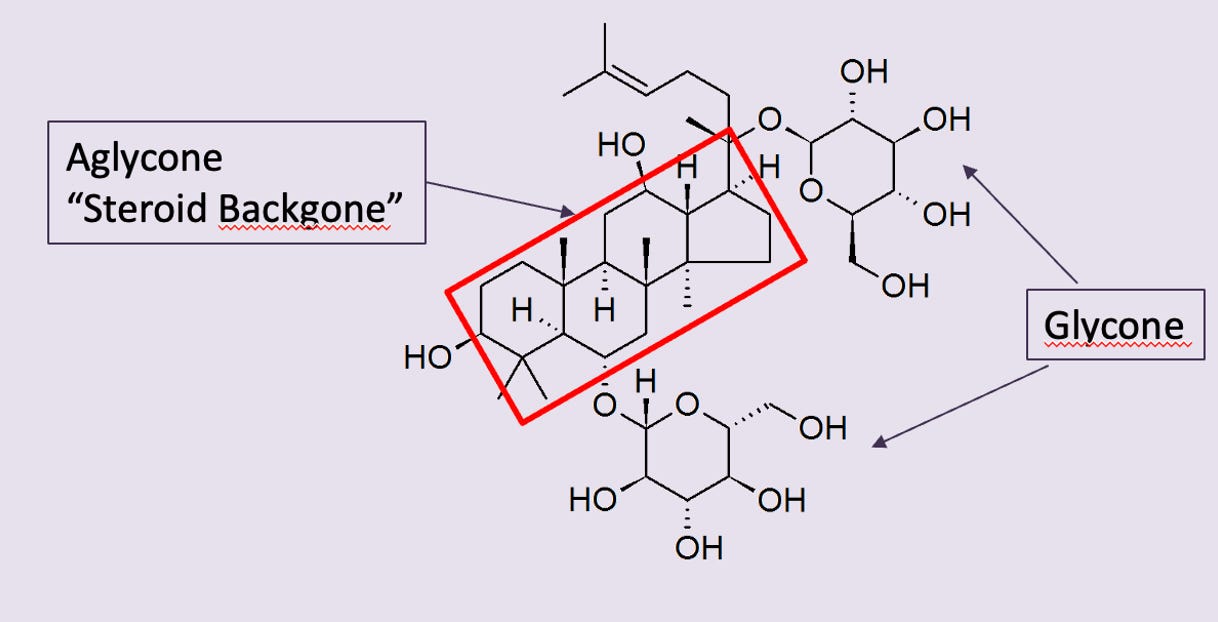
In American ginseng, sterol binding translates into a dual pattern: ginsenosides inhibit some root-colonizing fungi, such as Trichoderma species, supporting their role as host resistance factors (Nicol et al., 2002). They also stimulate growth of other pathogens, including Cylindrocarpon destructans, and sterol-poor oomycetes such as Pythium and Phytophthora (Nicol et al., 2003). In these taxa, canonical sterol-mediated membrane disruption is blunted, and ginsenosides instead function as substrates and chemical cues. Pythium irregulare enzymatically deglycosylates ginsenosides into more hydrophobic sapogenins and sugars that it can utilize metabolically, confirming that for some pathogens ginsenosides act as exploitable resources (Yousef & Bernards, 2006). Thus, “sterol disruption” represents only one branch of a broader, ratio-dependent interaction network that partitions the fungal community into suppressed versus favored guilds.
This selectivity operates at field-realistic concentrations. Nicol et al. (2003) quantified ginsenosides in American ginseng rhizosphere soil at 0.02–0.098% (w/w) and measured ~0.6% ginsenosides in root exudates collected over twenty-two days from pot-grown plants. At comparable concentrations in vitro, ginsenoside mixtures inhibited some fungi while stimulating Cylindrocarpon and multiple Pythium species, demonstrating that these soil levels fall squarely within a biologically active and alellopathic range (Nicol et al., 2003). In Panax notoginseng, multiple ginsenosides accumulate in both rhizosphere soils and exudates under continuous cultivation, and when applied individually at 1 µg/mL, several directly suppress seedling emergence, root elongation, and root meristem cell viability, establishing genuine autotoxicity at low micromolar levels (Yang et al., 2015). These concentrations at milligrams per liter in soil solution are aligned with Nicol’s bulk-soil percentages.
At the community scale, ginsenosides also restructure microbiomes. Application of ginsenoside mixtures at 0.1–10 mg/L significantly alters soil enzyme activities, reduces bacterial diversity, and shifts fungal communities toward disease-associated genera (Miao et al., 2023). Exudate-tracking studies from Luo at al. (2020) show that different ginsenosides are preferentially utilized as carbon sources by distinct microbial taxa, and as exudate composition changes across growth stages, the rhizosphere microbiome shifts in parallel, indicating that ginsenosides act as selective carbon and signaling inputs rather than inert residues. Complementary work demonstrates that autotoxic ginsenoside mixtures preferentially stimulate potentially pathogenic fungi within soil communities, reinforcing their role as active ecological filters (Li et al., 2020).
The ecological footprint of ginseng chemistry appears to persist across decades. Methanol-extractable residues from former American ginseng soils enhance root rot caused by Ilyonectria mors-panacis for at least 30 years after cultivation, plausibly involving transformed ginsenosides and associated allelochemicals that suppress host defenses and interact synergistically with pathogens (Goodwin & Zaro, 2024).
References
1. Carter, J. P., Spink, J., Cannon, P. F., Daniels, M. J., & Osbourn, A. E. (1999). Isolation, characterization, and avenacin sensitivity of a diverse collection of cereal-root-colonizing fungi. Applied and Environmental Microbiology, 65(8), 3364–3372. https://doi.org/10.1128/AEM.65.8.3364-3372.1999
2. Goodwin, P. H., & Zaro, G. (2024). Appearance and persistence of activity in soil extracts increasing root rot of American ginseng (Panax quinquefolius) by Ilyonectria mors-panacis. Soil Systems, 8(4), 133. https://doi.org/10.3390/soilsystems8040133
3. Li, Y., Dai, S., Wang, B., Jiang, Y., Ma, Y., Pan, L., Wu, K., Huang, X., Zhang, J., & Cai, Z. (2020). Autotoxic ginsenoside disrupts soil fungal microbiomes by stimulating potentially pathogenic microbes. Applied and Environmental Microbiology, 86(9), e00130-20. https://doi.org/10.1128/AEM.00130-20
4. Luo, L. F., Yang, L., Yan, Z. X., Jiang, B. B., Li, S., Huang, H. C., Liu, Y. X., Zhu, S. S., & Yang, M. (2020). Ginsenosides in root exudates of Panax notoginseng drive the change of soil microbiota through carbon source different utilization. Plant and Soil, 455, 139–153. https://doi.org/10.1007/s11104-020-04663-5
5. Miao, X., Wang, E., Zhou, Y., Zhan, Y., Yan, N., Chen, C., & Li, Q. (2023). Effect of ginsenosides on microbial community and enzyme activity in continuous cropping soil of ginseng. Frontiers in Microbiology, 14, 1060282. https://doi.org/10.3389/fmicb.2023.1060282
6. Moses, T., Papadopoulou, K. K., & Osbourn, A. (2014). Metabolic and functional diversity of saponins, biosynthetic intermediates and semi-synthetic derivatives. Critical Reviews in Biochemistry and Molecular Biology, 49(6), 471–492. https://doi.org/10.3109/10409238.2014.953628
7. Nicol, R. W., Traquair, J. A., & Bernards, M. A. (2002). Ginsenosides as host resistance factors in American ginseng (Panax quinquefolius). Canadian Journal of Botany, 80(5), 557–562. https://doi.org/10.1139/b02-034
8. Nicol, R. W., Yousef, L., Traquair, J. A., & Bernards, M. A. (2003). Ginsenosides stimulate the growth of soilborne pathogens of American ginseng. Phytochemistry, 64(1), 257–264. https://doi.org/10.1016/S0031-9422(03)00271-1
9. Oh, J. Y., Kim, Y., Jang, M., Joo, S. C., Kwon, W., Kim, S., Jung, S., Yang, D. C., & Kim, Y. J. (2014). Investigation of ginsenosides in different tissues after elicitor treatment in Panax ginseng. Journal of Ginseng Research, 38(4), 270–277. https://doi.org/10.1016/j.jgr.2014.04.004
10. Yang, M., Zhang, X., Xu, Y., Mei, X., Jiang, B., Liao, J., Yin, Z., Zheng, J., Zhao, Z., Fan, L., He, X., Zhu, Y., & Zhu, S. (2015). Autotoxic ginsenosides in the rhizosphere contribute to the replant failure of Panax notoginseng. PLOS ONE, 10(2), e0118555. https://doi.org/10.1371/journal.pone.0118555
11. Yousef, L. F., & Bernards, M. A. (2006). In vitro metabolism of ginsenosides by the ginseng root pathogen Pythium irregulare. Phytochemistry, 67(16), 1740–1749. https://doi.org/10.1016/j.phytochem.2005.06.030