

Recent posting on cannabis trichomes and root border cells got me curious about the role of complex, micellular-like microenvironments. Specifically, if we compare different forms of it within plant systems, can we develop either unique extraction processes or delivery methods?
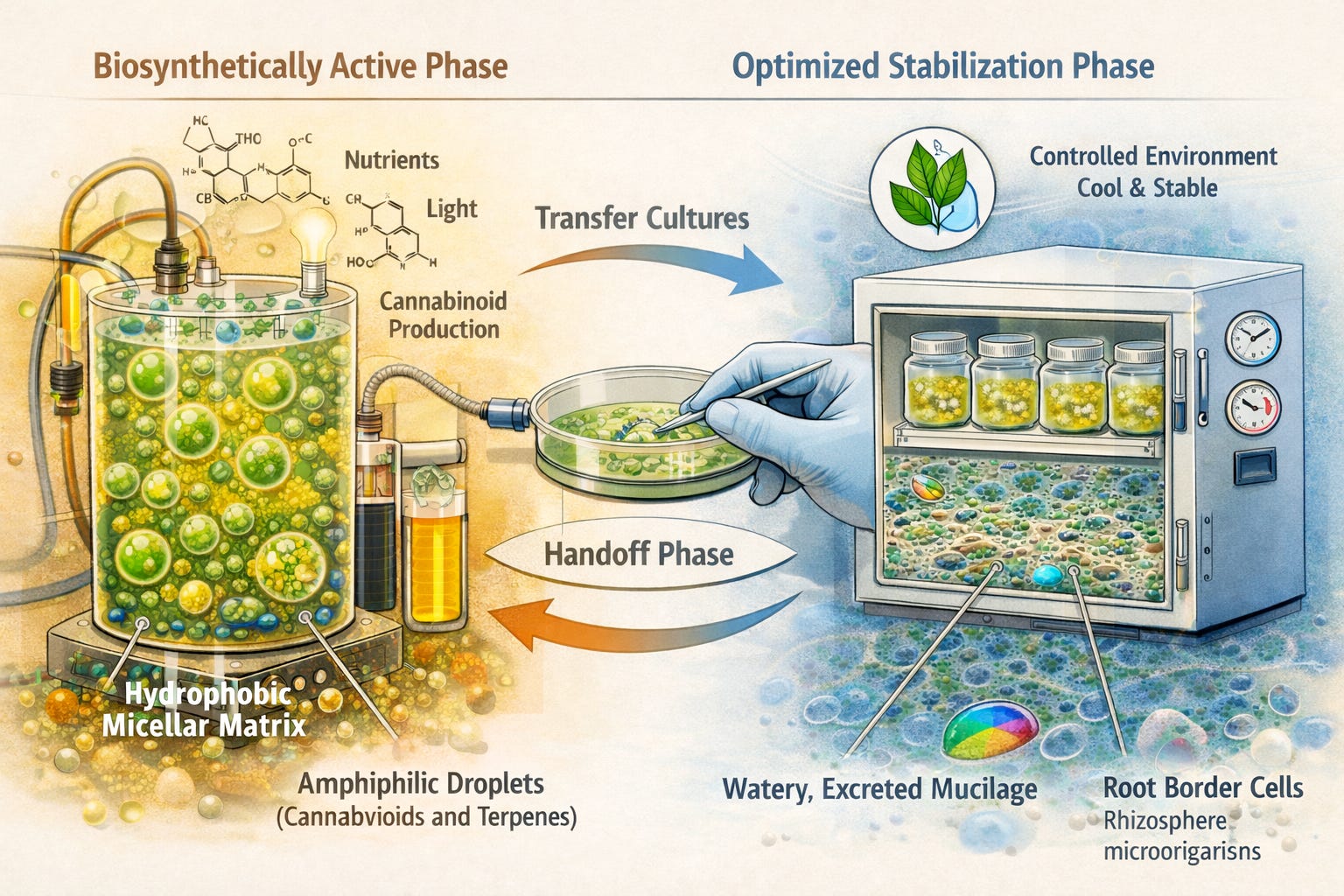
Analyses of trichome exudate show the presence of amphiphilic and hydrophilic constituents that form micellar or emulsion-like microenvironments, allowing enzymes to remain catalytically active under highly hydrophobic conditions (Rodziewicz et al., 2019). Reverse micelle-like structures and acidic vacuolar conditions further stabilize enzymatic activity and concentrate secondary metabolites, blurring the boundary between biosynthesis and storage (Klyachko & Levashov, 2003; Taiz, 1992). This architecture explains how cannabinoids and terpenes can continue to accumulate late in flower development even when cytosolic metabolism is downregulated.
Root border-cell mucilage is a hydrated, polyanionic, polymer-rich gel containing polysaccharides, proteins, extracellular DNA, and metabolites, continuously exchanging with bulk soil solution and microbes (Kranawetter & Sumner, 2025; Omelyanchuk et al., 2024). Border cells themselves are metabolically specialized (enriched in flavonoids and triterpenoid saponins in Medicago), but that specialization is primarily intracellular and then exported into mucilage/exudate space (Watson et al., 2015). Root border cell secretions are structured by a gel microenvironment that determines which molecules persist, diffuse, complex, signal, or get consumed.
Where glandular trichome cavities provide an extracellular hydrophobic storage space that supports accumulation as well as surface-wall-associated final steps of cannabinoid formation (Xie et al., 2023), root border-cell mucilage excreted into the rhizosphere as extracellular hydrated gel does not support hydrophobic-product accumulation, but can retain and present amphipathic/charged metabolites to immobilize ions and tune environmental pH, and act as a filter (Kranawetter & Sumner, 2025; Omelyanchuk et al., 2024; Korenblum et al., 2020).
If we model those two systems in a linked fashion can one act to allow trichome tissue culture grows to have a biosynthetically active phase followed by stabilization and optimized environment for absorption phase?
References
1. Klyachko, N. L., & Levashov, A. V. (2003). Bioorganic synthesis in reverse micelles and related systems. Current Opinion in Colloid & Interface Science, 8(2), 179–186. https://doi.org/10.1016/S1359-0294(03)00016-5
2. Korenblum, E., Dong, Y., Szymanski, J., Panda, S., Jozwiak, A., Massalha, H., Meir, S., Rogachev, I., & Aharoni, A. (2020). Rhizosphere microbiome mediates systemic root metabolite exudation by root-to-root signaling. Proceedings of the National Academy of Sciences of the United States of America, 117(7), 3874–3883. https://doi.org/10.1073/pnas.1912130117
3. Kranawetter, C., & Sumner, L. W. (2025). Differential root zone secretions and the role of root border cells in rhizosphere manipulation. Phytochemistry Reviews, 24(6), 5639–5658. https://doi.org/10.1007/s11101-025-10084-y
4. Omelyanchuk, N. A., Cherenko, V. A., & Zemlyanskaya, E. V. (2024). Root cap border cells as regulators of rhizosphere microbiota. Vavilovskii Zhurnal Genetiki i Selektsii, 28(8), 918–926. https://doi.org/10.18699/vjgb-24-99
5. Rodziewicz, P., Loroch, S., Marczak, Ł., Kayser, O., & Stehle, F. (2019). Cannabinoid synthases and osmoprotective metabolites accumulate in the exudates of Cannabis sativa L. glandular trichomes. Plant Science, 284, 108–116. https://doi.org/10.1016/j.plantsci.2019.04.008
6. Taiz, L. (1992). The plant vacuole. Journal of Experimental Biology, 172(1), 113–122. https://doi.org/10.1242/jeb.172.1.113
7. Xie, Z., Li, X., Góngora-Castillo, E., & … (2023). Cannabis sativa: glandular trichome biology and cannabinoid production. Frontiers in Plant Science, 14, 1212345. https://doi.org/10.3389/fpls.2023.1212345