

One of the principles of learning we apply in our Master’s Program in Herbal Product Design, is to provide base line knowledge thru resources, an opportunity to apply that knowledge thru an assignment that challenges them to work thru an incomplete data environment to produce innovative strategies.
This was an assignment to tie together issues around dissolution, bioavailability and label claims. It’s an exercise in discerning how to apply new knowledge that may have direct or indirect relationship to the problem of how to integrate evidence from Milk Thistle low bio-availability, the techniques being used to improve it and an understanding of FDA label claims requirements to propose enhanced herbal product labels.
Assignment
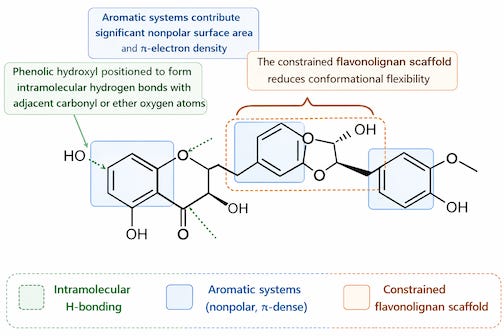
Silybin is a flavonolignan composed of a taxifolin (flavanonol) unit linked to a coniferyl alcohol–derived moiety through an oxeran (benzodioxane-like) linkage. The molecule exhibits poor aqueous solubility and limited oral bioavailability.

The low solubility is explained by the following structural determinants:
Silybin lacks carboxylic acids or amines that would readily ionize at neutral pH. Its phenolic hydroxyl groups have relatively high pKa values so that at physiological pH the molecule remains largely unionized (Křen & Walterová, 2005).
Several phenolic hydroxyl groups are positioned to form intramolecular hydrogen bonds with adjacent carbonyl or ether oxygen atoms. These internal interactions reduce the availability of hydroxyl groups for hydrogen bonding with water (Wu et al., 2008).
The molecule contains multiple fused aromatic rings. Aromatic systems contribute significant nonpolar surface area and π-electron density, increasing lipophilicity (Jiang et al., 2010).
The constrained flavonolignan scaffold reduces conformational flexibility. Reduced flexibility can limit favorable solvation conformations and promote π–π stacking or crystal lattice stabilization in the solid state, further limiting dissolution (Křen & Walterová, 2005).
Enhanced bioavailability strategies of silybin are listed below along with citations if you want to investigate the approach for future use. Such investigation is not necessary for this assignment.
lipid micropores (Liu X, et al., 2007)
self-microemulsifying (Li X. et al., 2009)
silybin-phospolipid complex (Xiao Y. et al., 2006)
nanostructural lipid carriers (Jia LJ. et al., 2010)
The article from Jiang-nan et al. (2010) describes how to enhance the oral bio-availability of the poorly water-soluble drug silybin by sodium cholate/phospholipid-mixed micelles. During digestion, bile salts form stable mixed micelles consisting of fatty acids such as palmitic acid and phospholipids such as lecithin enhance the transport of lipophilic drugs across biological membranes.
The aim of this study was to incorporate silybin into mixed micelles containing a bile salt sodium cholate and phospholipid, and to assess its bioavailability compared with silybin- N-methylglucamine, the soluble chemical derivative of silybin. Derivation refers to adding a chemical component to the silybin molecule to make it more water-soluble.
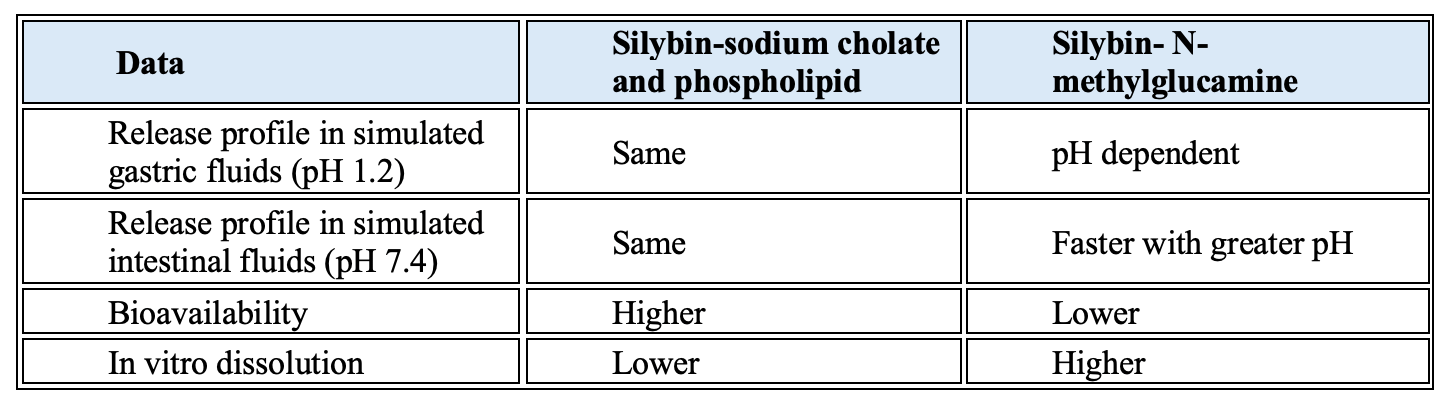
The reason for the findings above may be that water-soluble characteristic of silybin-N-methylglucamine resulted in a faster drug release; the rapid and effective transmembrane transport of the sodium cholate and phospholipid in the mixed micelles led to a much higher bio-availability, on the contrary, although more soluble, silybin-N- methylglucamine cannot be absorbed effectively in vivo.
Student Challenge:
1. Does increasing bioavailability turn a grandfathered ingredient into a new dietary ingredient requiring notification?
2. In answering the question, provide insight into what you would propose as a more consumer-oriented labeling rule.
My feedback
This is a discourse on the ideas central to the challenge and the aggregation of my individual responses to students.
Structure/Function
The low solubility of silybin is explained by the following structural determinants:
Silybin lacks carboxylic acids or amines that would readily ionize at neutral pH. Its phenolic hydroxyl groups have relatively high pKa values so that at physiological pH the molecule remains largely unionized (Křen & Walterová, 2005).
Several phenolic hydroxyl groups are positioned to form intramolecular hydrogen bonds with adjacent carbonyl or ether oxygen atoms. These internal interactions reduce the availability of hydroxyl groups for hydrogen bonding with water (Wu et al., 2008).
The molecule contains multiple fused aromatic rings. Aromatic systems contribute significant nonpolar surface area and π-electron density, increasing lipophilicity (Jiang et al., 2010).
The constrained flavonolignan scaffold reduces conformational flexibility. Reduced flexibility can limit favorable solvation conformations and promote π–π stacking or crystal lattice stabilization in the solid state, further limiting dissolution (Křen & Walterová, 2005).
Bioavailability is not the same as benefit
Change in bioavailability is what matters in pharmacokinetics because it determines how much of a compound reaches systemic circulation and therefore how much can interact with biological targets. Human pharmacokinetic data for a silybin–phosphatidylcholine complex demonstrate how an absorption claim can be substantiated when plasma levels are directly measured against conventional silymarin products in healthy volunteers (Barzaghi et al., 1990). Even then, increased plasma levels do not independently establish improved clinical outcomes (Federal Trade Commission, 2022; Dwyer et al., 2018).
Herbal products are altered at every stage. Simply drying an herb alters its chemical makeup. Crushing seed, performing selective solvent extraction, concentrating extractives, creating emulsions, or applying nano-encapsulation techniques each represent escalating levels of modification. In the case of milk thistle, what distinguishes crushing seed from selective extraction, and selective extraction from micellar or nano delivery systems? Where does the line get drawn, and at what point does alteration create something meaningfully different from what was historically marketed?
The idea that increased bioavailability could constitute adulteration raises a difficult issue. Medicinal plants naturally exhibit wide metabolite variability. Establishing acceptable compositional ranges that reflect plant material normally found in trade would require defining boundaries beyond which a product is no longer representative of the botanical as recognized under DSHEA.
Increasing systemic exposure is not inherently beneficial. Higher absorption can increase interaction risk or alter safety margins (Dwyer et al., 2018). A formulation intended to increase systemic exposure should disclose that intention clearly, because consumers reasonably infer that greater absorption can also mean greater potential for interaction.
Side-effect reporting remains a concern. The current adverse event reporting system is limited. A more robust and curated system would provide a stronger basis for informing consumers about real-world exposure effects.
Increased bioavailability may create NDI issues
The herbal marketplace has grown more sophisticated since DSHEA was introduced in 1994. Companies increasingly apply pharmaceutical engineered strategies to modify absorption and claim enhanced exposure. This is a transitional phase. Companies must either generate that evidence or attempt to extrapolate from traditional literature. Grandfathering protections were based on historical use in traditional systems, not on the newer delivery systems.
FDA has not ruled that enhanced bioavailability automatically constitutes a new dietary ingredient (NDI). However, current draft guidance frames NDI status around whether manufacturing changes alter the identity or key properties of the ingredient, explicitly including bioavailability (U.S. Food and Drug Administration, 2024). If manufacturing changes alter physicochemical structure, purity or impurities, or biological properties such as bioavailability or toxicity, a previously marketed dietary ingredient may become an NDI requiring notification (U.S. Food and Drug Administration, 2024; 21 U.S.C. § 350b, n.d.).
Nanotechnology illustrates the boundary clearly. Engineering particles in the 1–100 nm range may alter composition or structure sufficiently that prior notifications would not apply, requiring separate notification and safety data (U.S. Food and Drug Administration, 2024). Thus, increased bioavailability alone is not the legal trigger. The regulatory question is whether the ingredient remains the same under FDA’s identity-and-properties framework.
It is also instructive to review FDA’s response to specific NDI submissions to understand the evaluative language used in determining whether a manufacturing change alters identity. For example, FDA’s response to docket FDA-2020-S-0023-0115 illustrates how the agency analyzes manufacturing methods and resulting material characteristics when assessing NDI status.
Ingredient identity must also be aligned with the dose basis claimed. For example, reporting silybin-equivalents rather than total extract weight clarifies what is being measured, particularly when delivery systems change which fraction is relevant (Yu et al., 2010).
AHPA’s guidance on extract ratios and percent native extract demonstrates how variability can be disclosed transparently. Where extract ratios are stated, they must reflect dried starting material to finished extract, and where variability exists, ranges or averages must be disclosed according to defined conventions. These conventions improve comparability without overstating precision.
Additional notes:
I like the idea of informing consumers, but with the level of attention span at the point of purchase how do you present a complex idea more simply without losing important info?
I do think too much scientific information on the label will overwhelm the consumer and chase them away. What is strategically needed?
Trust is so valuable - hard to gain and easy to lose. What we provide to consumers about our product is a very important element in building it.
If QR codes are used to provide expanded explanation of absorption technology or pharmacokinetic data, the linked material must also comply with label claim regulations and cannot imply unsubstantiated health outcomes.
Should we setup an independent bioavailability institute to provide certification for data?
Isn’t everything altered by the time it gets into the bottle? Simply drying an herb alters the chemical makeup. At what point does the alteration cross a line? Altered to what extent?
There is no agency measuring effectiveness, certainly not the FDA. They also do not require bioavailability, dissolution or solubility testing. Those are done by companies that want to make a good product backed by science.
Liability vs. education labeling - very different endpoints.
Side effect reporting would be a concern in that the current Adverse Events Reporting/Collection system is woefully inadequate. A robust and curated system would be a stronger basis for that type of consumer information. How is bio equivalency measured and does the manufacture need to test for and report it?
The point of the German government’s Commission E was to evaluate all the available published and unpublished data—some of it submitted by various companies—on close to 400 herbs to determine their safety, efficacy, and suitability to be sold as nonprescription medicines in German pharmacies. These monographs were written as package inserts to help guide patients and health professionals to determine the government-accepted, approved use or uses of this herb were. For example, the definition of the herbal drug, the approved use or uses, recommended dosage, adverse effects, and any known contraindications or drug interactions.
References
Barzaghi, N., Crema, F., Gatti, G., Pifferi, G., & Perucca, E. (1990). Pharmacokinetic studies on IdB 1016, a silybin–phosphatidylcholine complex, in healthy human subjects. European Journal of Drug Metabolism and Pharmacokinetics, 15(4), 333–338. https://doi.org/10.1007/BF03190223
Dwyer, J. T., Coates, P. M., & Smith, M. J. (2018). Dietary supplements: Regulatory challenges and research resources. Nutrients, 10(1), 41. https://doi.org/10.3390/nu10010041
Federal Trade Commission. (2022). Health Products Compliance Guidance. No DOI.
Jiang, Y., Yu, J.-N., Wang, Q., Li, H.-D., & Liu, Y. (2010). Enhanced dissolution and oral bioavailability of silybin by solid dispersion with polyvinylpyrrolidone. *Drug Development and Industrial Pharmacy, 36*(3), 290–295. https://doi.org/10.3109/03639040903148016
Křen, V., & Walterová, D. (2005). Silybin and silymarin—New and emerging applications in medicine. *Current Medicinal Chemistry, 12*(3), 315–338. https://doi.org/10.2174/0929867053363353
Liu X, et al. (2007) Preparation and in vitro-in vivo evaluation of silybin lipid microspheres. Asian J Pharm Sci. 2: 204–10.
Li X. et al. (2009) In vitro and in vivo evaluation of a self-microemulsifying drug delivery system for silybin. J Chin Pharm Sci. 18: 342–7.
Xiao Y. et al. (2006). The preparation of silybin-phospholipid complex and the study on its pharmacokinetics in rats. Int J Pharm. 307: 77–82.
Jia LJ. et al. (2010) Preparation and characterization of silybin-loaded nanostructured lipid carriers. Drug Deliv. 17: 11–8.
U.S. Food and Drug Administration. (2024). Dietary Supplements: New Dietary Ingredient Notifications and Related Issues: Guidance for Industry (Draft).
Wu, J.-W., Lin, L.-C., & Tsai, T.-H. (2008). Drug–drug interactions of silymarin on the perspective of pharmacokinetics. *Journal of Ethnopharmacology, 121*(2), 185–193. https://doi.org/10.1016/j.jep.2008.10.036
Yu, J.-N., Zhu, Y., Wang, L., Peng, M., Tong, S.-S., Cao, X., Qiu, H., & Xu, X.-M. (2010). Enhancement of oral bioavailability of the poorly water-soluble drug silybin by sodium cholate/phospholipid-mixed micelles. Acta Pharmacologica Sinica, 31(6), 759–764. https://doi.org/10.1038/aps.2010.55
21 U.S.C. § 350b. (n.d.). New dietary ingredients.