

Phytochemicals that interact with the endocannabinoid system are referred to as cannabimimetics. They have been found in a broad range of plants. Found in the roots of one such plant, Echinacea purpurea, are a chemically diverse set of unsaturated N‑alkylamides (alkamides), dominated by dodecanoic‑acid–derived isobutylamides with di‑, tri‑, or tetra‑unsaturation. The most studied constituents include dodeca‑2E,4E,8Z,10E/Z‑tetraenoic acid isobutylamide and dodeca‑2E,4E‑dienoic acid isobutylamide (Raduner et al., 2006). These molecules share a common amphipathic architecture with a C12 lipophilic acyl chain coupled via an amide bond to a small, branched amine (Figure 1). This scaffold parallels endocannabinoids in functional topology, though not in exact composition.
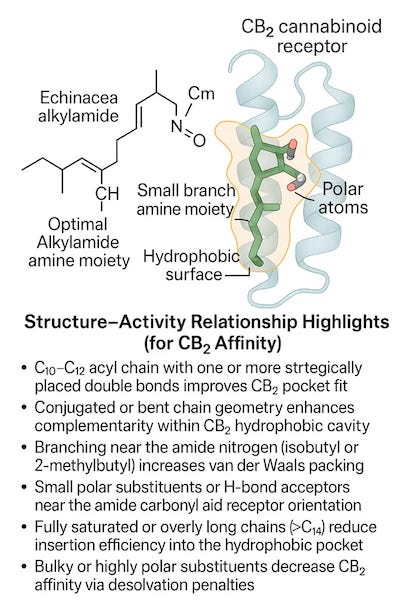
Multiple independent studies establish Echinacea alkylamides as CB2 ‑preferring ligands. Radioligand displacement and functional assays demonstrate nanomolar CB2 affinity (Ki ≈ 60 nM) with markedly weaker CB1 interaction (Ki > 1500 nM), consistent with immunomodulatory rather than psychoactive signaling (Gertsch et al., 2004; Raduner et al., 2006; Woelkart et al., 2005). In human immune cell systems, Echinacea alkylamides demonstrate CB₂-dependent signaling and modulation of cytokine-related gene expression, linking receptor engagement to functional immune outcomes (Gertsch et al., 2004; Raduner et al., 2006).
Fatty acid amide hydrolase (FAAH) is a key degradative enzyme within the endocannabinoid system, responsible for hydrolyzing anandamide (AEA) and related fatty acid ethanolamides that activate cannabinoid receptors. Inhibition of FAAH reduces endocannabinoid catabolism, thereby increasing endogenous ligand availability at CB₁ and CB₂ receptors and functionally enhancing cannabinoid signaling without direct receptor agonism (Cravatt et al., 1996; Piomelli et al., 2006).
Beyond direct receptor binding, Echinacea root extracts inhibit fatty acid amide hydrolase (FAAH) in vitro, with biochemometric analyses correlating inhibition strength to alkylamide abundance (Liu et al., 2021). While extract‑level FAAH inhibition is robust, quantitative IC50 or Ki values for individual purified alkylamides remain largely unreported. Nevertheless, indirect elevation of endocannabinoid tone via reduced degradation is a plausible secondary cannabimimetic mechanism. Evidence suggests that endocannabinoid-system modulation by Echinacea is mixture-dependent, with synergistic and pleiotropic effects observed at the extract level rather than clearly defined high-affinity FAAH inhibition by isolated alkylamides (Chicca et al., 2009; Todd et al., 2015).
Structure–Activity Relationships
Available structure–activity data support the conclusion that Echinacea alkylamides constitute a CB₂-biased cannabimimetic scaffold (Raduner et al., 2006; Woelkart et al., 2005). Across binding and cellular studies, alkylamides bearing C₁₀–C₁₂ acyl chains with one or more double bonds demonstrate greater CB₂ engagement than shorter, longer, or fully saturated analogues (Woelkart et al., 2005). Molecular modeling and receptor analyses suggest that unsaturation may favor conformations compatible with the hydrophobic CB₂ binding cavity, although current data remain insufficient to permit quantitative prediction of affinity or efficacy across novel analogues (Raduner et al., 2006).
Comparative binding data indicate that naturally occurring alkylamides bearing branched isobutyl or 2-methylbutyl amine substituents and C10–C12 unsaturated acyl chains demonstrate measurable CB₂ affinity (Woelkart et al., 2005; Raduner et al., 2006). Molecular modeling suggests that hydrophobic interactions within the CB₂ binding cavity and amide orientation may contribute to receptor engagement, although detailed interaction mapping has not been experimentally resolved (Raduner et al., 2006). Importantly, existing SAR conclusions derive from relatively small analogue panels and extract-associated comparisons rather than systematic medicinal chemistry series, limiting quantitative prediction of affinity, efficacy, or signaling bias.
A related alkylamide scaffold with cannabimetic activity is also found outside Echinacea, including in Acmella oleracea (syn. Spilanthes acmella) and Heliopsis longipes, whose isobutylamide constituents (e.g., spilanthol and affinin) have demonstrated cannabinoid receptor–relevant pharmacologic activity in screening systems (Appendino et al., 2008; Pertwee, 2008).
Traditional Herbalism
Investigating traditional herbalism strategies for using Echinacea for upper respiratory infections focuses on three claims: (1) whether Echinacea alkylamides can plausibly tune immune function via the ECS; (2) whether a high-dose, high-frequency loading regimen is required for clinically meaningful benefit in acute URIs; and (3) that the level of lip and tongue buzz or tingle provides support for ECS activity based on the levels of alkylamides.
There is data to support the idea that Echinacea alkylamides can shift immune signaling set-points through CB2-biased cannabimimetic activity, which is a plausible mechanistic basis for tuning rather than blunt stimulation. In human immune cell systems, defined alkylamides modulate cytokine-related transcriptional outputs through CB2-dependent signaling, indicating that the alkylamide mixture can act as an exogenous input into an endogenous immunoregulatory receptor system (Gertsch et al., 2004; Raduner et al., 2006). Work on Echinacea extracts produced broader immunopharmacologic effects, consistent with a modulatory profile rather than a single-direction stimulant model (Chicca et al., 2009).
Evidence for a loading dose requirement is mixed. In a randomized trial of early treatment for common cold, participants took 1 g doses six times on day one, then three times daily thereafter, and they found no detectable benefit versus placebo (Barrett et al., 2002). That weakens any universal assertion that loading is necessary or sufficient.
However, more recent trial data support a treatment strategy of higher early dosing may improve measurable virologic or symptom-resolution endpoints in some formulations and study contexts. In a randomized controlled trial comparing higher-dose acute treatment formulations to conventional prophylactic-dose comparators, the higher-dose arms used very high doses during days 1–3 and showed faster viral clearance by day 10 and a shorter time to remission in an extrapolated analysis, with the authors explicitly concluding that dose increases during acute symptoms might improve benefits (Sumer et al., 2023).
Shah et al. (2007) conducted a meta-analysis of randomized controlled trials evaluating Echinacea for prevention and treatment of the common cold and reported a pooled reduction in cold incidence and an average reduction in duration of approximately 1.4 days among treatment trials. However, substantial heterogeneity across studies, including differences in species, extract composition, and dosing regimens, limited definitive conclusions regarding optimal dose or formulation (Shah et al., 2007).
Since neither trial included ECS biomarkers, CB2-dependent signatures, or PK–PD linkage to alkylamide exposure, they lack prove that the effect is mediated by CB2/ECS engagement.
A rapid oral tingling or “buzz” has long been used as an industry quality marker for Echinacea preparations. Human psychophysical data from alkylamide analogues demonstrate that such tingling is not mediated by TRPV1 or TRPA1 but is consistent with a mechanosensory chemesthesis modeled on two‑pore potassium (KCNK) channel interference (Albin & Simons, 2010). Crucially, no direct evidence links this sensory effect to CB1 or CB2 activation. The buzz therefore represents a parallel membrane‑active phenotype of unsaturated alkylamides rather than a functional readout of ECS engagement.
An Example of Design Constraints
Two concepts are often conflated in both traditional and modern discourse: regulated support of host defense versus nonspecific innate immune activation that can amplify inflammation. This distinction is particularly salient designing a product for viral respiratory infections, where disease severity is frequently driven not by inadequate immune activation but by dysregulated cytokine signaling (Ye et al., 2020). Consequently, extract design and interpretation must specify not only which immune pathways are being supported, but also which sources of inflammatory escalation are being excluded or actively controlled.
Any mechanistic or clinical inference is contingent on rigorous identity control. Metabolomic profiling demonstrates that Echinacea taxonomic identity and chemical uniformity are not interchangeable. Genotypes and taxonomic treatments differ substantially in metabolite profiles relevant to biological interpretation (Wu et al., 2008). Processed products introduce further uncertainty. DNA metabarcoding has revealed non-declared species in commercial Echinacea products, while HPTLC provides chemical resolution but limited discrimination among closely related taxa (Raclariu et al., 2018). A defensible design therefore requires a dual-track authentication strategy with genetic confirmation where feasible, combined with chemical fingerprinting to ensure that the extracted material corresponds to the intended Echinacea species.
Extract-level immune effects cannot be interpreted along a single “immune boosting” axis. Ethanolic E. purpurea extracts have been shown to contain both cytokine-inducing and cytokine-suppressive constituents, with macrophage responses shifting direction depending on fraction composition (Todd et al., 2015). Importantly, part of the observed macrophage activation originates from bacterial endophytes rather than plant metabolites. Haron et al. (2016) further demonstrated that macrophage activation attributed to E. purpurea extracts could be fully accounted for by Proteobacteria colonizers. These findings show that enrichment and depletion decisions will determine cytokine directionality.
Because macrophage activation encompasses multiple functional states, a low-inflammatory-risk design must explicitly state the intended phenotype bias. Classical inflammatory activation differs fundamentally from alternative, regulatory activation programs, such as those associated with IL-4 signaling and tissue-repair functions (Stein et al., 1992). Even without mapping every cytokine pathway, the extract design and the assays used to test it should specify what type of macrophage response is intended, rather than assuming that any increase in macrophage activation is beneficial.
Once the intended immune phenotype is defined, marker selection must serve two purposes: quality control and biological relevance. Phenylpropanoids are frequently used as analytical markers in Echinacea because they are abundant and measurable; however, their inclusion in specifications should also be justified by their contribution to biological activity. In vitro and cell-based studies indicate that phenolic constituents such as cichoric acid and related caffeic acid derivatives possess antioxidant and immunomodulatory properties that can influence cytokine signaling and oxidative stress pathways, which are mechanistically relevant to macrophage polarization and inflammatory tone. Thus, phenylpropanoid levels may function not only as manufacturing markers but as partial indicators of the extract’s capacity to shape immune response directionality.
If phenylpropanoids are used as quality markers, their analytical behavior under processing conditions must be explicitly controlled. Validated HPLC-UV methods exist for major Echinacea phenolics (Brown et al., 2011), but marker interpretation is complicated by processing-induced degradation. Cichoric acid, in particular, is highly susceptible to enzymatic breakdown during preparation, meaning that measured levels may reflect handling and processing decisions rather than starting material quality (Nüsslein et al., 2000). A defensible design therefore specifies extraction solvent, temperature, time-to-extraction, and enzyme-inactivation steps, and verifies marker stability under those conditions so that measured phenolic content meaningfully reflects both compositional integrity and intended biological function.
Given the demonstrated mixture effects, the most defensible extract architecture is not a single, undifferentiated extraction, but an intentionally controlled extract composition. A workable design consistent with current evidence involves: (i) standardized primary extraction to access alkylamides and relevant phenolics; (ii) fraction-aware composition control guided by cytokine panel outputs, explicitly retaining suppressive or regulatory activity while minimizing pro-inflammatory fractions; (iii) control of microbial confounds through defined microbial or endotoxin release criteria; and (iv) analytical confirmation of target constituents using validated methods (Todd et al., 2015; Haron et al., 2016; Brown et al., 2011).
Limitations Related to Extract Complexity and Matrix Effects
Interpretation of Echinacea alkylamide pharmacology is constrained by the intrinsic complexity of botanical extracts and the physicochemical properties of lipophilic constituents. Alkylamides occur as mixtures of closely related congeners whose relative abundances vary with species, plant part, harvest conditions, and extraction method. As a result, extract-level bioactivity may reflect additive, synergistic, or antagonistic interactions among alkylamides and co-extracted metabolites rather than the behavior of any single compound. Such matrix effects complicate attribution of CB₂ binding or signaling outcomes to defined molecular entities, particularly when extract composition is incompletely characterized.
In addition, the lipophilicity and membrane-partitioning behavior of alkylamides raises the possibility that some observed cellular effects arise from indirect modulation of membrane properties, receptor microenvironment, or intracellular signaling thresholds, rather than from direct receptor–ligand interactions alone. These factors may contribute to apparent activity in functional assays and obscure distinctions between true CB₂ agonism and secondary effects mediated by altered membrane dynamics or endocannabinoid availability.
References
1. Albin, K. C., & Simons, C. T. (2010). Psychophysical evaluation of a sanshool derivative (alkylamide) and the elucidation of mechanisms subserving tingle. PLOS ONE, 5(3), e9520. https://doi.org/10.1371/journal.pone.0009520
2. A related alkylamide scaffold with cannabimetic activity is also found outside Echinacea, including in Acmella oleracea (syn. Spilanthes acmella) and Heliopsis longipes, whose isobutylamide constituents (e.g., spilanthol and affinin) have demonstrated cannabinoid receptor–relevant pharmacologic activity in screening systems (Appendino et al., 2008; Pertwee, 2008).
3. Barrett, B. P., Brown, R. L., Locken, K., Maberry, R., Bobula, J. A., & D’Alessio, D. (2002). Treatment of the common cold with unrefined echinacea: A randomized, double-blind, placebo-controlled trial. Annals of Internal Medicine, 137(12), 939–946. https://doi.org/10.7326/0003-4819-137-12-200212170-00006
4. Brown, P. N., Chan, M., Paley, L., & Betz, J. M. (2011). Determination of major phenolic compounds in Echinacea spp. raw materials and finished products by high-performance liquid chromatography with ultraviolet detection: Single-laboratory validation matrix extension. Journal of AOAC International, 94(5), 1400–1410.
5. Chicca, A., Raduner, S., Pellati, F., Strompen, T., Altmann, K.-H., Schoop, R., & Gertsch, J. (2009). Synergistic immunomopharmacological effects of N-alkylamides in Echinacea purpurea herbal extracts. International Immunopharmacology, 9(7–8), 850–858. https://doi.org/10.1016/j.intimp.2009.03.006
6. Cravatt, B. F., Giang, D. K., Mayfield, S. P., Boger, D. L., Lerner, R. A., & Gilula, N. B. (1996). Molecular characterization of an enzyme that degrades neuromodulatory fatty-acid amides. Nature, 384(6604), 83–87. https://doi.org/10.1038/384083a0
7. Dietz, B., Heilmann, J., & Bauer, R. (2001). Absorption of dodeca-2E,4E,8Z,10E/Z-tetraenoic acid isobutylamides after oral application of Echinacea purpurea tincture. Planta Medica, 67(9), 863–864. https://doi.org/10.1055/s-2001-18846
8. Gertsch, J., Schoop, R., Kuenzle, U., & Suter, A. (2004). Echinacea alkylamides modulate TNF-alpha gene expression via cannabinoid receptor CB2 and multiple signal transduction pathways. FEBS Letters, 577(3), 563–569. https://doi.org/10.1016/j.febslet.2004.10.064
9. Haron, M. H., Tyler, H. L., Pugh, N. D., Moraes, R. M., Maddox, V. L., Jackson, C. R., & Pasco, D. S. (2016). Activities and prevalence of Proteobacteria members colonizing Echinacea purpurea fully account for macrophage activation exhibited by extracts of this botanical. Planta Medica, 82(14), 1258–1265. https://doi.org/10.1055/s-0042-108590
10. Karg, C. A., Wang, P., Vollmar, A. M., & Moser, S. (2019). Re-opening the stage for Echinacea research—Characterization of phylloxanthobilins as a novel anti-oxidative compound class in Echinacea purpurea. Phytomedicine, 60, 152969. https://doi.org/10.1016/j.phymed.2019.152969
11. Karg, C. A., Parráková, L., Fuchs, D., Schennach, H., Kräutler, B., Moser, S., & Gostner, J. M. (2022). A chlorophyll-derived phylloxanthobilin is a potent antioxidant that modulates immunometabolism in human PBMC. Antioxidants, 11(10), 2056. https://doi.org/10.3390/antiox11102056
12. Nicolussi, S., Ardjomand-Woelkart, K., Stange, R., Gancitano, G., Klein, P., & Ogal, M. (2022). Echinacea as a potential force against coronavirus infections? A mini-review of randomized controlled trials in adults and children. Microorganisms, 10(2), 211. https://doi.org/10.3390/microorganisms10020211
13. Nüsslein, B., Kurzmann, M., Bauer, R., & Kreis, W. (2000). Enzymatic degradation of cichoric acid in Echinacea purpurea preparations. Journal of Natural Products, 63(12), 1615–1618. https://doi.org/10.1021/np0002839
14. Pertwee, R. G. (2008). The diverse CB1 and CB2 receptor pharmacology of three plant cannabinoids. British Journal of Pharmacology, 153(2), 199–215. https://doi.org/10.1038/sj.bjp.0707442
15. Piomelli, D., Tarzia, G., Duranti, A., Tontini, A., Mor, M., Compton, T. R., Dasse, O., Monaghan, E. P., Parrott, J. A., & Putman, D. (2006). Pharmacological profile of the selective FAAH inhibitor URB597 (KDS-4103). CNS Drug Reviews, 12(1), 21–38. https://doi.org/10.1111/j.1527-3458.2006.00021.x
16. Raclariu, A. C., Ţebrencu, C. E., Ichim, M. C., Ciupercǎ, O. T., Brysting, A. K., & de Boer, H. (2018). What’s in the box? Authentication of Echinacea herbal products using DNA metabarcoding and HPTLC. Phytomedicine, 44, 32–38. https://doi.org/10.1016/j.phymed.2018.03.058
17. Raduner, S., Majewska, A., Chen, J.-Z., Xie, X.-Q., Hamon, J., Faller, B., Altmann, K.-H., & Gertsch, J. (2006). Alkylamides from Echinacea are a new class of cannabinomimetics: Cannabinoid type 2 receptor-dependent and -independent immunomodulatory effects. Journal of Biological Chemistry, 281(20), 14192–14206. https://doi.org/10.1074/jbc.M601074200
18. Rizzello, C. G., Coda, R., Macías, D. S., Pinto, D., Marzani, B., Filannino, P., Giuliani, G., Paradiso, V. M., Di Cagno, R., & Gobbetti, M. (2013). Lactic acid fermentation as a tool to enhance the functional features of Echinacea spp. Microbial Cell Factories, 12, 44. https://doi.org/10.1186/1475-2859-12-44
19. Shah, S. A., Sander, S., White, C. M., Rinaldi, M., & Coleman, C. I. (2007). Evaluation of Echinacea for the prevention and treatment of the common cold: A meta-analysis. The Lancet Infectious Diseases, 7(7), 473–480. https://doi.org/10.1016/S1473-3099(07)70160-3
20. Stein, M., Keshav, S., Harris, N., & Gordon, S. (1992). Interleukin-4 potently enhances murine macrophage mannose receptor activity: A marker of alternative immunologic macrophage activation. Journal of Experimental Medicine, 176(1), 287–292. https://doi.org/10.1084/jem.176.1.287
21. Sumer, J., Keckeis, K., Scanferla, G., Frischknecht, M., Notter, J., Steffen, A., Kohler, P., Schmid, P., Roth, B., Wissel, K., Vernazza, P., Klein, P., Schoop, R., & Albrich, W. C. (2023). Novel Echinacea formulations for the treatment of acute respiratory tract infections in adults: A randomized blinded controlled trial. Frontiers in Medicine, 10, 948787. https://doi.org/10.3389/fmed.2023.948787
22. Todd, D. A., Gulledge, T. V., Britton, E. R., Oberhofer, M., Leyte-Lugo, M., Moody, A. N., Shymanovich, T., Grubbs, L. F., Juzumaite, M., Graf, T. N., Oberlies, N. H., & Cech, N. B. (2015). Ethanolic Echinacea purpurea extracts contain a mixture of cytokine-suppressive and cytokine-inducing compounds, including some that originate from endophytic bacteria. PLOS ONE, 10(5), e0124276. https://doi.org/10.1371/journal.pone.0124276
23. Woelkart, K., Xu, W., Pei, Y., Makriyannis, A., Picone, R. P., & Bauer, R. (2005). The endocannabinoid system as a target for alkamides from Echinacea angustifolia roots. Planta Medica, 71(8), 701–705. https://doi.org/10.1055/s-2005-871290
24. Wu, L., Dixon, P. M., Nikolau, B. J., Kraus, G. A., & Huber, K. C. (2008). Metabolic profiling of Echinacea genotypes and a test of alternative taxonomic treatments. Planta Medica, 74(14), 1637–1643.
25. Ye, Q., Wang, B., & Mao, J. (2020). The pathogenesis and treatment of the “cytokine storm” in COVID-19. Journal of Infection, 80(6), 607–613. https://doi.org/10.1016/j.jinf.2020.03.037