

Red clover is not a single intervention but a range of preparations that share a core isoflavone scaffold differing based on the extraction process. This leads to varied chemical form, ratio, processing history, and stability profiles.
Phytochemical Architecture and Ratio Logic
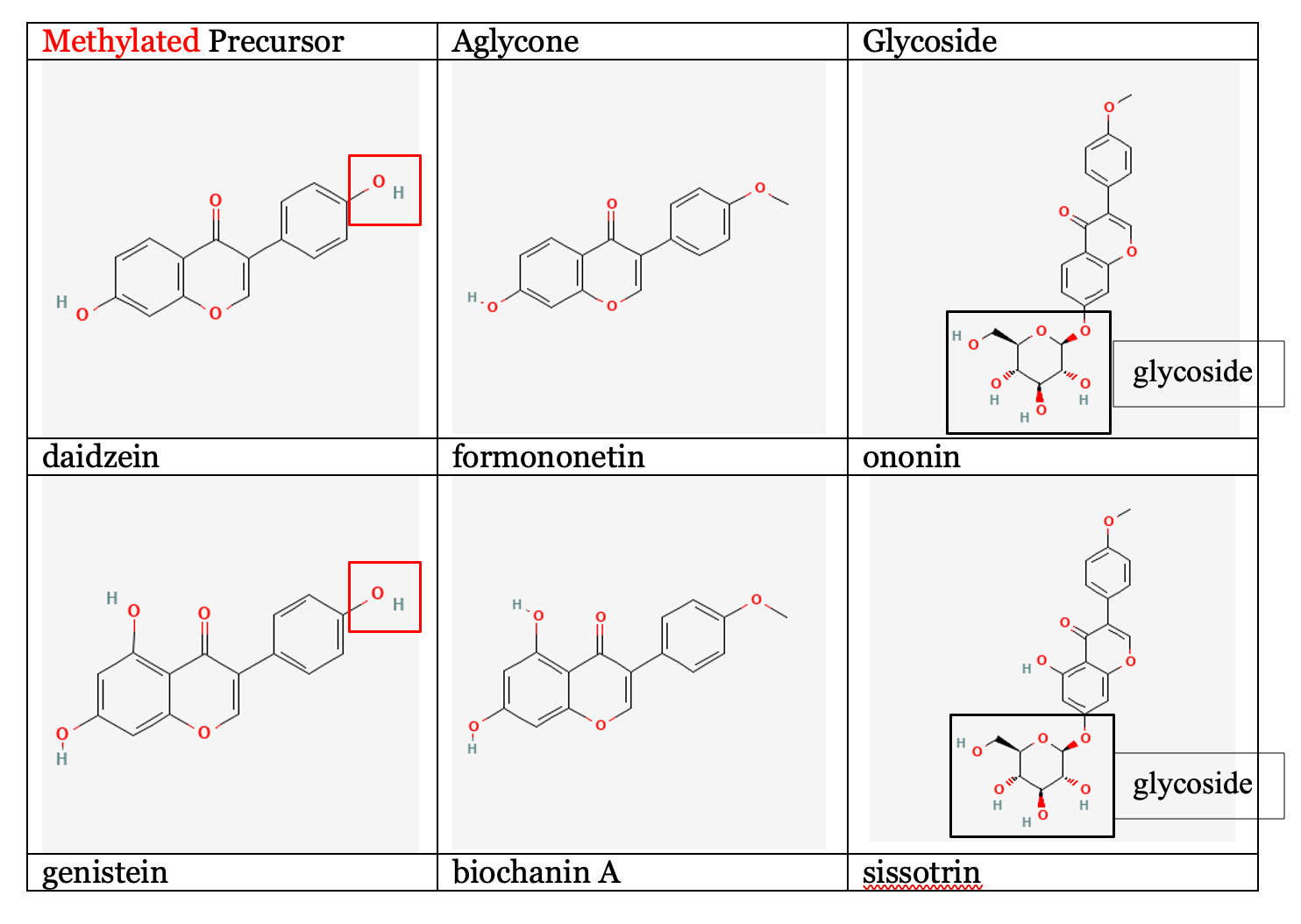
Red clover contains isoflavones in three structurally and functionally distinct forms: methylated precursors, aglycones, and glycosides. A glycoside consists of an aglycone plus a sugar moiety, and the sugar component represents a structurally defined portion of the molecule that alters solubility, stability, and transport behavior.
The table below shows the structural relationships between methylated precursors formononetin and biochanin A, demethylated aglycones daidzein and genistein and glycosides ononin and sissotrin. This structural differentiation determines solubility, membrane permeability, metabolic fate, and receptor interaction potential.
Stability and Dynamic Complexity
Historical use found in clinical literature include respiratory and dermatologic indications, whereas contemporary randomized trials focus on vasomotor symptoms. The systematic review literature treating menopausal hot flushes as the primary endpoint relies almost exclusively on standardized extracts rather than crude infusions (Howes et al., 2007; Myers & Vigar, 2017). Correlation between extraction profile and traditional use remains plausible but unproven. However, what is established is that menopausal trials depend on solvent-derived preparations with defined isoflavone content rather than glycoside-dominant infusions.
Aqueous extracts are chemically unstable relative to alcohol-containing preparations because water supports hydrolysis, oxidation, and microbial growth. Analytical stability work has shown that isoflavone conjugates, including malonyl glucosides, require low-temperature storage to prevent degradation or transformation (De Rijke et al., 2001). Therefore, aqueous plant extracts must be used promptly or refrigerated to limit compositional drift.
Alcohol lowers water activity and suppresses microbial growth and many enzymatic processes. However, ethanol does not eliminate endogenous chemical change. In a controlled evaluation of a 45% ethanolic tincture, time-dependent shifts in isoflavone concentrations were observed, demonstrating dynamic complexity within the extract during storage (Malca-Garcia et al., 2019). This has direct dosing implications. If labeled total isoflavone content remains constant but the aglycone:glycoside ratio drifts over time, effective exposure may change despite nominal dose stability.
Re-glycosylation of aglycones under storage conditions is unlikely because glycosylation generally requires enzymatic catalysis and activated sugar donors. However, hydrolysis, oxidation, and other transformations can occur in both aqueous and ethanolic matrices. Therefore, ratio preservation cannot be assumed across shelf life without stability validation (Malca-Garcia et al., 2019).
Fermented preparations introduce additional stabilization challenges. Fermentation increases aglycone content via enzymatic cleavage of sugar moieties, but if microbial activity is not halted or controlled, continued transformation may occur post-production. Temperature control and microbial inactivation are central stabilization strategies. Evidence from fermented isoflavone systems demonstrates that lower storage temperatures preserve aglycone content more effectively than higher temperatures (Cheng et al., 2006). Thus, fermentation can enhance bioavailability while simultaneously increasing the need for controlled stabilization.
In general, stability strategies include the following:
Store cold and specify a maximum storage temperature, since reaction rates for hydrolysis and oxidation decline with temperature since even tincture drift was observed during storage despite ethanol.
In your packaging, minimize headspace and make sure its oxygen impermeable.
Use amber or fully opaque containers and avoid UV exposure, because photo-oxidation accelerates phenolic transformations in solution and the objective is to reduce non-enzymatic pathways that ethanol does not block.
Clarify and fine filter the tincture and avoid prolonged contact with reactive plant solids, because endogenous reactions can be promoted by residual enzymes, metal ions, and heterogeneous catalysis at solid surfaces in complex extracts.
Measure and hold pH within a narrow range compatible with the intended product, because acid- or base-catalyzed hydrolysis can shift glycoside-related equilibria, and ethanol does not prevent pH-dependent hydrolysis.
Verify the actual ethanol percent by volume and keep it consistent lot-to-lot, because small increases in water content increase hydrolysis capacity and raise water activity, which can increase drift even when nominally “45%” is targeted.
If oxidation markers track with isoflavone drift, consider adding a suitable antioxidant system and validate it does not change the intended isoflavone profile at time zero, because the goal is preservation of ratios rather than creating a new chemical intervention.
Perform shelf-life studies designed to validate the ratios, sampling multiple time points under real storage conditions.
Absorption and Bioavailability
Bioavailability refers to the fraction of ingested phytochemicals that cross the intestinal barrier and enter systemic circulation. Glycosides are generally less readily absorbed than aglycones and often require hydrolysis before uptake. A capsule may protect contents from gastric degradation, but it does not inherently solve glycoside-to-aglycone conversion constraints.
A substantial portion of ingested glycoside-rich isoflavones may pass through the intestine without entering circulation if hydrolysis is incomplete. Fermentation or enzymatic hydrolysis prior to ingestion increases the proportion of aglycones and shifts the burden of conversion upstream. Lambert et al. (2017) employed an aglycone-enriched red clover extract combined with probiotics and demonstrated significant reductions in objectively measured vasomotor symptoms over 12 weeks, consistent with improved effective exposure. Mechanistic reviews of isoflavone bioavailability support the importance of aglycones in determining cellular and tissue-level effects (Ferriere et al., 2024).
Clinical Endpoint Differentiation
Clinical endpoints vary in sensitivity to dose, ratio, and form. For vasomotor symptoms, standardized solvent-derived extracts delivering 80 mg per day of total isoflavones over approximately 12 weeks have the most reproducible evidence base. A randomized, double-blind trial of Promensil reported significant reductions in hot flush frequency relative to placebo (van de Weijer & Barentsen, 2002). The larger ICE trial demonstrated preparation-dependent differences in early response patterns but convergence toward placebo by week 12, reinforcing heterogeneity across products (Tice et al., 2003). Meta-analytic pooling supports 80 mg per day as the most consistently studied regimen, though between-study variability remains (Myers & Vigar, 2017).
Aglycone enrichment modifies the exposure-response relationship. In Lambert et al., a preparation providing 34 mg per day of isoflavones in aglycone-rich form, combined with probiotics, reduced hot flush frequency and intensity using ambulatory skin conductance monitoring as an objective measure (Lambert et al., 2017). This indicates that chemical form can partially compensate for lower nominal dose.
Ratio manipulation also affects non-vasomotor endpoints. Enrichment studies have demonstrated that formononetin-weighted preparations reduce arterial stiffness, whereas biochanin-enriched preparations lower LDL cholesterol in men, supporting the concept that precursor weighting biases downstream metabolite pools and physiologic targets (Teede et al., 2003; Nestel et al., 2004).
Tissue-level endpoints can respond over shorter timeframes. A 14-day double-blind cross-over study of fermented red clover extract in early postmenopausal women altered skeletal muscle signaling proteins related to proteolysis following resistance exercise, indicating that intracellular signaling endpoints can shift under short-term exposure when preparation form supports effective delivery (Oxfeldt et al., 2020).
Red clover efficacy therefore cannot be interpreted solely by crude plant equivalence or total milligram labeling. Plant developmental state, ecological influence, extraction solvent, enzymatic conversion, fermentation control, storage stability, and ratio weighting collectively shape systemic exposure and endpoint expression. The uploaded structural framework clarifies that these distinctions begin at the molecular level and propagate through extraction, absorption, and clinical outcome.
References
1. Cheng, I.-C., Shang, H.-F., Lin, T.-F., Wang, T.-H., & Lin, H.-S. (2006). Stability of isoflavone phytoestrogens in fermented soymilk with Bifidobacterium animalis Bb12 during storage at different temperatures. International Journal of Food Science and Technology, 41(10), 1182–1191. https://doi.org/10.1111/j.1365-2621.2006.01177.x
2. De Rijke, E., Zafra-Gómez, A., Ariese, F., Brinkman, U. A. T., & Gooije, C. (2001). Determination of isoflavone glucoside malonates in Trifolium pratense L. (red clover) extracts: Quantification and stability studies. Journal of Chromatography A, 932(1–2), 55–64. https://doi.org/10.1016/S0021-9673(01)01231-6
3. Ferriere, F., Aasi, N., Flouriot, G., & Pakdel, F. (2024). Exploring the complex mechanisms of isoflavones: From cell bioavailability, to cell dynamics and breast cancer. Phytotherapy Research. https://doi.org/10.1002/ptr.8417
4. Howes, L. G., Howes, J. B., & Knight, D. C. (2007). Trifolium pratense isoflavones in the treatment of menopausal hot flushes: A systematic review and meta-analysis. Phytomedicine, 14(2–3), 153–159. https://doi.org/10.1016/j.phymed.2006.12.009
5. Lambert, M. N. T., et al. (2017). Combined red clover isoflavones and probiotics potently reduce menopausal vasomotor symptoms. PLOS ONE, 12(6), e0176590. https://doi.org/10.1371/journal.pone.0176590
6. Malca-Garcia, G. R., Zagal, D., Graham, J., Nikolić, D., Friesen, J. B., Lankin, D. C., Chen, S.-N., & Pauli, G. F. (2019). Dynamics of the isoflavone metabolome of traditional preparations of Trifolium pratense L. Journal of Ethnopharmacology, 238, 111865. https://doi.org/10.1016/j.jep.2019.111865
7. Myers, S. P., & Vigar, V. (2017). Effects of a standardized extract of Trifolium pratense (Promensil) at a dosage of 80 mg in the treatment of menopausal hot flushes: A systematic review and meta-analysis. Phytomedicine, 24, 141–147. https://doi.org/10.1016/j.phymed.2016.12.003
8. Nestel, P., Cehun, M., Chronopoulos, A., DaSilva, L., Teede, H., & McGrath, B. (2004). A biochanin-enriched isoflavone from red clover lowers LDL cholesterol in men. European Journal of Clinical Nutrition, 58(3), 403–408. https://doi.org/10.1038/sj.ejcn.1601796
9. Oxfeldt, M., Dalgaard, L. B., Risikesan, J., Johansen, F. T., & Hansen, M. (2020). Influence of fermented red clover extract on skeletal muscle in early postmenopausal women: A double-blinded cross-over study. Nutrients, 12(11), 3587. https://doi.org/10.3390/nu12113587
10. Teede, H. J., McGrath, B. P., DeSilva, L., Cehun, M., Fassoulakis, A., & Nestel, P. J. (2003). Isoflavones reduce arterial stiffness: A placebo-controlled study in men and postmenopausal women. Arteriosclerosis, Thrombosis, and Vascular Biology, 23(6), 1066–1071. https://doi.org/10.1161/01.ATV.0000072967.97296.4A
11. Tice, J. A., Ettinger, B., Ensrud, K., Wallace, R., Blackwell, T., & Cummings, S. R. (2003). Phytoestrogen supplements for the treatment of hot flashes: The Isoflavone Clover Extract study: A randomized controlled trial. JAMA, 290(2), 207–214. https://doi.org/10.1001/jama.290.2.207
12. van de Weijer, P. H. M., & Barentsen, R. (2002). Isoflavones from red clover significantly reduce menopausal hot flush symptoms compared with placebo. Maturitas, 42(3), 187–193. https://doi.org/10.1016/S0378-5122(02)00080-4