

Herbal product design too often begins with broad condition names. Terms such as anxiety, depression, stress, fatigue, poor sleep, and inflammation may be familiar to consumers, but they are not sufficiently precise to guide formulation or claim language. Each term contains multiple symptom patterns, severities, triggers and mechanisms. They also create regulatory risk when used in dietary supplement labeling, because a dietary supplement may support normal structure or function but may not claim to diagnose, treat, cure, mitigate, or prevent disease (Food and Drug Administration [FDA], 2024).
Herbal clinicians, who are also product designers, may begin with a single individual and modify the formula over time using clinical case reports or interpreting the condition and subsequent results thru traditional texts. Many can link patterns that appear in tradition systems such as the Ayurveda doshas or the Traditional Chinese Medicine (TCM) pattern diagnosis. Many early companies in herbal product renaissance were founded by clinicians who understood that as product designers they needed to identify a repeatable population pattern, not a single individualized case or small series of cases.
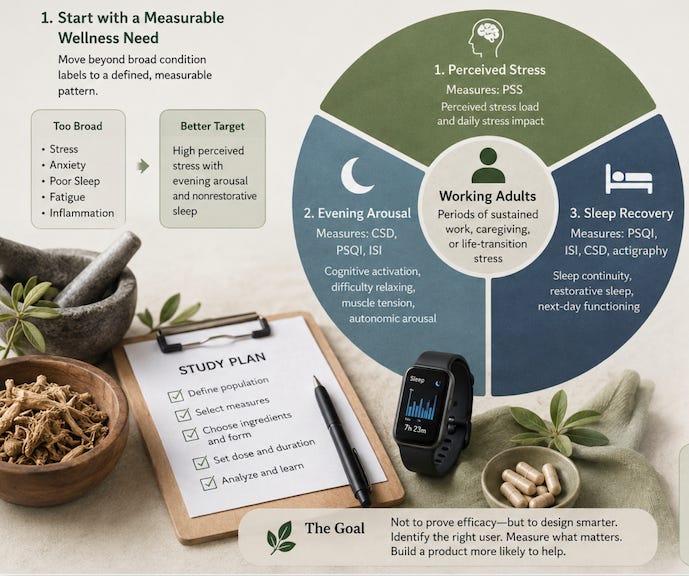
In our program, a first step begins with a measurable wellness need, defining those experiences with enough precision that a product designer can identify the population, measurement tools, ingredients and dosage form with claims that the evidence can support. The same process also serves consumers. A well-defined product gives the consumer a clearer basis for deciding whether their pattern resembles the population and endpoint the product was designed to support.
For example, stress or poor sleep is too broad to focus a product. A more useful design target is high perceived stress with evening arousal and nonrestorative sleep. This does not diagnose anxiety or insomnia. It describes a functional pattern that can be measured using stress and sleep instruments, followed with sleep diaries or actigraphy device, usually a wrist-worn activity/sleep tracker, and translated into conservative structure/function language.
For non-clinician designers, the first consideration is whether the condition exists at the population level in a form specific enough to support product design. Epidemiology can provide evidence since it studies the distribution and determinants of health-related states in populations (BMJ, n.d.). This data may also provide subgroups that differ by age, sex, life stage, occupation, caregiving burden, medication use, or comorbid conditions. A product concept is stronger when it can identify what kind of improvement would be meaningful. Specificity is key.
Beyond epidemiological data, using findings from health care providers is also an excellent way to frame the condition. Depression, anxiety, and sleep disturbance are not single formulation targets. American Psychological Association (APA) depression assessment resource lists instruments such as the Beck Depression Inventory as tools used to screen for depression and measure behavioral manifestations and severity. Centre for Addiction and Mental Health (CAMH) anxiety assessment guidance similarly identifies instruments such as the GAD-7 for common anxiety symptoms and the PHQ-9 for depression-related assessment and monitoring. These instruments show that diagnostic names are composites.
For the stress-sleep example, the relevant dimensions may include perceived stress load, evening rumination, autonomic arousal, difficulty initiating rest, sleep fragmentation, nonrestorative sleep, and next-day fatigue. Some of these may appear in anxiety, depression, insomnia, PTSD, burnout, menopause transition, caregiving strain, shift work, or chronic pain. That overlap is why the product should be designed around a defined wellness need rather than a disease label.
Stress-Related Sleep Disruption
Stress-related sleep disruption is a useful pilot example because it sits close to several disease-adjacent categories without requiring disease language. We can break down the example into three measurable parts with working adults as the target. The first is perceived stress. The second is evening arousal, which may include cognitive activation, difficulty relaxing, muscle tension, or autonomic activation. The third is sleep recovery, meaning the person’s ability to obtain sleep that is sufficiently continuous and restorative to support next-day functioning.
The consumer-facing language can contain appropriate structure/function wording that includes support for relaxation after periods of stress or restful sleep, or healthy stress recovery, or the transition from daytime activation to nighttime rest. The claim should not imply treatment of anxiety, insomnia, depression-related sleep disturbance, PTSD-related sleep disturbance, adrenal dysfunction, or pathological cortisol patterns.
Strategies for how to measure perceived stress include the Perceived Stress Scale (PSS). Cohen, Kamarck, and Mermelstein (1983) developed the PSS as a global measure of perceived stress. A later review found the 10-item version to have stronger psychometric support than the 14-item and 4-item forms (Lee, 2012).
For sleep, the Pittsburgh Sleep Quality Index (PSQI) is a validated self-rated instrument assessing sleep quality and sleep disturbance over a one-month interval (Buysse et al., 1989). The Insomnia Severity Index (ISI) is validated as an outcome measure in insomnia research (Bastien et al., 2001) with the caveat it be used internally, with consumer-facing language avoiding the implication that the product treats insomnia.
A sleep diary is useful for tracking sleep times, perceived quality and next-day restfulness. The Consensus Sleep Diary (CSD) was developed to standardize prospective sleep self-monitoring across research and clinical contexts (Carney et al., 2012). Actigraphy can provide additional data by estimating sleep-wake patterns in real-world settings. The American Academy of Sleep Medicine has issued clinical practice guidance on actigraphy for sleep and circadian rhythm sleep-wake disorder assessment (Smith et al., 2018).
Heart-rate variability (HRV) may contribute when the proposed mechanism involves autonomic recovery, but it should be interpreted cautiously. HRV is associated with stress, but its interpretation depends on measurement method and context (Kim et al., 2018). Cortisol awakening response and diurnal cortisol slope may be relevant to stress physiology, but expert consensus emphasizes issues such as sampling accuracy, participant instruction, covariate control, quantification strategy, and reporting standards as potential areas where the data becomes less useful (Stalder et al., 2016).
At-Home Measurement and Consumer Choice
The same tools that help define a product-development target can also help consumers make more informed choices. A consumer can complete a perceived-stress questionnaire online, keep a sleep diary, track sleep timing with a wrist-worn activity/sleep tracker, and record adherence or adverse effects. These records can help identify a pattern such as high perceived stress, evening activation, fragmented sleep, or poor recovery.
The limit is that individual self-observation cannot prove causation since the data produced suffers from bias leading to skewed insights that do not reflect reality. For consumers, the appropriate use is self-observation and general wellness education, not diagnosis or evidence of efficacy. The consumer-facing tool should also identify conditions that do not belong in self-selection. This might include severe or persistent sleep disturbance, suicidal thinking, suspected sleep apnea, pregnancy, complex medication use, or symptoms suggesting endocrine, psychiatric, or other medical disease.
When Measurement Becomes a Claim
Creating educational linkage between the population level evidence and the consumer needs to be achieved with regulatory concerns front and center. During the design process, claims should be created during formulation with each public claim linked to evidence. The risk is that a questionnaire, sleep diary, wearable sleep tracker, cortisol discussion, or product-selection quiz may begin to identify a wellness pattern but once it becomes part of the purchase pathway, it may also shape the consumer’s understanding of intended use.
The regulatory concern is not just centered on the exact words of the claim. It is the full message the consumer receives. FDA allows structure/function claims for dietary supplements, but those claims cannot suggest that the product diagnoses, treats, cures, or prevents disease. Covered structure/function claims also require FDA notification within 30 days after the product is first marketed (Food and Drug Administration [FDA], 2023b, 2024). FTC similarly evaluates health-product advertising for truthful, non-misleading, scientifically supported claims, including implied claims (Federal Trade Commission [FTC], 2022).
The evidence must match the claim based on population, dose, plant part, extract type, standardization, dosage form, duration, endpoint, and effect size. A study showing reduced perceived stress does not automatically support a sleep-continuity claim. A cortisol change does not automatically support a claim about evening recovery. A trial using a standardized capsule does not support a different dosage form, lower dose, or extract process. FDA’s substantiation guidance frames the issue as the amount, type, and quality of evidence needed to support the claim being made (FDA, 2018).
The company can use more technical language in its internal research than it uses with consumers. Internally, it may produce data on perceived stress, evening arousal, disrupted sleep, heart-rate variability, cortisol patterns, or validated sleep scores. Using that data publicly on the label will approach a claim to treat and diagnose.
A product website can function as claim, the same as if part of the physical package. The FD&C Act defines labeling as labels and other written, printed, or graphic matter on or accompanying a product (Federal Food, Drug, and Cosmetic Act, 21 U.S.C. § 321[k], [m]). FDA guidance states that context from the label and other labeling can determine whether a statement is a disease claim, and FDA warning letters show that website and social media claims may be used as evidence of intended disease use when tied to products being sold (FDA, 2002, 2022, 2023a).
Internal Data When Clinical Trials Are Not Feasible
A small herbal product company may not be able to run a randomized clinical trial during early development cycle. It can still generate internal data that improves design decisions. The goal is not to prove efficacy, but to use early clinical data to guide product-development decisions, including plant selection, extraction method, dosage form, and dosing strategy. When paired with analytical testing, existing peer-reviewed evidence, and traditional knowledge, this work creates the groundwork for a product that is more likely to be effective while keeping claims within the evidence.
For stress-related sleep disruption, this could begin with a generating baseline data. Participants would track perceived stress, evening activation, sleep timing, awakenings, next-day restfulness, caffeine and alcohol timing, adherence, and adverse effects for one to two weeks before product use. The same measures would continue during a 2–8-week product-use phase. A wrist-worn activity/sleep tracker may add sleep-timing and continuity trends, but those data should remain supportive rather than diagnostic.
This type of pilot can clarify the appropriate subset population. And it can answer several questions, including are the selective measures useful? Is the dose and dosage form tolerated? Is adherence realistic? Is the signal strong enough to justify more testing?
Published examples support this lower-cost strategy. Seely and Singh used an open-label longitudinal study of OCTA, an eight-herb natural health product, to examine changes in perceived stress without presenting the design as a definitive placebo-controlled efficacy trial (Seely & Singh, 2007). A registered Sleep Well Observation Study uses a single-arm, open-label, prospective observational pilot design for a dietary supplement, illustrating how outcome tracking can be studied before a controlled trial (ClinicalTrials.gov, 2023). In sleep-measurement research, Hassinger et al. (2024) compared manual sleep logs with a commercial wearable device, showing how self-report and wearable data can be combined in real-world monitoring without treating wearable output as diagnostic.
Ashwagandha is useful as the concrete example because the published trials provide a defined ingredient, dose, duration, population, and endpoint structure. The trials used 300 mg twice daily for 60 days or eight weeks in adults under stress and measured perceived stress and serum cortisol, among other endpoints (Chandrasekhar et al., 2012; Choudhary et al., 2017). An internal ashwagandha program should match that evidence as closely as possible: plant part, extract type, standardization, dose, duration, and stress endpoint. Those data may support a carefully worded occasional-stress rationale when the marketed product is sufficiently similar to the studied preparation. They do not automatically support a sleep-continuity claim, a different extract, a lower-dose blend, or a different dosage form.
Conclusion
I’m not proposing turning wellness into diagnosis. Rather to make herbal product design more precise. A formula designed for “stress” can drift toward broad claims and unfocused herb selection. A formula designed for high perceived stress with evening arousal and nonrestorative sleep can be tied to a defined user, measurable endpoints, analytical testing, existing evidence, and clearer claim language. That does not prove efficacy, but it gives the company a stronger design rationale and gives consumers a better basis for deciding whether the product fits their pattern. The result is a product-development process that is more likely to produce meaningful benefit while staying within the evidence.
References
American Psychological Association. (n.d.). Depression assessment instruments. https://www.apa.org/depression-guideline/assessment
Bastien, C. H., Vallières, A., & Morin, C. M. (2001). Validation of the Insomnia Severity Index as an outcome measure for insomnia research. Sleep Medicine, 2(4), 297–307. https://doi.org/10.1016/S1389-9457(00)00065-4
BMJ. (n.d.). Chapter 1: What is epidemiology? https://www.bmj.com/about-bmj/resources-readers/publications/epidemiology-uninitiated/1-what-epidemiology
Buysse, D. J., Reynolds, C. F., III, Monk, T. H., Berman, S. R., & Kupfer, D. J. (1989). The Pittsburgh Sleep Quality Index: A new instrument for psychiatric practice and research. Psychiatry Research, 28(2), 193–213. https://doi.org/10.1016/0165-1781(89)90047-4
Carney, C. E., Buysse, D. J., Ancoli-Israel, S., Edinger, J. D., Krystal, A. D., Lichstein, K. L., & Morin, C. M. (2012). The Consensus Sleep Diary: Standardizing prospective sleep self-monitoring. Sleep, 35(2), 287–302. https://doi.org/10.5665/sleep.1642
Centre for Addiction and Mental Health. (n.d.). Anxiety: Screening and assessment. https://www.camh.ca/en/professionals/treating-conditions-and-disorders/anxiety-disorders/anxiety---screening-and-assessment
Chandrasekhar, K., Kapoor, J., & Anishetty, S. (2012). A prospective, randomized double-blind, placebo-controlled study of safety and efficacy of a high-concentration full-spectrum extract of ashwagandha root in reducing stress and anxiety in adults. Indian Journal of Psychological Medicine, 34(3), 255–262. https://doi.org/10.4103/0253-7176.106022
Choudhary, D., Bhattacharyya, S., & Joshi, K. (2017). Body weight management in adults under chronic stress through treatment with ashwagandha root extract: A double-blind, randomized, placebo-controlled trial. Journal of Evidence-Based Complementary & Alternative Medicine, 22(1), 96–106. https://doi.org/10.1177/2156587216641830
ClinicalTrials.gov. (2023). Sleep Well Observation Study (NCT05748574). U.S. National Library of Medicine. https://clinicaltrials.gov/study/NCT05748574
Cohen, S., Kamarck, T., & Mermelstein, R. (1983). A global measure of perceived stress. Journal of Health and Social Behavior, 24(4), 385–396. https://doi.org/10.2307/2136404
Federal Food, Drug, and Cosmetic Act, 21 U.S.C. § 321(k), (m).
Federal Trade Commission. (2022, December 20). Health products compliance guidance. https://www.ftc.gov/business-guidance/resources/health-products-compliance-guidance
Food and Drug Administration. (2002, January 9). Small entity compliance guide on structure/function claims. https://www.fda.gov/regulatory-information/search-fda-guidance-documents/small-entity-compliance-guide-structurefunction-claims
Food and Drug Administration. (2018, September 20). Guidance for industry: Substantiation for dietary supplement claims made under section 403(r)(6) of the Federal Food, Drug, and Cosmetic Act. https://www.fda.gov/regulatory-information/search-fda-guidance-documents/guidance-industry-substantiation-dietary-supplement-claims-made-under-section-403r-6-federal-food
Food and Drug Administration. (2022, June 8). New Sun Inc., warning letter, MARCS-CMS 626254. https://www.fda.gov/inspections-compliance-enforcement-and-criminal-investigations/warning-letters/new-sun-inc-626254-06082022
Food and Drug Administration. (2023a, April 27). EarthLab, Inc., dba Wise Woman Herbals, warning letter, MARCS-CMS 634872. https://www.fda.gov/inspections-compliance-enforcement-and-criminal-investigations/warning-letters/earthlab-inc-dba-wise-woman-herbals-634872-04272023
Food and Drug Administration. (2023b, February 9). Notifications for structure/function and related claims in dietary supplement labeling. https://www.fda.gov/food/information-industry-dietary-supplements/notifications-structurefunction-and-related-claims-dietary-supplement-labeling
Food and Drug Administration. (2024, March 28). Structure/function claims. https://www.fda.gov/food/nutrition-food-labeling-and-critical-foods/structurefunction-claims
Hassinger, A. B., Kwon, M., Wang, J., Mishra, A., & Wilding, G. E. (2024). Pilot study comparing sleep logs to a commercial wearable device in describing the sleep patterns of physicians-in-training. PLOS ONE, 19(7), Article e0305881. https://doi.org/10.1371/journal.pone.0305881
Kim, H.-G., Cheon, E.-J., Bai, D.-S., Lee, Y. H., & Koo, B.-H. (2018). Stress and heart rate variability: A meta-analysis and review of the literature. Psychiatry Investigation, 15(3), 235–245. https://doi.org/10.30773/pi.2017.08.17
Lee, E.-H. (2012). Review of the psychometric evidence of the Perceived Stress Scale. Asian Nursing Research, 6(4), 121–127. https://doi.org/10.1016/j.anr.2012.08.004
Smith, M. T., McCrae, C. S., Cheung, J., Martin, J. L., Harrod, C. G., Heald, J. L., & Carden, K. A. (2018). Use of actigraphy for the evaluation of sleep disorders and circadian rhythm sleep-wake disorders: An American Academy of Sleep Medicine clinical practice guideline. Journal of Clinical Sleep Medicine, 14(7), 1231–1237. https://doi.org/10.5664/jcsm.7230
Seely, D., & Singh, R. (2007). Adaptogenic potential of a polyherbal natural health product: Report on a longitudinal clinical trial. Evidence-Based Complementary and Alternative Medicine, 4(3), 375–380. https://doi.org/10.1093/ecam/nel101
Stalder, T., Kirschbaum, C., Kudielka, B. M., Adam, E. K., Pruessner, J. C., Wüst, S., Dockray, S., Smyth, N., Evans, P., Hellhammer, D. H., Miller, R., Wetherell, M. A., Lupien, S. J., & Clow, A. (2016). Assessment of the cortisol awakening response: Expert consensus guidelines. Psychoneuroendocrinology, 63, 414–432. https://doi.org/10.1016/j.psyneuen.2015.10.010