

Writing is essential to my work and personal experience of the world as both poet and scientist. My own linguistic history had me understanding English from the beginning but choosing to speak Thai, Cantonese, German before using English. This pattern was based on the language I spent the greatest time near. My parents were entertaining a great deal, with my father’s work as a cultural affairs officer in the foreign service, so the folks looking after us were native speakers. My own personal evolution as a user of language has been both a struggle and a gift.
If we take it a step further and generalize, planetary dispersal of humans can be traced via the diversification of language. How do researchers know the approximate age of words? If they trace common words back to a point of common origin, they can predict when the word first appeared in a human language. Common ancestry is used to designate language families. The individual words with common ancestry then are cognates.
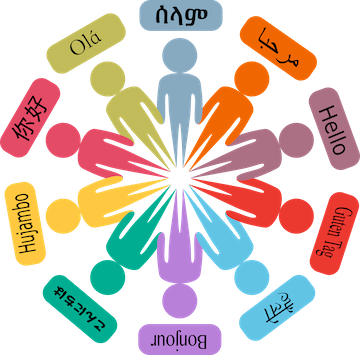
Father (English), padre (Italian), pere (French), pater (Latin) and pitar (Sanskrit) are cognates. They share a common ancestry within the Indo-European, spoken by 46% of the world’s population, including languages such as English, Spanish, Russian, and Hindi/Urdu. Other language families included Inuit-Yupik (Arctic languages); Chukchi-Kamchatkan (languages of far northeastern Siberia); Altaic (modern Turkish, Uzbek and Mongolian); Dravidian (languages of south India); Kartvelian (Georgian) and Uralic (Finnish and Hungarian).
It makes sense a word as important as father would be highly conserved within a language family. Researchers probed which words were more likely to be conserved across several language families. They found 23 ultra conserved words that are cognates in four or more language families. Lead researcher, Mark Pagel of Reading University: “I was really delighted to see to give there,” Pagel said. But the research team was surprised by the presence of bark as a conserved word.
“I have spoken to some anthropologists about that, and they say that bark played a very significant role in the lives of forest-dwelling hunter-gatherers,” Pagel said. Human technology involved using plants for everything from storage utensils, rope, fuel and medicine.
Among other ultra-conserved words, they found mother, not, what, to hear and man. Each is an idea in sound, which are expected because of their base importance in various cultures/peoples. However, why to flow, ashes and worm? What does it tell us about our unconscious awareness of the fragility human life?