

This and following posts will be serialized from a longer piece of writing. The focus will be broken up into sections:
Root Border Cells and Mycorrhizal Communities
Endophytic Transition States
Secondary Metabolites as System Equilibrium
Carbon Allocation Governs Chemical Expression
Signal Convergence
Wild Ecosystems
Ratio Control as Emergent
Finding Terroir
Root Border Cells
Root border cells are living, terminally differentiated cells produced by the root cap and released into the rhizosphere as single cells, sheets, or aggregates depending on species and developmental context. They are developmentally programmed rather than passively shed and retain secretory capacity after release, forming a dynamic chemical boundary between the root meristem and surrounding soil (Hawes et al., 1998). Their detachment patterns, mucilage composition, and secretory profiles vary across taxa and environmental conditions, indicating regulated production rather than fixed structure (Omelyanchuk et al., 2024; Kranawetter & Sumner, 2025).
Experimental evidence shows that border-cell production responds to chemical context. In pea (Pisum sativum), exposure to the phytoalexin pisatin increased border-cell number, whereas ferulic acid reduced production, indicating that plants adjust allocation to this boundary zone in response to defense state and cell wall–associated signals (Curlango-Rivera et al., 2010).
Integrated metabolomic and transcriptomic analyses in Medicago truncatula demonstrate that border cells are enriched in specialized metabolites, including flavonoids and triterpenoid saponins, alongside reduced primary metabolic activity, indicating functional specialization toward signaling and defense (Watson et al., 2015). These cells secrete mixtures of carbohydrates, proteins, amino acids, organic acids, extracellular DNA, and secondary metabolites into mucilage, shaping microbial attachment and growth in the immediate vicinity of the root tip. Because the rhizosphere is typically carbon-limited, these exudates act as localized resource inputs that alter competition, favor taxa capable of utilizing specific substrates, and impose antimicrobial constraints that structure community composition near the root apex (Hawes et al., 1998; Omelyanchuk et al., 2024; Fortier et al., 2023).
The concept of a root extracellular trap integrates border cells and mucilage into a coordinated defensive structure combining physical entrapment with chemical and nucleic acid–mediated activity. A synthesiss of the plant extracellular trap supports an active defensive role for border cells and mucilage in microbial capture, signaling, and localized defense responses, although the degree of selectivity is not yet quantified across systems (Driouich et al., 2019; Fortier et al., 2023). In Pinus densiflora, bacteria captured within this matrix induced reactive oxygen species responses in adjacent cap-derived cells, indicating that this structure functions as a selective filter rather than a passive barrier (Shirakawa et al., 2023). Root cap–derived extracellular structures capture microbes and influence local microbial behavior and defense responses, indicating an active role in modulating microbial interactions (Shirakawa et al., 2023; Driouich et al., 2019).
Microbial interactions in this zone are bidirectional. Microbes modify local chemical conditions, while plant-derived metabolites such as flavonoids and isoflavonoids function as both antimicrobial agents and symbiotic signals. In Medicago truncatula, mycorrhizal establishment is associated with shifts in isoflavonoid accumulation and defense-related gene expression, supporting a role for phenylpropanoid-derived metabolites in mediating symbiotic interactions (Harrison & Dixon, 1993). However, whether these signaling dynamics originate specifically from border-cell secretion or broader root tissues remains unresolved and requires spatially resolved analysis (Kranawetter & Sumner, 2025).
Mycorrhizal Communities
Arbuscular mycorrhizal fungi (AMF) and plants have maintained mutualistic associations for more than 400 million years, with the fungus receiving host-derived carbon and the plant gaining improved access to phosphorus and other limiting nutrients (Smith & Smith, 2011). This exchange is regulated rather than passive. Depending on species and environment, AMF can draw an estimated 4–20% of plant-fixed carbon, and the host adjusts carbon flow in relation to nutrient return. Because secondary metabolism draws on the same carbon pool, mycorrhizal nutrient exchange can shift how resources are partitioned between growth and specialized metabolite production (Smith & Smith, 2011). AMF symbiosis alters host carbon allocation, hormone signaling, and gene expression linked to secondary metabolism, although integrated causal models connecting these processes remain incomplete (Luginbuehl et al., 2017; Pozo et al., 2020; Genre et al., 2020).
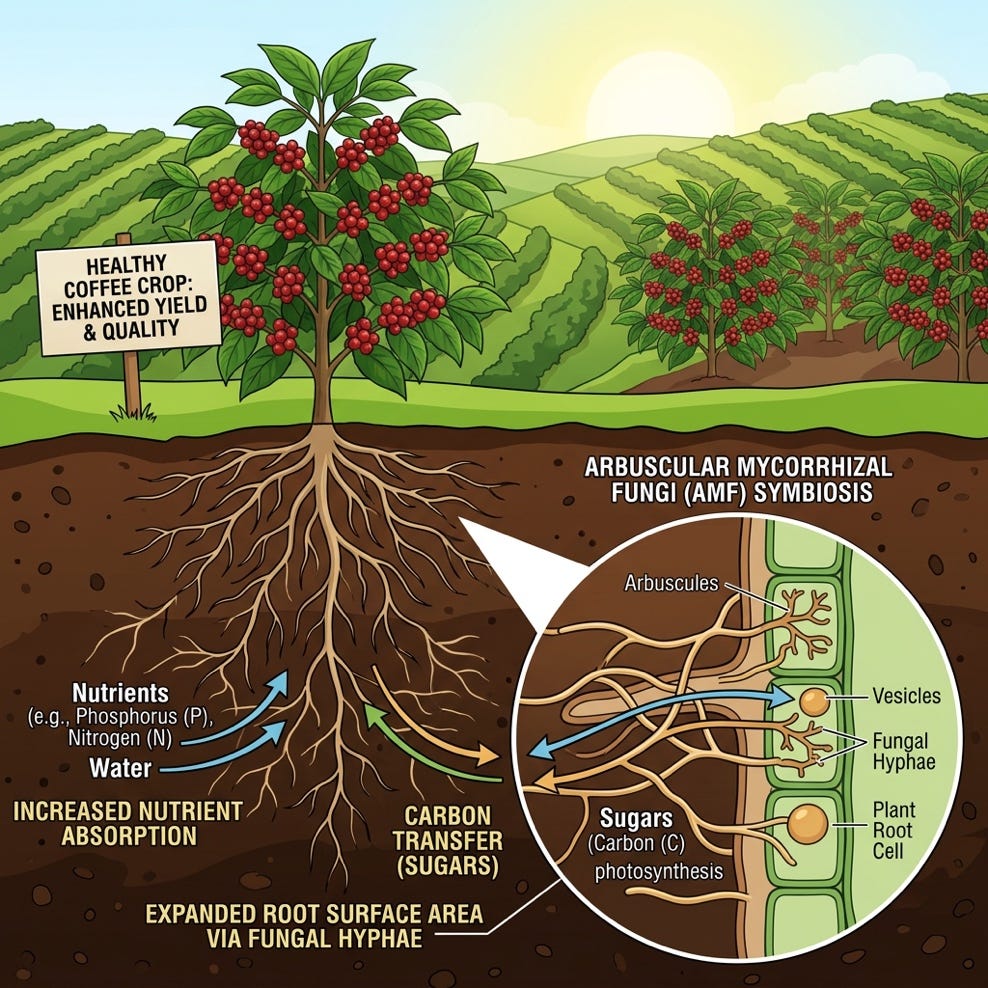
This exchange is conditional rather than uniformly cooperative. Experimental evidence shows that plants preferentially allocate carbon to more cooperative fungal partners while restricting allocation to less efficient ones, indicating that resource flow is adjusted based on nutrient return rather than fixed symbiotic benefit (Kiers et al., 2011). Fungal nutrient transfer responds to plant carbon supply, creating a bidirectional feedback system in which both partners regulate exchange rates (Fellbaum et al., 2014). At the system level, these interactions can maintain nutrient limitation rather than fully alleviate it, reinforcing constrained resource conditions under which plant metabolic processes operate (Franklin et al., 2014).
Carbon transfer to AMF is not limited to simple sugars. In Medicago truncatula, host-derived lipids were shown to contribute directly to the fungal carbon supply, indicating that mycorrhizal carbon allocation includes complex metabolites derived from central metabolism (Luginbuehl et al., 2017). This broadens the metabolic consequences of symbiosis.
Several plant systems show that AMF association is accompanied by altered secondary metabolism. In Artemisia annua, co-inoculation with Glomus mosseae and Bacillus subtilis increased biomass and artemisinin content (Awasthi et al., 2011), while a separate study showed that AMF increased artemisinin accumulation together with jasmonate levels and expression of biosynthetic genes (Mandal et al., 2015). In grapevine, AMF colonization was associated with changes in secondary metabolism, including increased phenolic content (Balestrini et al., 2010). In Salvia miltiorrhiza, arbuscular mycorrhizal colonization increases biomass and accumulation of phenolic acids and diterpenoid compounds (Zhang et al., 2015).
In Hypericum perforatum, AMF did not produce a uniform increase across compounds but shifted relative proportions under different phosphorus regimes. In contrast to systems showing absolute increases, under low phosphorus, hypericin and pseudohypericin increased while hyperforin showed a comparatively smaller increase or relative decrease, indicating a redistribution of flux toward naphthodianthrones rather than phloroglucinols. Under higher phosphorus, these differences were reduced, showing that AMF-driven effects operate through nutrient-dependent partitioning rather than absolute upregulation (Lazzara et al., 2017).
Research reviews support components of this model, including carbon transfer from host to fungus, signaling overlap between AM symbiosis and plant immunity, and effects of AM colonization on secondary metabolite accumulation, while noting that integrated causal models linking all three remain incomplete (Genre et al., 2020; Pozo et al., 2020; Zhao et al., 2022; Battini et al., 2021). Carbon reallocation, signaling, and precursor competition operate as a coupled control system rather than independent effects. Under low phosphorus, increased carbon flux to arbuscular mycorrhizal fungi reduces the pool of assimilated carbon and energy available to the plant, tightening constraints on ATP- and NADPH-dependent biosynthesis. This shifts pathway competition, favoring branches with lower energetic or reductive cost or those prioritized by stress-associated signaling.
Concurrently, AMF-associated modulation of jasmonate and related pathways biases transcriptional control toward specific secondary metabolic branches, amplifying selective flux rather than total output. Because many secondary metabolites derive from shared intermediates such as acetyl-CoA and malonyl-CoA, these constraints force redistribution across competing pathways, producing reciprocal changes in compound classes. When phosphorus availability rises, carbon demand from the symbiosis decreases and cellular energy status improves, reducing competition for precursors and cofactors and attenuating stress-linked signaling biases (Smith & Smith, 2011; Luginbuehl et al., 2017; Wasternack & Hause, 2013; Weng et al., 2012).
In Ocimum tenuiflorum, metabolomic profiling of AMF inoculated plants showed a directional shift in carbon allocation characterized by increased accumulation of phenylpropanoids, flavonoids, and terpenoid compounds, with relative reduction in primary metabolites such as sugars and amino acids. The effect is best described as a reallocation of carbon from growth-associated metabolism toward secondary metabolic pathways, rather than selective amplification of a single compound class (Thokchom et al., 2023).
Additional studies confirm that AMF can alter terpene composition and other secondary metabolite classes, but the enzymatic basis of these shifts usually remains unresolved unless pathway expression is measured directly (Copetta et al., 2006; Battini et al., 2021; Zhao et al., 2022). AMF-associated shifts in O. basilicum are consistent with preferential flux through plastidial monoterpene pathways toward linalool, with concurrent increases in other oxygenated monoterpenes such as 1,8-cineole (eucalyptol) and terpinen-4-ol, while compounds such as eugenol, methyl chavicol (estragole), and certain sesquiterpenes show comparatively smaller increases or relative dilution. This pattern indicates that AMF influence extends beyond precursor supply to selective enhancement of terpene synthase and downstream oxidative enzyme activity, biasing product distribution toward specific oxygenated monoterpene structures rather than uniformly increasing total terpene output/
In Alkanna tinctoria, AMF altered not only total alkannin/shikonin content but the internal distribution of individual derivatives, producing measurable shifts in the ratios among acetylated, deoxy-, and parent hydroxylated forms rather than parallel increases across the pathway. Specifically, AMF colonization was associated with a relative increase in acetylated derivatives (e.g., acetylalkannin/shikonin) and certain deoxy forms, while the proportion of non-acylated parent compounds showed comparatively smaller increases, indicating redistribution of flux toward downstream modification steps.
These ratio shifts were contingent on cultivation conditions. Under nutrient-limited or stress-associated conditions, AMF effects favored accumulation of more lipophilic, modified derivatives (acetylated and deoxy forms), consistent with enhanced activity of acyltransferases and reductive tailoring enzymes, whereas under more nutrient-replete conditions, the differential among derivatives was reduced and profiles were more balanced. The observed derivative shifts are consistent with altered downstream modification steps under AMF colonization, but direct evidence for the responsible acyltransferases or reductive enzymes has not yet been established in this system (Zhao et al., 2023; Zhao et al., 2022).
Shifts toward more lipophilic derivatives such as acetylalkannin and acetylshikonin exhibit enhanced antimicrobial activity, likely due to improved membrane interaction and redox cycling capacity, strengthening defense against soil-borne pathogens (Brigham et al., 1999; Tatsumi et al., 2016). It also promotes retention within root tissues and the rhizoplane, maintaining higher local concentrations where biotic pressure is greatest (Yazaki, 2017). In parallel, quinone derivatives contribute to oxidative stress buffering through redox-active mechanisms, supporting cellular stability under nutrient limitation or environmental stress (Papageorgiou et al., 2008). These properties align with observations that flux is preferentially directed toward downstream modified products under constraint, suggesting that redistribution of pathway output enhances both defensive efficacy and metabolic efficiency, even though the underlying enzymatic controls remain unresolved (Sasaki et al., 2008).
References
Awasthi, A., Bharti, N., Nair, P., Singh, R., Shukla, A. K., Gupta, M. M., Darokar, M. P., & Kalra, A. (2011). Synergistic effect of Glomus mosseae and nitrogen-fixing Bacillus subtilis strain Daz26 on artemisinin content in Artemisia annua L. Applied Soil Ecology, 49, 125–130. https://doi.org/10.1016/j.apsoil.2011.06.005
Balestrini, R., Magurno, F., Walker, C., Lumini, E., & Bianciotto, V. (2010). Cohabitation of Glomus intraradices and Gigaspora margarita in grapevine roots: Effects on plant growth and secondary metabolism. Mycorrhiza, 20(6), 435–445. https://doi.org/10.1007/s00572-010-0304-8
Battini, F., Turrini, A., Sbrana, C., Giovannetti, M., & Agnolucci, M. (2021). Arbuscular mycorrhizal fungi and plant secondary metabolite production: A meta-analysis. Plants, 10(9), 1872. https://doi.org/10.3390/plants10091872
Brigham, L. A., Michaels, P. J., & Flores, H. E. (1999). Cell-specific production and antimicrobial activity of naphthoquinones in Lithospermum erythrorhizon. Plant Physiology, 119(2), 417–428. https://doi.org/10.1104/pp.119.2.417
Copetta, A., Lingua, G., & Berta, G. (2006). Effects of three arbuscular mycorrhizal fungi on growth, distribution of glandular hairs, and essential oil production in Ocimum basilicum L. Mycorrhiza, 16(7), 485–494. https://doi.org/10.1007/s00572-006-0062-8
Curlango-Rivera, G., Duclos, D. V., Clay, N. K., & Hawes, M. C. (2010). Root border cells protect root tips from pathogens and toxic metals. Plant and Soil, 336, 5–17. https://doi.org/10.1007/s11104-010-0291-8
Driouich, A., Follet-Gueye, M.-L., Vicré-Gibouin, M., & Hawes, M. (2019). The plant extracellular trap: A defensive structure. Plant Physiology and Biochemistry, 135, 147–156. https://doi.org/10.1016/j.plaphy.2019.03.001
Fellbaum, C. R., Mensah, J. A., Cloos, A. J., Strahan, G. E., Pfeffer, P. E., Kiers, E. T., & Bücking, H. (2014). Fungal nutrient allocation in common mycorrhizal networks is regulated by the carbon supply from plants. New Phytologist, 203(2), 646–656. https://doi.org/10.1111/nph.12827
Fortier, M., Lemaitre, V., Gaudry, A., Pawlak, B., Driouich, A., & Follet-Gueye, M.-L. (2023). A fine-tuned defense at the pea root caps: Involvement of border cells and arabinogalactan proteins against soilborne diseases. Frontiers in Plant Science, 14, 1132132. https://doi.org/10.3389/fpls.2023.1132132
Franklin, O., Näsholm, T., Högberg, P., & Högberg, M. N. (2014). Forests trapped in nitrogen limitation—An ecological market perspective on ectomycorrhizal symbiosis. New Phytologist. https://doi.org/10.1111/nph.12840
Genre, A., Chabaud, M., Balzergue, C., Puech-Pagès, V., Novero, M., Rey, T., Fournier, J., Rochange, S., & Bécard, G. (2020). Short-chain chitin oligomers from arbuscular mycorrhizal fungi trigger nuclear Ca²⁺ spiking in Medicago truncatula roots. Nature Reviews Microbiology, 18(10), 575–590. https://doi.org/10.1038/s41579-020-0390-2
Harrison, M. J., & Dixon, R. A. (1993). Isoflavonoid accumulation and expression of defense gene transcripts during the establishment of vesicular-arbuscular mycorrhizal associations in roots of Medicago truncatula. Molecular Plant-Microbe Interactions, 6, 643–654. https://doi.org/10.1094/MPMI-6-643
Hawes, M. C., Brigham, L. A., Wen, F., Woo, H. H., & Zhu, Y. (1998). Function of root border cells in plant health: Pioneers in the rhizosphere. Annual Review of Phytopathology, 36, 311–327. https://doi.org/10.1146/annurev.phyto.36.1.311
Kiers, E. T., Duhamel, M., Beesetty, Y., Mensah, J. A., Franken, O., Verbruggen, E., Fellbaum, C. R., Kowalchuk, G. A., Hart, M. M., Bago, A., Palmer, T. M., West, S. A., Vandenkoornhuyse, P., Jansa, J., & Bücking, H. (2011). Reciprocal rewards stabilize cooperation in the mycorrhizal symbiosis. Science, 333(6044), 880–882. https://doi.org/10.1126/science.1208473
Kranawetter, C., & Sumner, L. W. (2025). Differential root zone secretions and the role of root border cells in rhizosphere manipulation. Phytochemistry Reviews, 24(6), 5639–5658. https://doi.org/10.1007/s11101-025-10084-y
Lazzara, S., Militello, M., Carrubba, A., Napoli, E., & Saia, S. (2017). Arbuscular mycorrhizal fungi influence secondary metabolite content in Hypericum perforatum under different phosphorus conditions. Mycorrhiza, 27(4), 345–354. https://doi.org/10.1007/s00572-016-0756-6
Luginbuehl, L. H., Menard, G. N., Kurup, S., Van Erp, H., Radhakrishnan, G. V., Breakspear, A., Oldroyd, G. E. D., & Eastmond, P. J. (2017). Fatty acids in arbuscular mycorrhizal fungi are synthesized by the host plant. Science, 356(6343), 1175–1178. https://doi.org/10.1126/science.aan0081
Mandal, S., Upadhyay, S., Wajid, S., Ram, M., Jain, D. C., Singh, V. P., Abdin, M. Z., & Kapoor, R. (2015). Arbuscular mycorrhiza increase artemisinin accumulation in Artemisia annua by higher expression of key biosynthesis genes via enhanced jasmonic acid levels. Mycorrhiza, 25(5), 345–357. https://doi.org/10.1007/s00572-014-0614-3
Omelyanchuk, N. A., Cherenko, V. A., & Zemlyanskaya, E. V. (2024). Root cap border cells as regulators of rhizosphere microbiota. Vavilovskii Zhurnal Genetiki i Selektsii, 28(8), 918–926. https://doi.org/10.18699/vjgb-24-99
Papageorgiou, V. P., Assimopoulou, A. N., & Ballis, A. C. (2008). Alkannins and shikonins: A new class of wound healing agents. Current Medicinal Chemistry, 15(30), 3248–3267. https://doi.org/10.2174/092986708786848523
Pozo, M. J., López-Ráez, J. A., Azcón-Aguilar, C., & García-Garrido, J. M. (2020). AM symbiosis and plant immune signalling. New Phytologist, 228(1), 10–15. https://doi.org/10.1111/nph.16304
Sasaki, K., et al. (2008). Metabolic engineering of shikonin pathway and derivative formation. Plant Biotechnology, 25(2), 123–129. https://doi.org/10.5511/plantbiotechnology.25.123
Smith, S. E., & Smith, F. A. (2011). Roles of arbuscular mycorrhizas in plant nutrition and growth: New paradigms from cellular to ecosystem scales. Annual Review of Plant Biology, 62, 227–250. https://doi.org/10.1146/annurev-arplant-042110-103846
Shirakawa, M., Matsushita, N., & Fukuda, K. (2023). Visualization of root extracellular traps in an ectomycorrhizal woody plant (Pinus densiflora) and their interactions with root-associated bacteria. Planta, 258(6), 112. https://doi.org/10.1007/s00425-023-04274-1
Tatsumi, K., et al. (2016). Lipophilicity-dependent antimicrobial activity of shikonin derivatives. Journal of Natural Medicines, 70(3), 579–585. https://doi.org/10.1007/s11418-016-0985-2
Thokchom, S. D., Gupta, S., Mewar, S. K., Kumar, P., Kalra, C., & Kapoor, R. (2023). Metabolome profiling of arbuscular mycorrhizal fungus treated Ocimum tenuiflorum L. provides insights into deviation in allocation of carbon compounds to secondary metabolism. Plant Physiology and Biochemistry, 203, 108039. https://doi.org/10.1016/j.plaphy.2023.108039
Wasternack, C., & Hause, B. (2013). Jasmonates: Biosynthesis, perception, signal transduction and action in plant stress response, growth and development. Annals of Botany, 111(6), 1021–1058. https://doi.org/10.1093/aob/mct067
Watson, B. S., Bedair, M. F., Urbanczyk-Wochniak, E., Huhman, D. V., Yang, D. S., Allen, S. N., Li, W., Tang, Y., & Sumner, L. W. (2015). Integrated metabolomics and transcriptomics reveal enhanced specialized metabolism in Medicago truncatula root border cells. Plant Physiology, 167(4), 1699–1716. https://doi.org/10.1104/pp.114.253054
Weng, J.-K., Philippe, R. N., & Noel, J. P. (2012). The rise of chemodiversity in plants. Science, 336(6089), 1667–1670. https://doi.org/10.1126/science.1217411
Yazaki, K. (2017). Transporters of secondary metabolites. Current Opinion in Plant Biology, 39, 8–15. https://doi.org/10.1016/j.pbi.2017.04.016
Zhang, Y., Li, X., Wang, Z., & Liu, Y. (2015). Effects of arbuscular mycorrhizal fungi on growth and secondary metabolites of Salvia miltiorrhiza. Industrial Crops and Products, 69, 68–73. https://doi.org/10.1016/j.indcrop.2015.02.018
Zhao, Y., Cartabia, A., Garcés-Ruiz, M., Herent, M.-F., Quetin-Leclercq, J., Ortiz, S., Declerck, S., & Lalaymia, I. (2023). Arbuscular mycorrhizal fungi impact the production of alkannin/shikonin and their derivatives in Alkanna tinctoria Tausch grown in semi-hydroponic and pot cultivation systems. Frontiers in Microbiology, 14, 1216029. https://doi.org/10.3389/fmicb.2023.1216029
Zhao, Y., Cartabia, A., Lalaymia, I., Declerck, S., & De Jaeger, N. (2022). Arbuscular mycorrhizal fungi and production of secondary metabolites in medicinal plants. Mycorrhiza, 32, 221–256. https://doi.org/10.1007/s00572-022-01079-0