

This and following posts will be serialized from a longer piece of writing. The focus will be broken up into sections:
Plant Root System
Secondary Metabolite Distribution Along Root Axis
Root Border Cells
Mycorrhizal Communities
Endophytic Transition
Secondary Metabolites Indicate System Equilibrium
Carbon Allocation Governs Chemical Expression
Signal Convergence
Wild Ecosystems
Ratio Control as Emergent
Finding Terroir
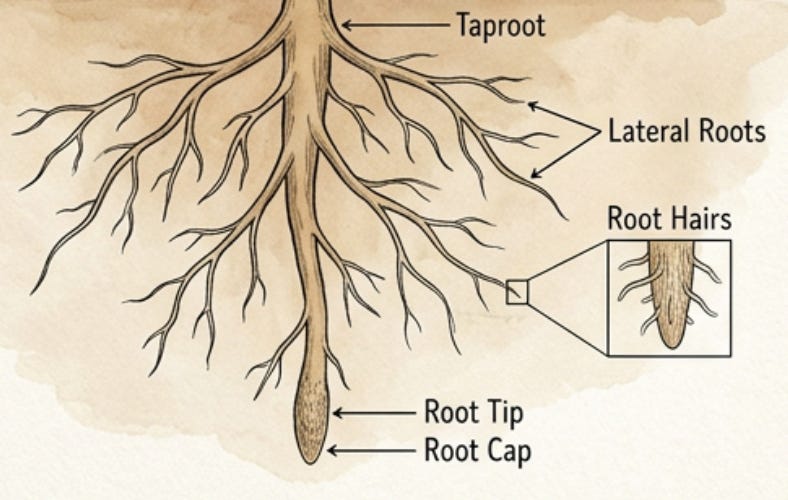
Plant root systems are composed of functionally distinct zones, including the meristematic region, elongation zone, maturation zone, and specialized structures such as root hairs and lateral roots, as well as root border cells. These zones differ in permeability, metabolic activity, and exudation profiles. Root tips and elongation zones tend to release higher concentrations of low–molecular weight compounds, including sugars, amino acids, and organic acids, while older regions may exude more complex or structurally modified metabolites, such as phenolic compounds, lignin. terpenoids, alkaloids, saponins, strigolactones, benzoxazinoids and glucosinolates (Badri & Vivanco, 2009; Bais et al., 2006; Hassan & Mathesius, 2012; Bouwmeester et al., 2007). These spatial differences create gradients in chemical availability that structure microbial colonization patterns along the root axis.
Although the focus will be on medicinally active compound, the paper will address compounds that structure microbial recruitment through substrate preference and signaling interactions, as demonstrated in experimental plant systems linking exudate chemistry to microbial assembly. Studies integrating metabolomics and microbial profiling shows that root exudate composition correlates with microbial substrate utilization and community assembly, with specific compounds selecting for taxa capable of metabolizing them (Zhalnina et al., 2018; Nuccio et al., 2020; Shi et al., 2015).
Symbionts are recruited by plant roots through chemically structured exudates released across spatial gradients and over time, reflecting regulated responses to environmental and developmental conditions (Badri & Vivanco, 2009; Sasse et al., 2018; Zhalnina et al., 2018). High-resolution studies using imaging and sequencing approaches show that bacterial and fungal populations are not evenly distributed along roots. Instead, distinct assemblages occupy the rhizoplane, the immediate root surface, and the surrounding rhizosphere soil, with further differentiation occurring along developmental zones of the root (Edwards et al., 2015). The implication is that microbial exposure to plant-derived signals varies in both intensity and composition depending on location. Root tips and hairs, which increase surface area and interface with soil particles, represent zones of intensified interaction.
Root exudates do not leak indiscriminately into soil as metabolic waste. They differentially reward, deter, or redirect microbial colonists by acting as one route by which plant metabolism may be modulated through microbiome-mediated feedback rather than as a directly demonstrated control point in most systems (Canarini et al., 2019; Yuan et al., 2021). The root–soil interface is not merely the site where secondary metabolism is expressed. It potentially functions as a control surface through which that metabolism is tuned (Hassan & Mathesius, 2012; Zhalnina et al., 2018). Rather than a simple form of passive carbon loss (Badri & Vivanco, 2009; Sasse et al., 2018) acting as selective drivers of microbial colonization by shaping resource availability and chemical signaling in the root–soil interface (Canarini et al., 2019; Oburger & Jones, 2018).
In maize, specific exudate metabolites were shown to shape microbial community structure, which in turn altered plant growth and defense phenotypes, linking exudate chemistry to downstream physiological responses (Hu et al., 2018). Broader analyses similarly report that shifts in microbial communities co-occur with changes in plant metabolic and signaling states, supporting a coupled system rather than independent processes (Jamil et al., 2022; Kudjordjie et al., 2019).
Controlled gnotobiotic and soil-based studies on Arabidopsis thaliana show that root-associated microbial communities are non-randomly assembled from the soil and partition into rhizosphere and endophytic compartments, with host genotype and root-derived factors selecting specific taxa. These community configurations are associated with measurable shifts in nutrient status, immune tone, and transcriptional programs linked to root function, demonstrating that microbiome presence is systemically integrated into plant regulation (Lundberg et al., 2012).
Plant-associated microbiota influence root architecture and modulate defense signaling networks, including jasmonate- and salicylate-mediated pathways, positioning the microbiome as an active component of plant development rather than a passive assemblage (Bulgarelli et al., 2012). In Avena barbata, Zhalnina et al. (2018) combined exometabolomics, isolate genomics, and rhizosphere community analysis to show that developmental changes in root exudate chemistry were matched by predictable microbial substrate preferences. Aromatic organic acids released by roots. They favored organisms able to consume them, and those metabolic preferences helped explain which microbes increased in the rhizosphere.
This selection is not limited to primary metabolites such as sugars or amino acids. In Arabidopsis, Stringlis et al. (2018) showed that the coumarin scopoletin, exuded under MYB72- and BGLU42-dependent control, selectively altered root microbiome assembly by inhibiting important fungal pathogens while leaving growth-promoting Pseudomonas strains. The results imply that the plant alters exudate chemistry, the exudate changes microbial membership, and the reassembled microbiome improves niche establishment and plant health.
References
Badri, D. V., & Vivanco, J. M. (2009). Regulation and function of root exudates. Plant, Cell & Environment, 32(6), 666–681. https://doi.org/10.1111/j.1365-3040.2009.01926.x
Bais, H. P., Weir, T. L., Perry, L. G., Gilroy, S., & Vivanco, J. M. (2006). The role of root exudates in rhizosphere interactions with plants and other organisms. Annual Review of Plant Biology, 57, 233–266. https://doi.org/10.1146/annurev.arplant.57.032905.105159
Bouwmeester, H. J., Roux, C., López-Ráez, J. A., & Bécard, G. (2007). Rhizosphere communication of plants, parasitic plants and AM fungi. Trends in Plant Science, 12(5), 224–230. https://doi.org/10.1016/j.tplants.2007.03.009
Bulgarelli, D., Schlaeppi, K., Spaepen, S., van Themaat, E. V. L., & Schulze-Lefert, P. (2012). Structure and functions of the bacterial microbiota of plants. Annual Review of Plant Biology, 63, 807–838. https://doi.org/10.1146/annurev-arplant-042811-105427
Canarini, A., Kaiser, C., Merchant, A., Richter, A., & Wanek, W. (2019). Root exudation of primary metabolites: Mechanisms and their roles in plant responses to environmental stimuli. Trends in Plant Science, 24(8), 699–711. https://doi.org/10.1016/j.tplants.2019.04.012
Edwards, J., Johnson, C., Santos-Medellín, C., Lurie, E., Podishetty, N. K., Bhatnagar, S., Eisen, J. A., & Sundaresan, V. (2015). Structure, variation, and assembly of the root-associated microbiomes of rice. PNAS, 112(8), E911–E920. https://doi.org/10.1073/pnas.1414592112
Hu, L., Robert, C. A. M., Cadot, S., et al. (2018). Root exudate metabolites drive plant-soil feedbacks. Nature Communications, 9, 2738. https://doi.org/10.1038/s41467-018-05122-7
Lundberg, D. S., Lebeis, S. L., Paredes, S. H., et al. (2012). Defining the core Arabidopsis root microbiome. Nature, 488, 86–90. https://doi.org/10.1038/nature11237
Nuccio, E. E., Starr, E., Karaoz, U., et al. (2020). Niche differentiation driven by carbon availability. Nature Communications, 11, 973. https://doi.org/10.1038/s41467-020-16801-1
Oburger, E., & Jones, D. L. (2018). Sampling root exudates. Plant and Soil, 430, 1–14. https://doi.org/10.1007/s11104-017-3358-3
Sasse, J., Martinoia, E., & Northen, T. (2018). Feed your friends: Do plant exudates shape the root microbiome? Trends in Plant Science, 23(1), 25–41. https://doi.org/10.1016/j.tplants.2017.09.003
Shi, S., Nuccio, E. E., Shi, Z. J., et al. (2015). Rhizosphere assembly patterns. PNAS, 112(50), E5211–E5220. https://doi.org/10.1073/pnas.1422785112
Stringlis, I. A., Yu, K., Feussner, K., et al. (2018). MYB72-dependent coumarin exudation shapes root microbiome assembly. PNAS, 115(22), E5213–E5222. https://doi.org/10.1073/pnas.1722335115
Yuan, J., Zhao, J., Wen, T., et al. (2021). Root exudates drive soil-borne legacy effects. Microbiome, 9, 156. https://doi.org/10.1186/s40168-021-01056-9
Zhalnina, K., Louie, K. B., Hao, Z., et al. (2018). Dynamic root exudate chemistry. Nature Microbiology, 3, 470–480. https://doi.org/10.1038/s41564-018-0129-3