

Have you ever wanted a poem to push you outside of your comfort zone; to become something different – distinct from your past work, a variation in rhythm and voice that you didn’t know existed? Here are some strategies I’ve applied using line breaks to push me into the deeper rhythmic structures of a poem-in-progress to create space for different voices to emerge.
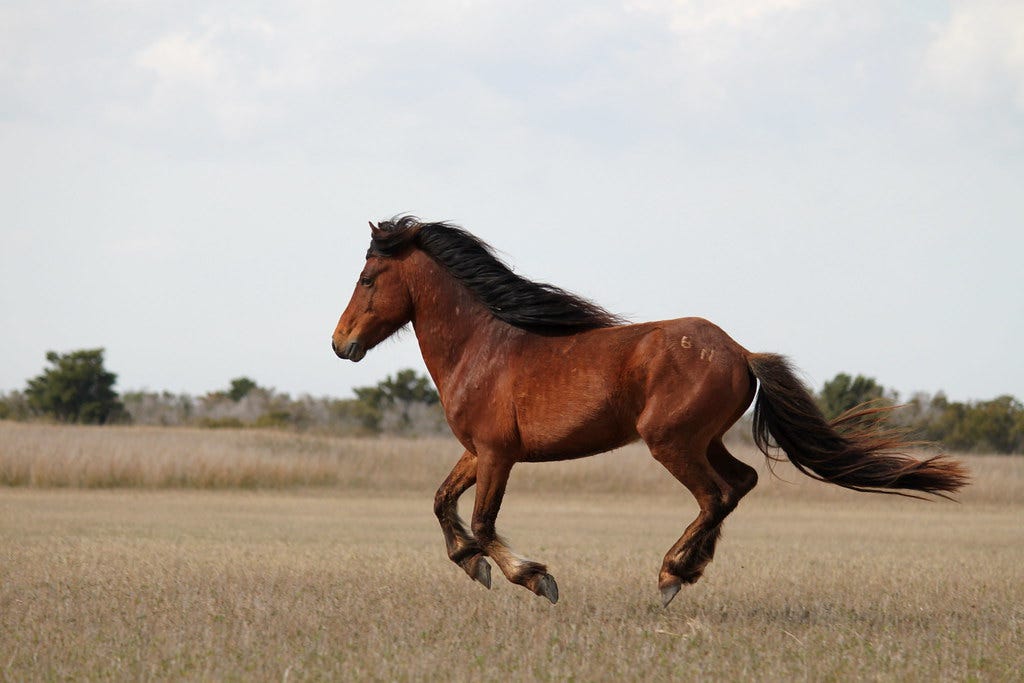
Photo by firelizard5, Wild horses on Shackleford Banks, NC
I’ll break the lines in unusual, uncomfortable places to push the poem. This can crack open the poem “… like a French camembert; it flows down, and the crust of stone burst open.” (Bernard Grolier). It can expose interesting rhythmic structures, found rhymes.
Or I’ll try putting two incomplete poems on a train track and aimed at each other. I use this approach to find the fulcrum point where fragments become whole.
In the same vein, I’ve gone back and rewritten the lines using syllabic count with regular repeating patterns to see if by cracking the lines in unusual sections (as previously suggested), I dissipated the energy. Sometimes the unusual breaks are better and vice versa.
Another approach is to use a source of unexpected ideas and a highly specific, unsual vocabulary, like science articles. Look for deep, underlying, non-linear patterns of ideas. Sometimes it might feel like the bones of a design that leaves room for an authentic emotional voice to emerge with its own cadence.
The following is an example of one of my poems, published in The Syzygy Poetry Journal, 2015 and as part of a book length manuscript, The Acoustic Property of Ancient Peoples, Finishing Line Press, 2018.
The ideas are from several articles on the science of weather in the upper atmospheric layers. They are all things that happen without our awareness. I imagined, what if we were creatures of air? The lineation and rhythmic structure support the sense of being airborne and returning to earth.
A Theory of Air
Gaia’s magnetic field snaps back
displeased at being rubbed
the wrong way.
An aurora borealis pungent
and teeming spills over
the invisible edge.
We are all creatures of air.
Hurricane speed currents plunge
ice crystals down to earth’s surface
as electrostatic discharge
organized in previously unexplored
directions, seeding nimbus dust
with reproducing bacteria
on the troposphere mist.
Our cellular progenitors, we carry
their imprint of sky, engulf
other ephemeral bodies
in symbiont desperation, a reverse
sublimation into multicellularity,
Gaia intending our existence
to be a lighter resurfacing
less of the organized, arrogant
tissue we now drag through air.