

This will be a serial conversation about the following:
How is it sustainably sourced, processed and extracted?
Balancing extraction, stability, and skin delivery
Sourcing, Sustainability, and Processing
Frankincense production remains dominated by wild or semi-managed harvesting from natural Boswellia populations, rather than intensive plantation agriculture, although experimental cultivation of B. papyrifera from cuttings and managed stands occurs in Oman (Birhane et al., 2025; Johnson et al., 2025). Tapping of Boswellia sacra begins by making sequential incisions in the bark, with resin collected after it hardens into tears. Both yield and tree health are strongly influenced by tapping frequency and environmental conditions. Overharvesting reduces long-term productivity (Alamri & Al-Shanfari, 2025; Johnson et al., 2025). In Ethiopia and Eritrea, Boswellia papyrifera is harvested from state or community-managed woodlands using similar repeated tapping systems, often under cooperative or concession frameworks (Melese et al., 2026; Tesfay et al., 2011).
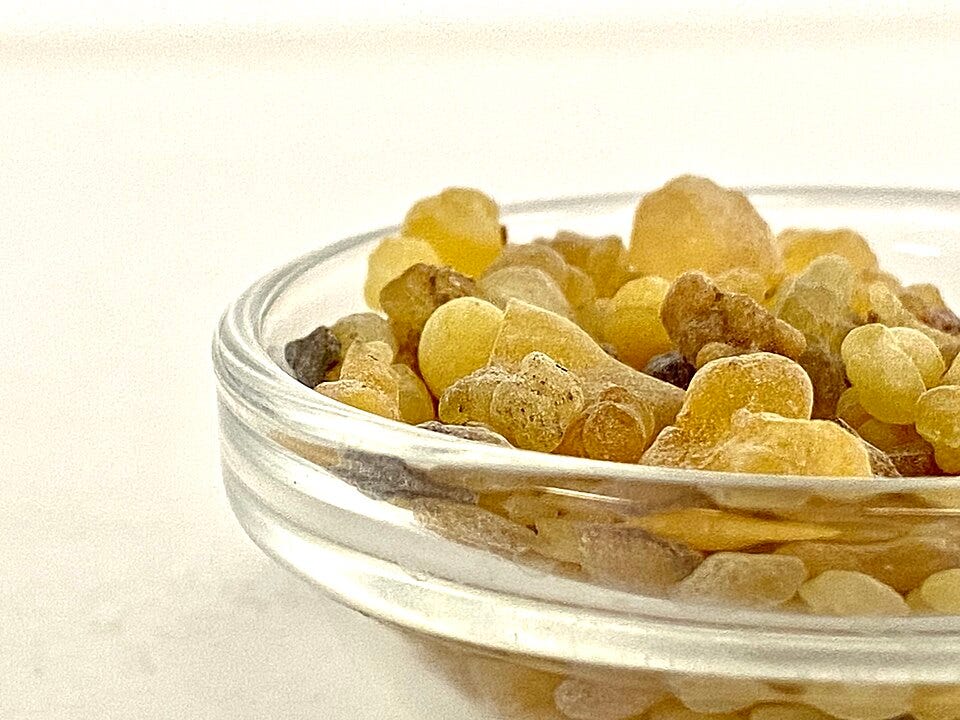
Processing at source is relatively low-tech and consistent across regions. Resin tears are air-dried on the tree, then collected, cleaned, and graded based on size, color, and impurity level, with higher grades reflecting clearer, lighter-colored resin from specific harvest zones (Rashan et al., 2023). Although Oman and Yemen remain historically and culturally central, particularly for high-value B. sacra, modern supply is geographically broader. Significant production now comes from the Horn of Africa, especially Somalia and Ethiopia, where multiple Boswellia species contribute to global trade volumes (Rashan et al., 2023; Sun et al., 2025).
Boswellic acid content varies across geographic sources and growing conditions (Al-Harrasi et al., 2019), while essential oil composition shows substantial chemotypic variation within the same species (DeCarlo et al., 2018). Analytical comparisons across Boswellia species further show substantial variability in their distribution depending on source material and processing (Frank & Unger, 2006; Bekana et al., 2014; Kosolapov et al., 2024). Environmental stress, including drought conditions, is associated with increased resin production and may influence terpene composition, although direct evidence linking stress to specific changes in triterpenoid profiles remains limited (Langenheim, 2003; Tholl, 2015).
Sourcing Boswellia requires attention to ecological and socio-economic factors. Continuous resin tapping has been shown to increase susceptibility to pest damage and reduce regeneration capacity in Boswellia papyrifera (Ayalew et al., 2021). At the same time, population dynamics vary across regions, and not all Boswellia populations are uniformly declining, indicating that sustainability must be evaluated at a local level (Johnson et al., 2025).
Economic pressures can drive overharvesting, particularly in regions with limited regulatory oversight. Lack of traceability and transparency further complicates supply chains. Sustainable sourcing requires verification of species identity, documentation of harvest practices, and traceability across the supply chain (DeCarlo et al., 2020). Traditional ecological knowledge embedded in harvesting practices contributes to both sustainability and material quality, and its erosion can negatively impact both.
Conflict also affects Boswellia supply by making harvest areas harder to monitor, weakening local management, and increasing pressure on resin as a cash resource. In Somaliland, post-conflict assessments linked poor tenure, weak traceability, complex trade chains, and overharvesting to damaging tapping practices (DeCarlo et al., 2020). Broader analysis of frankincense landscapes identifies armed conflict as a neglected conservation risk because it can disrupt land access, trade routes, field monitoring, and sustainable harvest oversight (Johnson & Bongers, 2024). The evidence is strongest for Somalia/Somaliland, but the pattern is relevant across conflict-affected Boswellia regions.
The market is driven by use as incense and medicinal application. Aging and processing of frankincense resin produce two distinct endpoints because oxidation, volatilization, and polymerization shift the chemical system over time. For incense, optimization favors controlled aging that reduces monoterpene volatility while preserving aromatic balance and increasing resin cohesiveness. Volatile terpenes such as α-pinene and limonene decrease through evaporation and oxidation, while remaining sesquiterpenes and oxygenated terpenoids contribute to more stable and complex combustion profiles (DeCarlo et al., 2018; Turek & Stintzing, 2013). Simultaneously, gradual oxidative cross-linking within the resin fraction increases hardness and burn stability, producing slower combustion and sustained fragrance release, which are valued in incense applications (Langenheim, 2003).
In contrast, medicinal applications for dermal delivery favor minimizing oxidative aging and preserving extractable, bioactive triterpenoids, particularly boswellic acids. These compounds are sensitive to oxidative modification and polymerization, which increase molecular weight and reduce solubility and extractability over time (Langenheim, 2003; Elhaddad et al., 2023). Processing methods therefore prioritize fresh or properly stabilized resin.
Extraction
Historically, Boswellia resin was commonly processed through burning, grinding, or infusion into oils and fats, particularly in Greco-Arab and South Asian medical traditions, where lipid-based preparations were used for topical and internal applications (Langenheim, 2003; Siddiqui, 2011). With the later development of distillation and early pharmacy practices, alcohol-based tinctures became a standard method for extracting plant resins and other phytochemicals due to ethanol’s ability to solubilize both polar and nonpolar constituents, although this reflects early modern rather than ancient practice (Chemat et al., 2017; Turek & Stintzing, 2013).
Ethanol can extract a broader array of compounds than oil, but with lower yield and uneven recovery of the lipophilic fraction. This is important for topical arthritis products, where activity is frequently attributed to the high–molecular weight triterpenoids, including boswellic acids, although other constituents may also contribute to overall activity (Roy et al., 2019; Siddiqui, 2011). In contrast, oil-based extraction is more consistent with the physicochemical properties of these lipophilic compounds and may provide a more direct match for their recovery, although direct comparative studies between oil and ethanol systems remain limited (Sharma et al., 2016).
Ethanol is more effective at extracting oxygenated cembranoids, as its intermediate polarity allows recovery of semi-polar diterpenoid derivatives that are less accessible in purely lipid systems. However, these same compounds are subject to volatilization and loss during ethanol processing, particularly under heat. Oil-based systems, in contrast, favor retention and stabilization of lipophilic and semi-volatile constituents and better support partitioning into the stratum corneum during topical application, even if extraction efficiency for some oxygenated variants is lower (Turek & Stintzing, 2013).
Supercritical CO₂ extraction can produce extracts enriched in boswellic acids under optimized conditions particularly when co-solvents are used (Rathod et al., 2018; Sharma et al., 2016). Ultrasound-assisted ethanol extraction can improve recovery relative to simple maceration, although its effectiveness is most clearly demonstrated for specific targets such as AKBA rather than total triterpenoid content (Niphadkar & Rathod, 2017).
References
Al-Harrasi, A., Csuk, R., Khan, A. L., & Hussain, J. (2019). Distribution of the anti-inflammatory and anti-cancerous boswellic acids in Boswellia sacra. Phytochemistry Reviews, 18(4), 905–925. https://doi.org/10.1007/s11101-019-09608-1
Alamri, M. M., & Al-Shanfari, A. B. (2025). Harvesting and agro-ecological zone effects on sustainability of Boswellia sacra in Oman. Discover Plants, 2, Article 113. https://doi.org/10.1007/s44372-025-00186-4
Ayalew, A., Eshete, A., Tadesse, W., & Sass-Klaassen, U. (2021). Continuous resin tapping for frankincense harvest increases susceptibility of Boswellia papyrifera trees to longhorn beetle damage. Forest Ecology and Management, 479, 118558. https://doi.org/10.1016/j.foreco.2020.118558
Bekana, D., Kebede, T., Assefa, M., & Kassa, H. (2014). Comparative phytochemical analyses of resins of Boswellia species (B. papyrifera, B. neglecta, and B. rivae) from Ethiopia. International Scholarly Research Notices, 2014, 374678. https://doi.org/10.1155/2014/374678
Birhane, E., Tesfay, A., Siyum, Z. G., Gidey, T., Gebretsadik, Y., Bongers, F., Hagazi, N., & Noulèkoun, F. (2025). Yield and chemical composition of frankincense from cutting-propagated Boswellia papyrifera. Journal of Arid Environments, 229, 105374. https://doi.org/10.1016/j.jaridenv.2025.105374
Chemat, F., Rombaut, N., Sicaire, A.-G., Meullemiestre, A., Fabiano-Tixier, A.-S., & Abert-Vian, M. (2017). Ultrasound assisted extraction of food and natural products. Mechanisms, techniques, combinations, protocols and applications. A review. Ultrasonics Sonochemistry, 34, 540–560. https://doi.org/10.1016/j.ultsonch.2016.06.035
DeCarlo, A., Ali, S., & Ceroni, M. (2020). Ecological and economic sustainability of non-timber forest products in post-conflict recovery: A case study of frankincense (Boswellia spp.) resin harvesting in Somaliland (Somalia). Sustainability, 12(9), 3578. https://doi.org/10.3390/su12093578
DeCarlo, A., Johnson, S., Poudel, A., Satyal, P., Bangerter, L., & Setzer, W. N. (2018). Chemical variation in essential oils from the oleo-gum resin of Boswellia carteri: A preliminary investigation. Chemistry & Biodiversity, 15(6), e1800047. https://doi.org/10.1002/cbdv.201800047
Elhaddad, H. M. M., Hammoda, H. M., Ghareeb, D. A., Mahmoud, F. A. A., Hussein, A., Yousef, M. I., Darwish, R. S., & Shawky, E. (2023). Investigating the effect of extraction procedure on the anti-inflammatory metabolites of olibanum resin from different Boswellia species through LC-MS/MS-based metabolomics. Food Bioscience, 53, 102668. https://doi.org/10.1016/j.fbio.2023.102668
Frank, A., & Unger, M. (2006). Analysis of frankincense from various Boswellia species with inhibitory activity on human drug metabolising cytochrome P450 enzymes using liquid chromatography mass spectrometry after automated on-line extraction. Journal of Chromatography A, 1112(1–2), 255–262. https://doi.org/10.1016/j.chroma.2005.11.116
Johnson, S., & Bongers, F. (2024). Armed conflict as an underappreciated driver of conservation outcomes in frankincense (Boswellia spp.). Trees, Forests and People, 15, 100490. https://doi.org/10.1016/j.tfp.2023.100490
Johnson, S., Bait Said, A., Vahalík, P., Karas, L., Sarrouf Willson, M., & Bongers, F. (2025). Rapid conservation assessment of Boswellia sacra in Oman reveals complex threat and population patterns. Journal of Arid Environments, 229, 105368. https://doi.org/10.1016/j.jaridenv.2025.105368
Kosolapov, D., Jáč, P., Riasová, P., Poušková, J., Polášek, M., & Nováková, L. (2024). Advances and challenges in the analysis of boswellic acids by separation methods. Critical Reviews in Analytical Chemistry. https://doi.org/10.1080/10408347.2024.2312502
Langenheim, J. H. (2003). Plant resins: Chemistry, evolution, ecology, and ethnobotany. Timber Press.
Niphadkar, S. S., & Rathod, V. K. (2017). Extraction of acetyl 11-keto-β-boswellic acids (AKBA) from Boswellia serrata using ultrasound. Separation Science and Technology, 52(6), 997–1005. https://doi.org/10.1080/01496395.2016.1274326
Rashan, L., Al-Hadhrami, Z., & Al-Hinai, M. (2023). Frankincense of Boswellia sacra: Traditional and modern applied uses, pharmacological activities, and clinical trials. Industrial Crops and Products, 203, 117106. https://doi.org/10.1016/j.indcrop.2023.117106
Rathod, V. K., Niphadkar, S. S., & Sonawane, S. H. (2018). Optimization of ethanol modified supercritical fluid extraction (SFE) of acetyl 11 keto β boswellic acid (AKBA) from Boswellia serrata using Box–Behnken experimental design. Biocatalysis and Agricultural Biotechnology, 13, 304–310. https://doi.org/10.1016/j.bcab.2017.11.013
Sharma, N., Bhardwaj, V., Singh, S., Ali, S. A., Gupta, D. K., Paul, S., Satti, N. K., Chandra, S., & Verma, M. K. (2016). Simultaneous quantification of triterpenoic acids by high performance liquid chromatography method in the extracts of gum resin of Boswellia serrata obtained by different extraction techniques. Chemistry Central Journal, 10, 49. https://doi.org/10.1186/s13065-016-0194-8
Siddiqui, M. Z. (2011). Boswellia serrata, a potential anti-inflammatory agent: An overview. Indian Journal of Pharmaceutical Sciences, 73(3), 255–261. https://doi.org/10.4103/0250-474X.93507
Sun, X., Yang, Y., Peng, C., Huang, Q., Wei, J., & Yang, X. (2025). Frankincense from Boswellia: A review of species, traditional uses, phytochemistry, pharmacology and toxicology. Chinese Herbal Medicines. https://doi.org/10.1016/j.chmed.2025.09.007
Tesfay, A., Teketay, D., & Fetene, M. (2011). Frankincense yield assessment and modeling in Boswellia papyrifera woodlands of northern Ethiopia. Journal of Arid Environments, 75(8), 695–702. https://doi.org/10.1016/j.jaridenv.2011.03.005
Tholl, D. (2015). Biosynthesis and biological functions of terpenoids. Advances in Biochemical Engineering/Biotechnology, 148, 63–106. https://doi.org/10.1007/10_2014_295
Turek, C., & Stintzing, F. C. (2013). Stability of essential oils: A review. Comprehensive Reviews in Food Science and Food Safety, 12(1), 40–53. https://doi.org/10.1111/1541-4337.12006