

This will be a serial conversation about the following:
Where does Boswellia resin originate and what is it?
How is it collected and what are the active phytochemicals?
How is it extracted, sustainably sourced and processed?
Balancing extraction, stability, and skin delivery
1. Origin
Archaeobotanical and historical evidence places organized harvesting and trade of frankincense from trees of the genus Boswellia as early as the beginning 1st millennium BCE, with southern Arabia functioning as the primary production and export hub (Langenheim, 2003; Avanzini, 2008). The plant is ecologically restricted, which helped make frankincense a high-value commodity in antiquity.
Exuding Resin
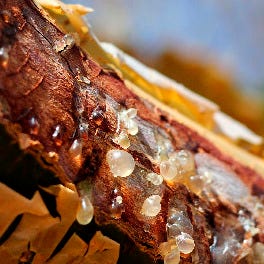
Full Tree

It drove the development of the Incense Route, overland caravan and maritime trade corridors linking southern Arabia to the Mediterranean, Mesopotamia, and South Asia. Overland routes moved resin northward through present-day Yemen and Saudi Arabia to Petra, Gaza, and Damascus, integrating with broader Near Eastern trade system (Avanzini, 2008; Sidebotham, 2011).
At its peak (roughly 1st century BCE to 2nd century CE), frankincense was used in religious rituals, embalming, medicine, and elite consumption. It was considered a high-value commodity within Roman trade networks. Pliny the Elder noted prices in certain markets approaching those of precious and luxury goods by weight (Pliny the Elder, trans. 1952; Sidebotham, 2011).
2. Resin as a Starting Material
Boswellia produces an oleo-gum-resin formed within secretory canals and released following bark injury. The volatile or oleo fraction contains monoterpenes and related terpenoids, most commonly α-pinene, β-pinene, limonene, myrcene, sabinene, p-cymene, and terpinene isomers, along with oxygenated derivatives such as linalool, terpinen-4-ol, borneol, and α-terpineol (DeCarlo et al., 2018). In addition to monoterpenes, smaller quantities of sesquiterpenes such as β-caryophyllene, germacrene D, and elemene-type compounds are frequently present and contribute to both volatility and odor persistence (DeCarlo et al., 2018). The resin fraction contains triterpenoids including boswellic acids, and the gum fraction contains polysaccharides (Murthy, 2022). These fractions differ in polarity and solvent compatibility, and therefore respond differently to grinding, heating, and solvent exposure (Siddiqui, 2011).
These compounds arise from coordinated primary and secondary metabolic processes localized in specialized secretory tissues. Resin ducts embedded in the bark and secondary phloem are lined with epithelial cells that synthesize and secrete resin components (Langenheim, 2003). This fraction is dominated by terpenoids derived from isoprenoid biosynthesis proceeding through two parallel pathways (Fig. 1). Within epithelial cells, intermediates are compartmentalized, with terpenoid synthesis occurring in the cytosol or plastids depending on pathway origin. The final metaoblic products are secreted into resin ducts through vesicular transport and membrane diffusion (Turner et al., 2000).
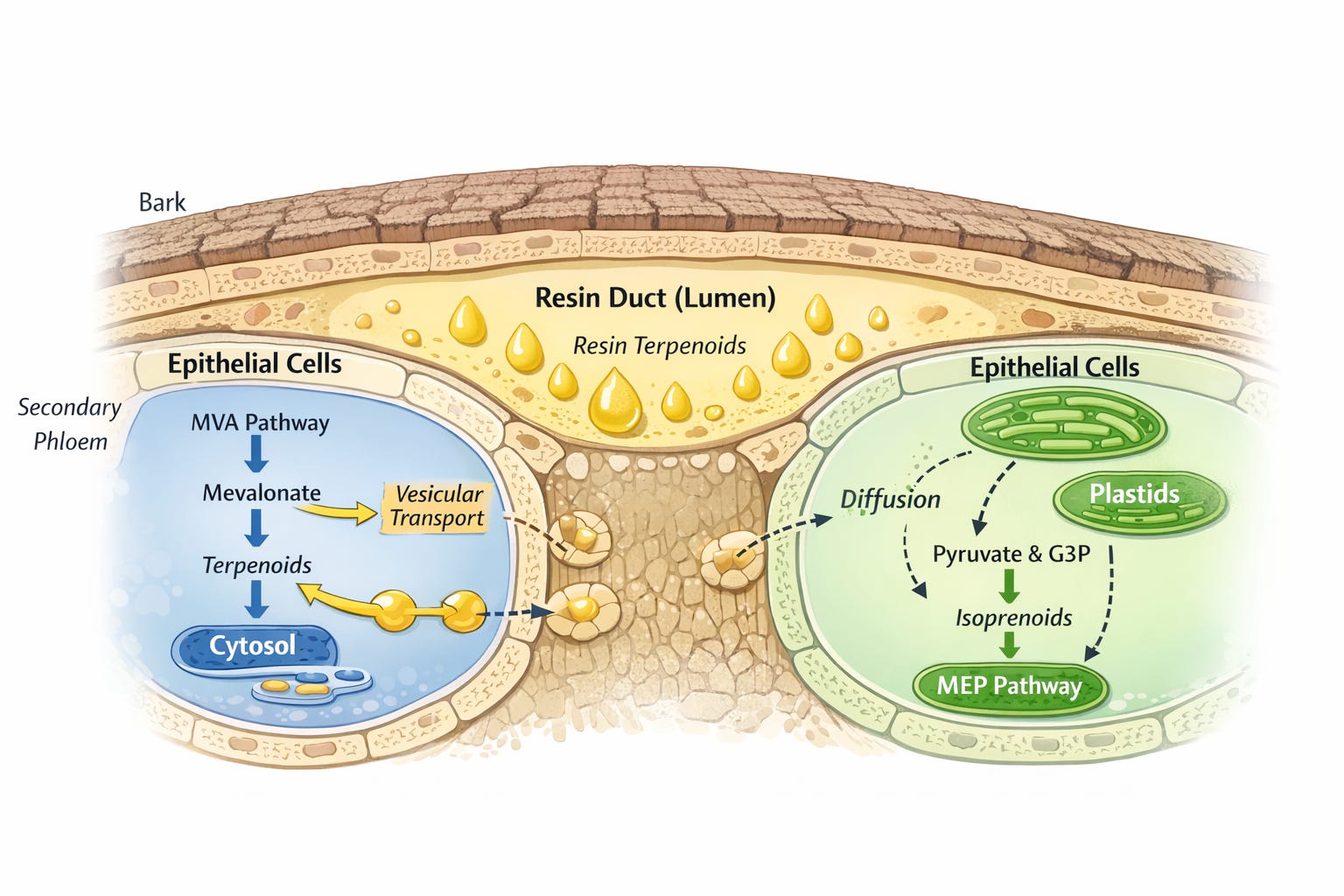
Figure 1. Terpene biosynthesis pathways contributing to Boswellia resin chemistry.
Inside the ducts (Fig.2), hydrophobic triterpenes aggregate into a viscous resin matrix via van der Waals interactions and hydrophobic association. The polysaccharide fraction remains associated with aqueous microdomains (Murthy, 2022).
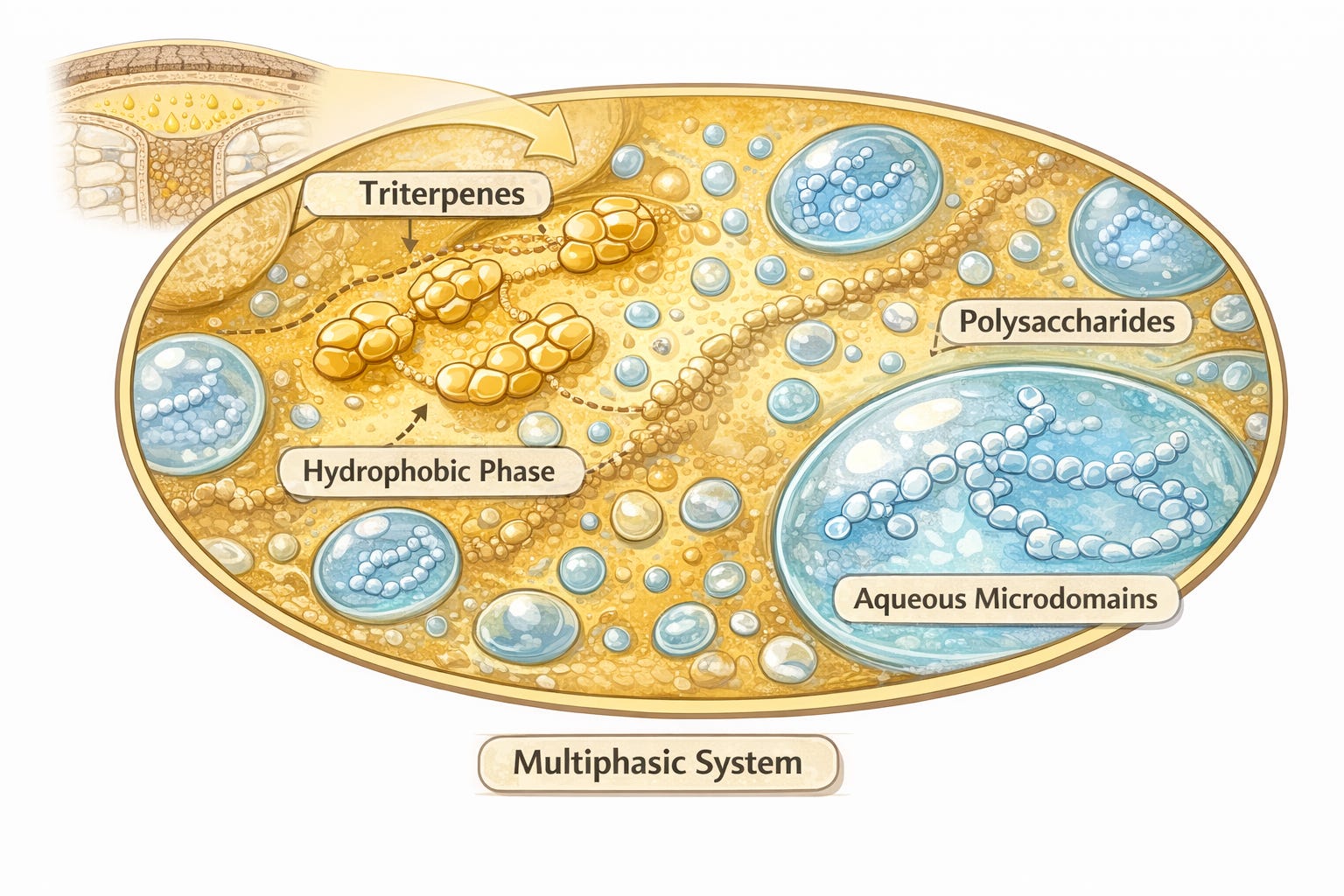
Figure 2. Volatile terpenes, hydrophobic triterpenoids, and polysaccharide-rich gum domains.
Two different metabolic pathways are involved in the production of Boswellia oleo-gum-resin. The cytosolic mevalonate pathway, located in the cytosol of secretory epithelial cells lining resin ducts, produces sesquiterpenes and triterpenes, including boswellic acids, from acetyl-CoA via mevalonate intermediates (Rehman et al., 2025). The plastidial methylerythritol phosphate pathway, located in plastids (primarily leucoplasts or chloroplasts) within those same secretory cells, produces monoterpenes from pyruvate and glyceraldehyde-3-phosphate (Lichtenthaler, 1999; Tholl, 2015; Turner et al., 2000).
Carbon substrates for both the mevalonate and methylerythritol phosphate pathways originate from photosynthetically derived sugars transported through the phloem, linking primary carbon metabolism to terpene biosynthesis and resin production (Lichtenthaler, 1999; Tholl, 2015). This coupling means that environmental and physiological conditions affecting carbon supply may influence resin yield and composition, although the specific outcome depends on species, tissue state, wounding, and storage conditions.
References
Avanzini, A. (2008). By land and by sea: A history of South Arabian trade. L’Erma di Bretschneider.
DeCarlo, A., Johnson, S., Poudel, A., Satyal, P., Bangerter, L., & Setzer, W. N. (2018). Chemical variation in essential oils from the oleo-gum resin of Boswellia carteri: A preliminary investigation. Chemistry & Biodiversity, 15(6), e1800047. https://doi.org/10.1002/cbdv.201800047
Langenheim, J. H. (2003). Plant resins: Chemistry, evolution, ecology, and ethnobotany. Timber Press.
Lichtenthaler, H. K. (1999). The 1-deoxy-D-xylulose-5-phosphate pathway of isoprenoid biosynthesis in plants. Annual Review of Plant Physiology and Plant Molecular Biology, 50, 47–65. https://doi.org/10.1146/annurev.arplant.50.1.47
Murthy, H. N. (2022). Chemical constituents and applications of gums, resins, and latexes of plant origin. In Gums, resins and latexes of plant origin. Springer. https://doi.org/10.1007/978-3-030-91378-6_1
Pliny the Elder. (1952). Natural History (H. Rackham, Trans.). Harvard University Press. (Original work published ca. 77 CE). https://doi.org/10.4159/DLCL.pliny_elder-natural_history
Rehman, N. U., Rafiq, K., Avula, S. K., Gibbons, S., Csuk, R., & Al-Harrasi, A. (2025). Triterpenoids from frankincense and Boswellia: A focus on their pharmacology and 13C-NMR assignments. Phytochemistry, 229, 114297. https://doi.org/10.1016/j.phytochem.2024.114297
Sidebotham, S. E. (2011). Berenike and the ancient maritime spice route. University of California Press. https://doi.org/10.1525/california/9780520241949.001.0001
Tholl, D. (2015). Biosynthesis and biological functions of terpenoids. Advances in Biochemical Engineering/Biotechnology, 148, 63–106. https://doi.org/10.1007/10_2014_295
Turner, G. W., Berry, A. M., & Gifford, E. M. (2000). Secretory cavities of Citrus limon. International Journal of Plant Sciences, 161(4), 537–547. https://doi.org/10.1086/314273