

In that literature, 300 mg twice daily is frequently the dose used in trials of a full-spectrum root extract standardized to a stated withanolide fraction. However, the same nominal mg/day can represent materially different exposures when the extract differs by
withanolide percentage
analyte definition (withanolides vs withanolide glycosides)
root-only vs root+leaf
solvent system that changes the recovered fractions (Della Porta et al., 2023; Mishra & Kumar, 2024).
Even when trials use similar milligram doses, it is difficult to interpret dose–response because the biologically relevant factor may be the amount of withanolide-class compounds delivered, rather than the total mass of plant extract administered (Lopresti & Smith, 2021). If commercial standardization has effectively selected doses that reliably achieve a target exposure band, then later trial dose convergence could be a market/process artifact rather than evidence that physiology has a single preferred mg/day.
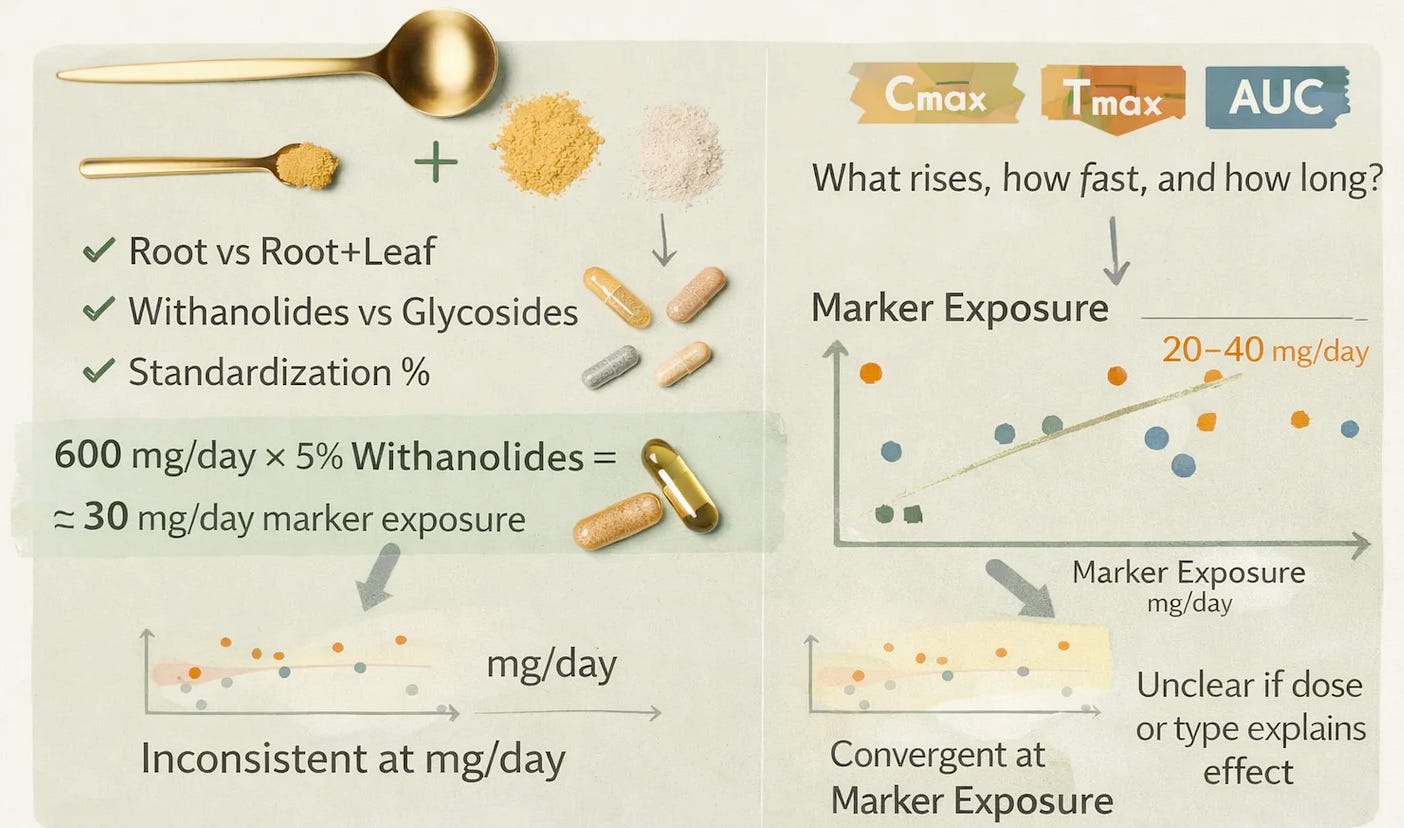
The cortisol-focused stress literature illustrates convergence around a small set of standardized extract formats and dosing conventions, often ~600 mg/day for full-spectrum 5% withanolide root extracts, or far lower capsule mass for highly concentrated root+leaf glycoside-standardized extracts (Chandrasekhar et al., 2012; Choudhary et al., 2017b; Mishra & Kumar, 2024).
Understanding dose–response improves if you can map trials onto exposure metrics (Cmax, AUC, Tmax) rather than mg/day. The available human pharmacokinetics (PK) data for ashwagandha is limited with different formulations yielding varied absorption profiles even when nominal withanolides administered are matched (Alluri et al., 2022). Separately, clinical PK profiling of a root extract using UHPLC-MS/MS indicates measurable circulating withanolide-class analytes after a single dose, reinforcing that trials may differ by exposure kinetics (what rises, how fast, and how long), not only by capsule mass (Vaidya et al., 2024).
If two extracts produce different absorption patterns, such as higher peak blood levels or different timing of exposure, at the same labeled dose, they may lead to different outcomes. Rapid systemic exposure to withanolide compounds after oral dosing has been demonstrated in human pharmacokinetic studies. This may influence short-term biomarkers such as stress hormones, although acute effects on cortisol have not been directly tested in controlled trials (Vaidya et al., 2024). In contrast, most clinical improvements in stress, sleep, cognition, and performance are observed only after several weeks of treatment, suggesting that many functional outcomes reflect longer-term adaptive processes rather than immediate pharmacodynamic effects (Lopresti & Smith, 2021).
Stress–cortisol trials usually report both the extract dose and the extract’s stated withanolide standardization. From these two values it is sometimes possible to estimate daily exposure to withanolide markers, even when the trial tested only one treatment dose (Della Porta et al., 2023). For example, trials using a full-spectrum root extract standardized to about 5% withanolides commonly administer 600 mg/day (300 mg twice daily), which corresponds to roughly 30 mg/day of withanolide markers (Chandrasekhar et al., 2012; Lopresti et al., 2019). In contrast, trials using highly concentrated root+leaf extracts standardized to high withanolide glycoside content can deliver comparable marker exposure with far lower capsule mass (Mishra & Kumar, 2024).
When clinical trials are normalized to estimated marker exposure rather than extract mass, a similar exposure range emerges across very different dosing regimens. Those using more concentrated extracts can achieve comparable marker exposure with much lower capsule mass. Despite these differences in extract dose, the available studies fall within an estimated exposure band of roughly 20–40 mg/day (Table 1). This pattern suggests that clinical signals may align more closely with biochemical exposure than with extract mass alone, implying that different formulations may converge on a similar effective exposure band even when the labeled dose differs substantially (Della Porta et al., 2023; Lopresti & Smith, 2021). Marker exposure values are not strictly comparable because some trials quantify total withanolides while others quantify withanolide glycosides.
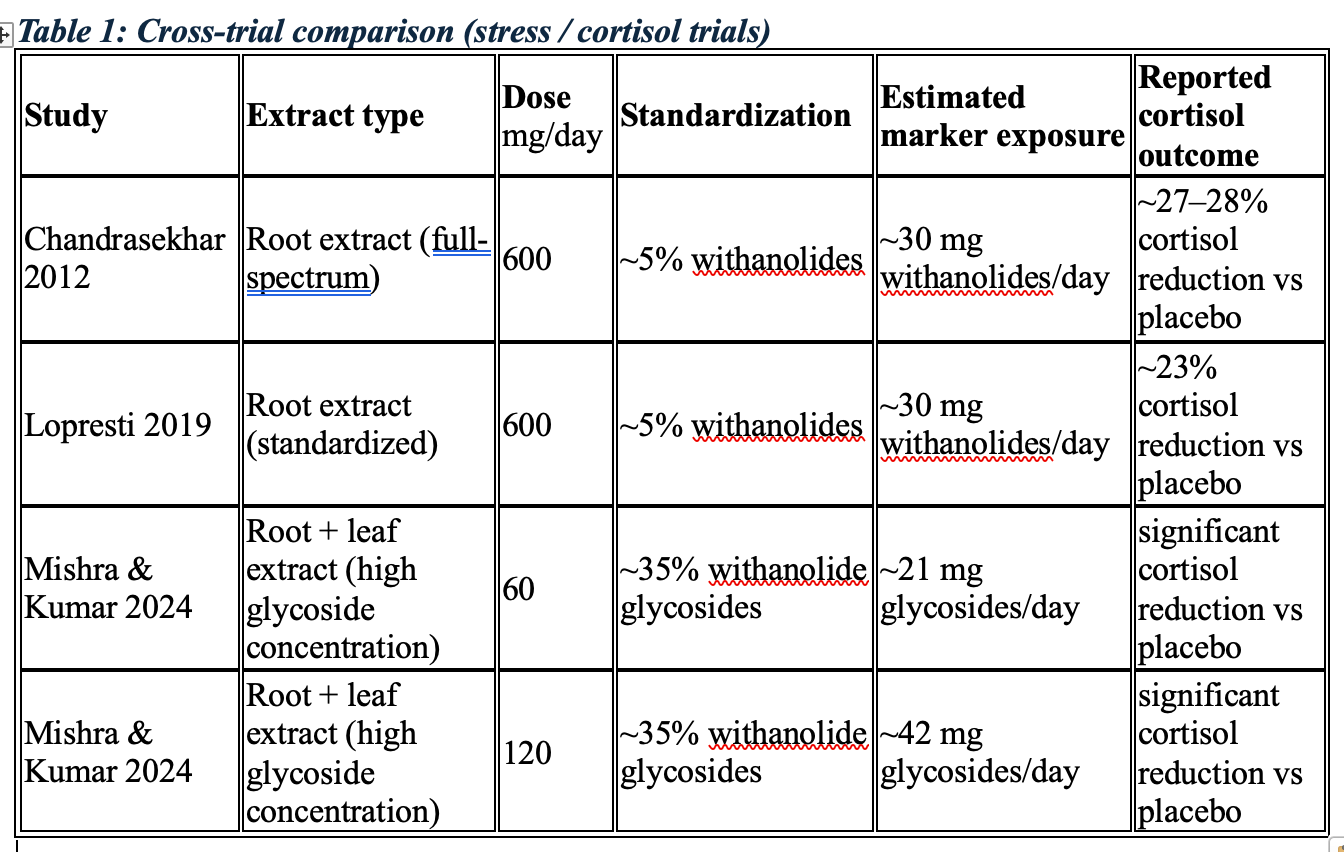
This comparison does not demonstrate a true dose–response relationship. The studies differ in extract chemistry, duration, study population, and measurement methods. Marker percentages also do not guarantee equivalent circulating exposure because absorption and metabolite profiles vary by extract type. The analysis therefore cannot establish causality or define an optimal dose. It only shows that exposure normalization can reveal patterns that are obscured when trials are compared using extract mass alone.
The stress trial pattern is consistent with a threshold/plateau model where below a threshold exposure, little changes. Above the threshold effects may saturate over typical consumer doses and incremental gains are small (Lopresti & Smith, 2021). This architecture can make many single-dose trials look dose-insensitive even if the system is not. When most tested regimens already land above threshold, mg/day variation becomes weakly informative (Della Porta et al., 2023).
A separate layer is baseline dependence. Several stress trials enroll high-stress participants, and the observed magnitude of change often appears larger in higher-stress cohorts than would be expected in low-stress samples at the same dose, implying that dose effect can be masked by state-dependent sensitivity (Chandrasekhar et al., 2012; Choudhary et al., 2017b; Mishra & Kumar, 2024).
In comparison, cognitive and performance endpoints appear less tightly coupled to short-term exposure. Trials in these domains frequently require 8 weeks or more and show greater variability in effect magnitude (Lopresti et al., 2019; Lopresti & Smith, 2021). This suggests that downstream adaptive mechanisms such as neuroplastic, mitochondrial, or endocrine may mediate these effects, weakening the immediate correlation between circulating withanolide levels and clinical change.
References
Alluri, V. K. R., Thanawala, S., & Upadhyay, V. (2022). A comparative pharmacokinetics study of Ashwagandha (Withania somnifera) root extract sustained-release capsules: An open-label, randomized, two-treatment, two-sequence, two-period, single-dose crossover clinical study. International Journal of Basic & Clinical Pharmacology, 11(1), 26–34. https://doi.org/10.18203/2319-2003.ijbcp20214831
Chandrasekhar, K., Kapoor, J., & Anishetty, S. (2012). A prospective, randomized double-blind, placebo-controlled study of safety and efficacy of a high-concentration full-spectrum extract of ashwagandha root in reducing stress and anxiety in adults. Indian Journal of Psychological Medicine, 34(3), 255–262. https://doi.org/10.4103/0253-7176.106022
Choudhary, D., Bhattacharyya, S., & Joshi, K. (2017). Body weight management in adults under chronic stress through treatment with Ashwagandha root extract: A double-blind, randomized, placebo-controlled trial. Journal of Evidence-Based Complementary & Alternative Medicine, 22(1), 96–106. https://doi.org/10.1177/2156587216641830
Della Porta, M., Maier, J. A., & Cazzola, R. (2023). Effects of Withania somnifera on cortisol levels in stressed human subjects: A systematic review. Nutrients, 15(24), 5015. https://doi.org/10.3390/nu15245015
Lopresti, A. L., & Smith, S. J. (2021). Ashwagandha (Withania somnifera) for the treatment and enhancement of mental and physical conditions: A systematic review of human trials. Journal of Herbal Medicine, 28, 100434. https://doi.org/10.1016/j.hermed.2021.100434
Lopresti, A. L., Smith, S. J., Malvi, H., & Kodgule, R. (2019). An investigation into the stress-relieving and pharmacological actions of an ashwagandha extract: A randomized, double-blind, placebo-controlled study. Medicine (Baltimore), 98(37), e17186. https://doi.org/10.1097/MD.0000000000017186
Mishra, D. N., & Kumar, M. (2024). Shoden promotes relief from stress and anxiety: A randomized, double-blind, placebo-controlled study. Heliyon, 10(17), e36885. https://doi.org/10.1016/j.heliyon.2024.e36885
Vaidya, V. G., Naik, N. N., Ganu, G., Parmar, V., Jagtap, S., Saste, G., Bhatt, A., Mulay, V., Girme, A., Modi, S. J., & Hingorani, L. (2024). Clinical pharmacokinetic evaluation of Withania somnifera (L.) Dunal root extract in healthy human volunteers: A non-randomized, single-dose study utilizing UHPLC-MS/MS analysis. Journal of Ethnopharmacology, 322, 117603. https://doi.org/10.1016/j.jep.2023.117603